Event submissions
Published
This submission belongs to the session S3. Computing and Artificial Intelligence of the event The 5th International Electronic Conference on Applied Sciences
Published date
02 Dec, 2024
Academic Editor
'%3e%3cpath%20d='M12.6657%2010.9104C12.4185%2010.325%2012.0599%209.79327%2011.6097%209.34482C11.1609%208.89508%2010.6293%208.5365%2010.0442%208.28888C10.0389%208.28626%2010.0337%208.28495%2010.0285%208.28233C10.8446%207.69279%2011.3752%206.73249%2011.3752%205.64904C11.3752%203.8542%209.92103%202.39999%208.1262%202.39999C6.33136%202.39999%204.87715%203.8542%204.87715%205.64904C4.87715%206.73249%205.40774%207.69279%206.22393%208.28364C6.21869%208.28626%206.21345%208.28757%206.20821%208.29019C5.62129%208.5378%205.09463%208.89284%204.64265%209.34613C4.1929%209.79493%203.83432%2010.3266%203.58671%2010.9117C3.34345%2011.4845%203.21226%2012.0987%203.20023%2012.7209C3.19988%2012.7349%203.20233%2012.7488%203.20744%2012.7619C3.21255%2012.7749%203.22022%2012.7867%203.22998%2012.7968C3.23975%2012.8068%203.25142%2012.8147%203.26431%2012.8202C3.2772%2012.8256%203.29105%2012.8284%203.30504%2012.8284H4.09109C4.14874%2012.8284%204.19459%2012.7825%204.1959%2012.7262C4.2221%2011.7148%204.62823%2010.7676%205.34617%2010.0497C6.08899%209.30683%207.0755%208.89808%208.1262%208.89808C9.17689%208.89808%2010.1634%209.30683%2010.9062%2010.0497C11.6242%2010.7676%2012.0303%2011.7148%2012.0565%2012.7262C12.0578%2012.7838%2012.1037%2012.8284%2012.1613%2012.8284H12.9474C12.9613%2012.8284%2012.9752%2012.8256%2012.9881%2012.8202C13.001%2012.8147%2013.0126%2012.8068%2013.0224%2012.7968C13.0322%2012.7867%2013.0398%2012.7749%2013.0449%2012.7619C13.0501%2012.7488%2013.0525%2012.7349%2013.0522%2012.7209C13.0391%2012.0947%2012.9094%2011.4855%2012.6657%2010.9104ZM8.1262%207.9024C7.52486%207.9024%206.9589%207.6679%206.53312%207.24211C6.10733%206.81633%205.87283%206.25037%205.87283%205.64904C5.87283%205.0477%206.10733%204.48174%206.53312%204.05596C6.9589%203.63018%207.52486%203.39567%208.1262%203.39567C8.72753%203.39567%209.29349%203.63018%209.71927%204.05596C10.1451%204.48174%2010.3796%205.0477%2010.3796%205.64904C10.3796%206.25037%2010.1451%206.81633%209.71927%207.24211C9.29349%207.6679%208.72753%207.9024%208.1262%207.9024Z'%20fill='%235D1EE1'/%3e%3c/g%3e%3c/svg%3e) Eugenio Vocaturo
Eugenio VocaturoCitation
Sandra Elena Rivas Morales, Mayra Alejandra Gomez Govea, Gabriel Ruiz Amaya, Miguel Angel Lopez Alvarez, Antonio Guzman Velazco, Jose Ignacio Gonzalez Rojas, Antonio Leija Tristan, Using bioinformatic predictions to identify key bacterial strains for bioremediation of wildfire-affected soils, in Proceedings of The 5th International Electronic Conference on Applied Sciences, 4 December–6 December 2024, MDPI: Basel, Switzerland
Share
Email
Facebook
Twitter
LinkedIn
Using bioinformatic predictions to identify key bacterial strains for bioremediation of wildfire-affected soils
'%3e%3cpath%20d='M12.6647%2010.9104C12.4176%2010.325%2012.0589%209.7933%2011.6088%209.34485C11.16%208.89511%2010.6283%208.53653%2010.0432%208.28891C10.038%208.28629%2010.0327%208.28498%2010.0275%208.28236C10.8437%207.69282%2011.3743%206.73252%2011.3743%205.64907C11.3743%203.85423%209.92005%202.40002%208.12522%202.40002C6.33038%202.40002%204.87618%203.85423%204.87618%205.64907C4.87618%206.73252%205.40677%207.69282%206.22296%208.28367C6.21772%208.28629%206.21248%208.2876%206.20724%208.29022C5.62031%208.53783%205.09365%208.89287%204.64167%209.34616C4.19192%209.79496%203.83334%2010.3266%203.58573%2010.9117C3.34247%2011.4846%203.21128%2012.0987%203.19925%2012.721C3.1989%2012.735%203.20135%2012.7489%203.20646%2012.7619C3.21157%2012.7749%203.21924%2012.7868%203.22901%2012.7968C3.23877%2012.8068%203.25045%2012.8148%203.26334%2012.8202C3.27623%2012.8256%203.29007%2012.8284%203.30406%2012.8284H4.09012C4.14776%2012.8284%204.19362%2012.7825%204.19493%2012.7262C4.22113%2011.7148%204.62726%2010.7676%205.34519%2010.0497C6.08802%209.30686%207.07452%208.89811%208.12522%208.89811C9.17592%208.89811%2010.1624%209.30686%2010.9052%2010.0497C11.6232%2010.7676%2012.0293%2011.7148%2012.0555%2012.7262C12.0568%2012.7839%2012.1027%2012.8284%2012.1603%2012.8284H12.9464C12.9604%2012.8284%2012.9742%2012.8256%2012.9871%2012.8202C13%2012.8148%2013.0117%2012.8068%2013.0214%2012.7968C13.0312%2012.7868%2013.0389%2012.7749%2013.044%2012.7619C13.0491%2012.7489%2013.0515%2012.735%2013.0512%2012.721C13.0381%2012.0947%2012.9084%2011.4856%2012.6647%2010.9104ZM8.12522%207.90243C7.52388%207.90243%206.95792%207.66793%206.53214%207.24215C6.10636%206.81636%205.87185%206.2504%205.87185%205.64907C5.87185%205.04773%206.10636%204.48177%206.53214%204.05599C6.95792%203.63021%207.52388%203.3957%208.12522%203.3957C8.72655%203.3957%209.29252%203.63021%209.7183%204.05599C10.1441%204.48177%2010.3786%205.04773%2010.3786%205.64907C10.3786%206.2504%2010.1441%206.81636%209.7183%207.24215C9.29252%207.66793%208.72655%207.90243%208.12522%207.90243Z'%20fill='%235D1EE1'/%3e%3c/g%3e%3c/svg%3e)
Sandra Elena Rivas Morales 1
Mayra Alejandra Gomez Govea 2
Gabriel Ruiz Amaya 2
Miguel Angel Lopez Alvarez 2
Antonio Guzman Velazco 2
Jose Ignacio Gonzalez Rojas 2
Antonio Leija Tristan 2
1. Laboratory of Conservation Biology and Sustainable development, Faculty of Biological Sciences, Universidad Autonoma de Nuevo Leon
2. Laboratory of Conservation Biology and Sustainable Development, Faculty of Biological Sciences, Universidad Autonoma de Nuevo Leon
Abstract
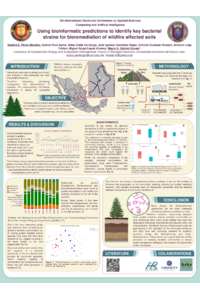
Microbiome management is becoming an increasingly interesting strategy for soil bioremediation and the substitution of chemical fertilizers. However, variations between in-lab experimentation and field testing have demonstrated that understanding interactions within the microbiome is crucial for the success of synthetic consortia applications.
Current approaches to restoring soil properties in our local environment are limited to reforestation and traditional soil retention practices. To integrate microbiome management and harness beneficial dynamics for soil restoration, this study aims to dissect interactions among the soil microbial community from a forest area in the south of Nuevo León, Mexico, affected by wildfire.
In this study, we evaluated a bioinformatic pipeline to identify, characterize, and select key taxa within the bacterial communities of soil samples from burned and unburned areas. Using QIIME2, the workflow employs sequences of the molecular marker 16S to identify community taxonomic composition. Subsequently, with PICRUSt2, we integrated abundances with genetic and enzymatic information from publicly available data to predict metabolic pathways in the community. We then used a statistical method for sparse data to infer the ecological network. We expect that identifying core species of the post-fire microbiome will allow us to harness their metabolic potential for bioremediation.
Finding simplified and accurate pipelines for the analysis of soil microbial communities is essential to accelerate ecological characterizations and optimize expenses in strain isolation, which represents an advantage for budget-limited research. This work also establishes a foundation for harnessing key members of the local soil microbiome, which is crucial for future investigations into soil bioremediation and reforestation.
Keywords
Microbiome management
bioinformatic predictions
soil bioremediation
wildfire
16s
Poster
sciforum-107829.pdf
Fermentation of carob syrup (Ceratonia siliqua L.) by SCOBY to produce a polyphenol-rich kombucha
Quantum-inspired Multi-objective Optimization of ESN using SRG for Nonlinear Time Series Prediction