Event submissions
Published
This submission belongs to the session S3. Computing and Artificial Intelligence of the event The 5th International Electronic Conference on Applied Sciences
Published date
02 Dec, 2024
Academic Editor
'%3e%3cpath%20d='M12.6657%2010.9104C12.4185%2010.325%2012.0599%209.79327%2011.6097%209.34482C11.1609%208.89508%2010.6293%208.5365%2010.0442%208.28888C10.0389%208.28626%2010.0337%208.28495%2010.0285%208.28233C10.8446%207.69279%2011.3752%206.73249%2011.3752%205.64904C11.3752%203.8542%209.92103%202.39999%208.1262%202.39999C6.33136%202.39999%204.87715%203.8542%204.87715%205.64904C4.87715%206.73249%205.40774%207.69279%206.22393%208.28364C6.21869%208.28626%206.21345%208.28757%206.20821%208.29019C5.62129%208.5378%205.09463%208.89284%204.64265%209.34613C4.1929%209.79493%203.83432%2010.3266%203.58671%2010.9117C3.34345%2011.4845%203.21226%2012.0987%203.20023%2012.7209C3.19988%2012.7349%203.20233%2012.7488%203.20744%2012.7619C3.21255%2012.7749%203.22022%2012.7867%203.22998%2012.7968C3.23975%2012.8068%203.25142%2012.8147%203.26431%2012.8202C3.2772%2012.8256%203.29105%2012.8284%203.30504%2012.8284H4.09109C4.14874%2012.8284%204.19459%2012.7825%204.1959%2012.7262C4.2221%2011.7148%204.62823%2010.7676%205.34617%2010.0497C6.08899%209.30683%207.0755%208.89808%208.1262%208.89808C9.17689%208.89808%2010.1634%209.30683%2010.9062%2010.0497C11.6242%2010.7676%2012.0303%2011.7148%2012.0565%2012.7262C12.0578%2012.7838%2012.1037%2012.8284%2012.1613%2012.8284H12.9474C12.9613%2012.8284%2012.9752%2012.8256%2012.9881%2012.8202C13.001%2012.8147%2013.0126%2012.8068%2013.0224%2012.7968C13.0322%2012.7867%2013.0398%2012.7749%2013.0449%2012.7619C13.0501%2012.7488%2013.0525%2012.7349%2013.0522%2012.7209C13.0391%2012.0947%2012.9094%2011.4855%2012.6657%2010.9104ZM8.1262%207.9024C7.52486%207.9024%206.9589%207.6679%206.53312%207.24211C6.10733%206.81633%205.87283%206.25037%205.87283%205.64904C5.87283%205.0477%206.10733%204.48174%206.53312%204.05596C6.9589%203.63018%207.52486%203.39567%208.1262%203.39567C8.72753%203.39567%209.29349%203.63018%209.71927%204.05596C10.1451%204.48174%2010.3796%205.0477%2010.3796%205.64904C10.3796%206.25037%2010.1451%206.81633%209.71927%207.24211C9.29349%207.6679%208.72753%207.9024%208.1262%207.9024Z'%20fill='%235D1EE1'/%3e%3c/g%3e%3c/svg%3e) Eugenio Vocaturo
Eugenio VocaturoCitation
Inalegwu S. Apeh, Thecla O. Ayoka, Charles O. Nnadi, Wilfred O. Obonga, Modelling the Quantitative Structure–Activity Relationship of 1,2,4-Triazolo[1,5-a]pyrimidine Analogues in the Inhibition of Plasmodium falciparum, in Proceedings of The 5th International Electronic Conference on Applied Sciences, 4 December–6 December 2024, MDPI: Basel, Switzerland
Share
Email
Facebook
Twitter
LinkedIn
Modelling the Quantitative Structure–Activity Relationship of 1,2,4-Triazolo[1,5-a]pyrimidine Analogues in the Inhibition of Plasmodium falciparum
'%3e%3cpath%20d='M12.6647%2010.9104C12.4176%2010.325%2012.0589%209.7933%2011.6088%209.34485C11.16%208.89511%2010.6283%208.53653%2010.0432%208.28891C10.038%208.28629%2010.0327%208.28498%2010.0275%208.28236C10.8437%207.69282%2011.3743%206.73252%2011.3743%205.64907C11.3743%203.85423%209.92005%202.40002%208.12522%202.40002C6.33038%202.40002%204.87618%203.85423%204.87618%205.64907C4.87618%206.73252%205.40677%207.69282%206.22296%208.28367C6.21772%208.28629%206.21248%208.2876%206.20724%208.29022C5.62031%208.53783%205.09365%208.89287%204.64167%209.34616C4.19192%209.79496%203.83334%2010.3266%203.58573%2010.9117C3.34247%2011.4846%203.21128%2012.0987%203.19925%2012.721C3.1989%2012.735%203.20135%2012.7489%203.20646%2012.7619C3.21157%2012.7749%203.21924%2012.7868%203.22901%2012.7968C3.23877%2012.8068%203.25045%2012.8148%203.26334%2012.8202C3.27623%2012.8256%203.29007%2012.8284%203.30406%2012.8284H4.09012C4.14776%2012.8284%204.19362%2012.7825%204.19493%2012.7262C4.22113%2011.7148%204.62726%2010.7676%205.34519%2010.0497C6.08802%209.30686%207.07452%208.89811%208.12522%208.89811C9.17592%208.89811%2010.1624%209.30686%2010.9052%2010.0497C11.6232%2010.7676%2012.0293%2011.7148%2012.0555%2012.7262C12.0568%2012.7839%2012.1027%2012.8284%2012.1603%2012.8284H12.9464C12.9604%2012.8284%2012.9742%2012.8256%2012.9871%2012.8202C13%2012.8148%2013.0117%2012.8068%2013.0214%2012.7968C13.0312%2012.7868%2013.0389%2012.7749%2013.044%2012.7619C13.0491%2012.7489%2013.0515%2012.735%2013.0512%2012.721C13.0381%2012.0947%2012.9084%2011.4856%2012.6647%2010.9104ZM8.12522%207.90243C7.52388%207.90243%206.95792%207.66793%206.53214%207.24215C6.10636%206.81636%205.87185%206.2504%205.87185%205.64907C5.87185%205.04773%206.10636%204.48177%206.53214%204.05599C6.95792%203.63021%207.52388%203.3957%208.12522%203.3957C8.72655%203.3957%209.29252%203.63021%209.7183%204.05599C10.1441%204.48177%2010.3786%205.04773%2010.3786%205.64907C10.3786%206.2504%2010.1441%206.81636%209.7183%207.24215C9.29252%207.66793%208.72655%207.90243%208.12522%207.90243Z'%20fill='%235D1EE1'/%3e%3c/g%3e%3c/svg%3e)
Inalegwu S. Apeh 1,2
Thecla O. Ayoka 3

Charles O. Nnadi 2
Wilfred O. Obonga 4
1. Department of Pharmacy, Benue State Hospital Management Board, 972261 Otukpo Benue State Nigeria
2. Department of Pharmaceutical and Medicinal Chemistry, Faculty of Pharmaceutical Sciences, University of Nigeria Nsukka, 410001 Enugu State, Nigeria
3. Department of Science Laboratory Technology (Biochemistry Unit), Faculty of Physical Sciences, University of Nigeria Nsukka 410001 Enugu State Nigeria
4. Department of Pharmaceutical and Medicinal Chemistry, Faculty of Pharmaceutical Sciences, University of Nigeria Nsukka, 410001 Enugu, Nigeria
Abstract
Triazolopyrimidine and its analogues represent important lead structures in anti-malarial research. This study modelled the quantitative structure–activity relationship (QSAR) of 125 congeners of 1,2,4-triazolo[1,5-a]pyrimidine from the ChEMBL database in the inhibition of Plasmodium falciparum using six machine learning algorithms. Recursive feature elimination was used to select the most significant of 306 molecular descriptors with 1 moleculal outlier. A split ratio of 20 % was used to split the x and y matrices into 99 training and 24 test compounds. The regression models were built using machine learning scikit-learn algorithms (multiple linear regression (MLR), k-nearest neighbours (kNN), support vector regressor (SVR), random forest regressor (RFR), RIDGE regression and LASSO). Model performance was evaluated using the coefficient of determination (R2), mean squared error (MSE), mean absolute error (MAE) and root mean squared error (RMSE) p-values, F-statistic and variance inflation factor (VIF). The number of significant variables considered to build the model was 5 (p < 0.05) with the regression equation pIC50 = 5.90–0.71npr1–1.52pmi3+0.88slogP–0.57vsurf-CW2+1.11vsurf-W2. On 5-fold cross validation, three algorithms, KNN (MSE=0.46, R2=0.54, MAE=0.54, RMSE=0.68), SVR (MSE=0.33, R2=0.67, MAE=0.46, RMSE=0.57) and RFR (MSE=0.43, R2=0.58, MAE=0.51, RMSE=0.66) showed robustness, high efficiency, and reliability in predicting the pIC50 of 1,2,4-triazolo[1,5-a]pyrimidine. The models provided useful data on the functionalities necessary for developing more potent 1,2,4-triazolo[1,5-a]pyrimidine analogues as anti-malarial agents.
Keywords
Triazolopyrimidine
QSAR
Anti-plasmodial
Machine learning
Poster
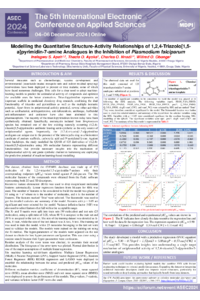
ASEC 2024 2.pdf
Functional Characterization of novel synbiotic drink developed using kefir and basil seed mucilage
Natural Language Interface for Database Querying: A Multilingual Chatbot