Event submissions
Published
This submission belongs to the session S3. Computing and Artificial Intelligence of the event The 5th International Electronic Conference on Applied Sciences
Published date
02 Dec, 2024
Academic Editor
'%3e%3cpath%20d='M12.6657%2010.9104C12.4185%2010.325%2012.0599%209.79327%2011.6097%209.34482C11.1609%208.89508%2010.6293%208.5365%2010.0442%208.28888C10.0389%208.28626%2010.0337%208.28495%2010.0285%208.28233C10.8446%207.69279%2011.3752%206.73249%2011.3752%205.64904C11.3752%203.8542%209.92103%202.39999%208.1262%202.39999C6.33136%202.39999%204.87715%203.8542%204.87715%205.64904C4.87715%206.73249%205.40774%207.69279%206.22393%208.28364C6.21869%208.28626%206.21345%208.28757%206.20821%208.29019C5.62129%208.5378%205.09463%208.89284%204.64265%209.34613C4.1929%209.79493%203.83432%2010.3266%203.58671%2010.9117C3.34345%2011.4845%203.21226%2012.0987%203.20023%2012.7209C3.19988%2012.7349%203.20233%2012.7488%203.20744%2012.7619C3.21255%2012.7749%203.22022%2012.7867%203.22998%2012.7968C3.23975%2012.8068%203.25142%2012.8147%203.26431%2012.8202C3.2772%2012.8256%203.29105%2012.8284%203.30504%2012.8284H4.09109C4.14874%2012.8284%204.19459%2012.7825%204.1959%2012.7262C4.2221%2011.7148%204.62823%2010.7676%205.34617%2010.0497C6.08899%209.30683%207.0755%208.89808%208.1262%208.89808C9.17689%208.89808%2010.1634%209.30683%2010.9062%2010.0497C11.6242%2010.7676%2012.0303%2011.7148%2012.0565%2012.7262C12.0578%2012.7838%2012.1037%2012.8284%2012.1613%2012.8284H12.9474C12.9613%2012.8284%2012.9752%2012.8256%2012.9881%2012.8202C13.001%2012.8147%2013.0126%2012.8068%2013.0224%2012.7968C13.0322%2012.7867%2013.0398%2012.7749%2013.0449%2012.7619C13.0501%2012.7488%2013.0525%2012.7349%2013.0522%2012.7209C13.0391%2012.0947%2012.9094%2011.4855%2012.6657%2010.9104ZM8.1262%207.9024C7.52486%207.9024%206.9589%207.6679%206.53312%207.24211C6.10733%206.81633%205.87283%206.25037%205.87283%205.64904C5.87283%205.0477%206.10733%204.48174%206.53312%204.05596C6.9589%203.63018%207.52486%203.39567%208.1262%203.39567C8.72753%203.39567%209.29349%203.63018%209.71927%204.05596C10.1451%204.48174%2010.3796%205.0477%2010.3796%205.64904C10.3796%206.25037%2010.1451%206.81633%209.71927%207.24211C9.29349%207.6679%208.72753%207.9024%208.1262%207.9024Z'%20fill='%235D1EE1'/%3e%3c/g%3e%3c/svg%3e) Eugenio Vocaturo
Eugenio VocaturoCitation
Shoffan Saifullah, Comparative Analysis of LSTM and GRU Models for Chicken Egg Fertility Classification using Deep Learning, in Proceedings of The 5th International Electronic Conference on Applied Sciences, 4 December–6 December 2024, MDPI: Basel, Switzerland
Share
Email
Facebook
Twitter
LinkedIn
Comparative Analysis of LSTM and GRU Models for Chicken Egg Fertility Classification using Deep Learning

Shoffan Saifullah 1,2
1. Faculty of Computer Science, AGH University of Krakow, Krakow, Poland
2. Department of Informatics, Universitas Pembangunan Nasional Veteran Yogyakarta, Yogyakarta, Indonesia
Abstract
This study explores the application of advanced Recurrent Neural Network (RNN) architectures—specifically Long Short-Term Memory (LSTM) and Gated Recurrent Unit (GRU)—for classifying chicken egg fertility based on embryonic development detected in egg images. Traditional methods, such as candling, are labor-intensive and often inaccurate, making them unsuitable for large-scale poultry operations. By leveraging the capabilities of LSTM and GRU models, this research aims to automate and enhance the accuracy of egg fertility classification, thereby contributing to agricultural automation. A dataset comprising 240 high-resolution egg images was employed, resized to 255x255 pixels for optimal processing efficiency. LSTM and GRU models were trained to discern fertile from infertile eggs by analyzing the sequential data represented by the pixel rows in these images. The LSTM model demonstrated superior performance, achieving a validation accuracy of 89.58% with a loss of 1.1691, outperforming the GRU model, which recorded a lower accuracy of 66.67% and a significantly higher loss of 12.6634. The LSTM’s complex gating mechanisms were more effective in capturing long-range dependencies within the data, leading to more reliable predictions. The findings suggest that LSTM models are better suited for precision-critical applications in poultry farming, where accurate fertility classification is paramount. In contrast, GRU models, while more computationally efficient, may struggle with generalization under constrained data conditions. This study underscores the potential of advanced RNNs in enhancing the efficiency and accuracy of automated farming systems, paving the way for future research to further optimize these models for real-world agricultural applications.
Keywords
Recurrent Neural Networks (RNN)
Egg Fertility Classification
Long Short-Term Memory (LSTM)
Gated Recurrent Unit (GRU)
Agricultural Automation
Poster
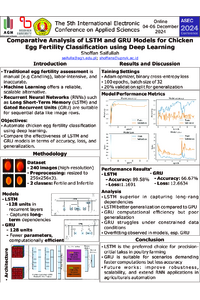
ASEC2024-Poster Shoffan Saifullah.pdf
Optimizing Network Traffic Classification Through a Novel BAT-ANN Model: An Empirical investigation in Improved Accuracy and Scalability in Network Security
Exploration of Key components in wireless sensor networks utilizing Artificial Intelligence and virtualized security