Event submissions
Published
This submission belongs to the session S1. Applied Biosciences and Bioengineering of the event The 5th International Electronic Conference on Applied Sciences
Published date
02 Dec, 2024
Academic Editor
'%3e%3cpath%20d='M12.6657%2010.9104C12.4185%2010.325%2012.0599%209.79327%2011.6097%209.34482C11.1609%208.89508%2010.6293%208.5365%2010.0442%208.28888C10.0389%208.28626%2010.0337%208.28495%2010.0285%208.28233C10.8446%207.69279%2011.3752%206.73249%2011.3752%205.64904C11.3752%203.8542%209.92103%202.39999%208.1262%202.39999C6.33136%202.39999%204.87715%203.8542%204.87715%205.64904C4.87715%206.73249%205.40774%207.69279%206.22393%208.28364C6.21869%208.28626%206.21345%208.28757%206.20821%208.29019C5.62129%208.5378%205.09463%208.89284%204.64265%209.34613C4.1929%209.79493%203.83432%2010.3266%203.58671%2010.9117C3.34345%2011.4845%203.21226%2012.0987%203.20023%2012.7209C3.19988%2012.7349%203.20233%2012.7488%203.20744%2012.7619C3.21255%2012.7749%203.22022%2012.7867%203.22998%2012.7968C3.23975%2012.8068%203.25142%2012.8147%203.26431%2012.8202C3.2772%2012.8256%203.29105%2012.8284%203.30504%2012.8284H4.09109C4.14874%2012.8284%204.19459%2012.7825%204.1959%2012.7262C4.2221%2011.7148%204.62823%2010.7676%205.34617%2010.0497C6.08899%209.30683%207.0755%208.89808%208.1262%208.89808C9.17689%208.89808%2010.1634%209.30683%2010.9062%2010.0497C11.6242%2010.7676%2012.0303%2011.7148%2012.0565%2012.7262C12.0578%2012.7838%2012.1037%2012.8284%2012.1613%2012.8284H12.9474C12.9613%2012.8284%2012.9752%2012.8256%2012.9881%2012.8202C13.001%2012.8147%2013.0126%2012.8068%2013.0224%2012.7968C13.0322%2012.7867%2013.0398%2012.7749%2013.0449%2012.7619C13.0501%2012.7488%2013.0525%2012.7349%2013.0522%2012.7209C13.0391%2012.0947%2012.9094%2011.4855%2012.6657%2010.9104ZM8.1262%207.9024C7.52486%207.9024%206.9589%207.6679%206.53312%207.24211C6.10733%206.81633%205.87283%206.25037%205.87283%205.64904C5.87283%205.0477%206.10733%204.48174%206.53312%204.05596C6.9589%203.63018%207.52486%203.39567%208.1262%203.39567C8.72753%203.39567%209.29349%203.63018%209.71927%204.05596C10.1451%204.48174%2010.3796%205.0477%2010.3796%205.64904C10.3796%206.25037%2010.1451%206.81633%209.71927%207.24211C9.29349%207.6679%208.72753%207.9024%208.1262%207.9024Z'%20fill='%235D1EE1'/%3e%3c/g%3e%3c/svg%3e) Paola Saccomandi
Paola SaccomandiCitation
Pasquale Caponnetto, Graziella Chiara Prezzavento, Sergio Triscari, Giulia Schilirò, Gabriele Pace, Simona Lanzafame, Neurocognitive and Humoral Changes induced by EEG-Biofeedback: a Systematic Review of the Applicability and Therapeutic Effect in Patients with Schizophrenia Spectrum Disorders, Psychosis or Clinical High risks for Psychosis, in Proceedings of The 5th International Electronic Conference on Applied Sciences, 4 December–6 December 2024, MDPI: Basel, Switzerland
Share
Email
Facebook
Twitter
LinkedIn
Neurocognitive and Humoral Changes induced by EEG-Biofeedback: a Systematic Review of the Applicability and Therapeutic Effect in Patients with Schizophrenia Spectrum Disorders, Psychosis or Clinical High risks for Psychosis

Pasquale Caponnetto 1,2

Graziella Chiara Prezzavento 3

Sergio Triscari 1

Giulia Schilirò 1

Gabriele Pace 4
'%3e%3cpath%20d='M12.6647%2010.9104C12.4176%2010.325%2012.0589%209.7933%2011.6088%209.34485C11.16%208.89511%2010.6283%208.53653%2010.0432%208.28891C10.038%208.28629%2010.0327%208.28498%2010.0275%208.28236C10.8437%207.69282%2011.3743%206.73252%2011.3743%205.64907C11.3743%203.85423%209.92005%202.40002%208.12522%202.40002C6.33038%202.40002%204.87618%203.85423%204.87618%205.64907C4.87618%206.73252%205.40677%207.69282%206.22296%208.28367C6.21772%208.28629%206.21248%208.2876%206.20724%208.29022C5.62031%208.53783%205.09365%208.89287%204.64167%209.34616C4.19192%209.79496%203.83334%2010.3266%203.58573%2010.9117C3.34247%2011.4846%203.21128%2012.0987%203.19925%2012.721C3.1989%2012.735%203.20135%2012.7489%203.20646%2012.7619C3.21157%2012.7749%203.21924%2012.7868%203.22901%2012.7968C3.23877%2012.8068%203.25045%2012.8148%203.26334%2012.8202C3.27623%2012.8256%203.29007%2012.8284%203.30406%2012.8284H4.09012C4.14776%2012.8284%204.19362%2012.7825%204.19493%2012.7262C4.22113%2011.7148%204.62726%2010.7676%205.34519%2010.0497C6.08802%209.30686%207.07452%208.89811%208.12522%208.89811C9.17592%208.89811%2010.1624%209.30686%2010.9052%2010.0497C11.6232%2010.7676%2012.0293%2011.7148%2012.0555%2012.7262C12.0568%2012.7839%2012.1027%2012.8284%2012.1603%2012.8284H12.9464C12.9604%2012.8284%2012.9742%2012.8256%2012.9871%2012.8202C13%2012.8148%2013.0117%2012.8068%2013.0214%2012.7968C13.0312%2012.7868%2013.0389%2012.7749%2013.044%2012.7619C13.0491%2012.7489%2013.0515%2012.735%2013.0512%2012.721C13.0381%2012.0947%2012.9084%2011.4856%2012.6647%2010.9104ZM8.12522%207.90243C7.52388%207.90243%206.95792%207.66793%206.53214%207.24215C6.10636%206.81636%205.87185%206.2504%205.87185%205.64907C5.87185%205.04773%206.10636%204.48177%206.53214%204.05599C6.95792%203.63021%207.52388%203.3957%208.12522%203.3957C8.72655%203.3957%209.29252%203.63021%209.7183%204.05599C10.1441%204.48177%2010.3786%205.04773%2010.3786%205.64907C10.3786%206.2504%2010.1441%206.81636%209.7183%207.24215C9.29252%207.66793%208.72655%207.90243%208.12522%207.90243Z'%20fill='%235D1EE1'/%3e%3c/g%3e%3c/svg%3e)
Simona Lanzafame 1
1. Department of Educational Sciences, Section of Psychology, University of Catania, 95121 Catania, Italy.
2. Center of Excellence for the Acceleration of Harm Reduction (CoEHAR), University of Catania, 95121 Catania, Italy.
3. Department of Educational Sciences, Section of Psychology, University of Catania
4. Department of Clinical and Experimental Medicine, University of Catania, 95123 Catania, Italy.
Abstract
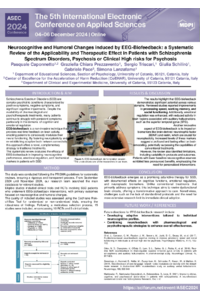
Introduction:Schizophrenia Spectrum Disorders are complex mental health conditions that significantly impact cognitive function and quality of life. While pharmacological and psychotherapeutic interventions are available, their effectiveness remains limited, particularly for negative symptoms and cognitive impairments. These limitations, alongside drug side effects and adherence difficulties, highlight the need for new treatments. Cognitive remediation strategies like EEG-biofeedback show promise by harnessing neuroplasticity. This systematic review aims to evaluate the neurocognitive and humoral changes induced by EEG-biofeedback and its therapeutic effects in patients with schizophrenia spectrum disorders.
Methods: Our review was conducted following PRISMA guidelines. Databases including EMBASE, ScienceDirect, Scopus, PsycINFO, and MEDLINE were searched for relevant studies: 15 studies, 10 RCTs and 5 Clinical trials were selected. Inclusion criteria encompassed studies involving patients with schizophrenia spectrum disorders, EEG-biofeedback interventions, and outcomes related to neurocognitive and humoral changes. The Cochrane Risk-of-Bias Tool for randomized trials (RoB 2) was used to assess the quality of included studies.
Results: The reviewed studies suggest that EEG-neurofeedback shows promise in addressing various aspects of schizophrenia spectrum disorders. Improvements were observed in processing speed, social functioning, working memory, and emotional regulation. Several studies reported successful modulation of brain activity in regions associated with auditory hallucinations. Neurofeedback training also led to increased functional connectivity between language networks and the default mode network. Some studies found improvements in brain-derived neurotrophic factor (BDNF) levels, self-efficacy, and clinical symptoms in schizophrenia patients.
Conclusions: Future research should focus on personalizing neurofeedback approaches and exploring their mechanisms of action in the context of schizophrenia pathophysiology.
Keywords
eeg-biofeedback
neurofeedback
neurocognitive changes
humoral changes
schizophrenia spectrum disorders
Poster
sciforum-107606.pdf
The Influence of Oregano powder on the chemical, microbiological and sensorial quality of bun-bread
Deep learning improves the identification of neutrophil abnormalities in immune and inflammatory conditions