Event submissions
Published
This submission belongs to the session S1. Applied Biosciences and Bioengineering of the event The 5th International Electronic Conference on Applied Sciences
Published date
02 Dec, 2024
Academic Editor
'%3e%3cpath%20d='M12.6657%2010.9104C12.4185%2010.325%2012.0599%209.79327%2011.6097%209.34482C11.1609%208.89508%2010.6293%208.5365%2010.0442%208.28888C10.0389%208.28626%2010.0337%208.28495%2010.0285%208.28233C10.8446%207.69279%2011.3752%206.73249%2011.3752%205.64904C11.3752%203.8542%209.92103%202.39999%208.1262%202.39999C6.33136%202.39999%204.87715%203.8542%204.87715%205.64904C4.87715%206.73249%205.40774%207.69279%206.22393%208.28364C6.21869%208.28626%206.21345%208.28757%206.20821%208.29019C5.62129%208.5378%205.09463%208.89284%204.64265%209.34613C4.1929%209.79493%203.83432%2010.3266%203.58671%2010.9117C3.34345%2011.4845%203.21226%2012.0987%203.20023%2012.7209C3.19988%2012.7349%203.20233%2012.7488%203.20744%2012.7619C3.21255%2012.7749%203.22022%2012.7867%203.22998%2012.7968C3.23975%2012.8068%203.25142%2012.8147%203.26431%2012.8202C3.2772%2012.8256%203.29105%2012.8284%203.30504%2012.8284H4.09109C4.14874%2012.8284%204.19459%2012.7825%204.1959%2012.7262C4.2221%2011.7148%204.62823%2010.7676%205.34617%2010.0497C6.08899%209.30683%207.0755%208.89808%208.1262%208.89808C9.17689%208.89808%2010.1634%209.30683%2010.9062%2010.0497C11.6242%2010.7676%2012.0303%2011.7148%2012.0565%2012.7262C12.0578%2012.7838%2012.1037%2012.8284%2012.1613%2012.8284H12.9474C12.9613%2012.8284%2012.9752%2012.8256%2012.9881%2012.8202C13.001%2012.8147%2013.0126%2012.8068%2013.0224%2012.7968C13.0322%2012.7867%2013.0398%2012.7749%2013.0449%2012.7619C13.0501%2012.7488%2013.0525%2012.7349%2013.0522%2012.7209C13.0391%2012.0947%2012.9094%2011.4855%2012.6657%2010.9104ZM8.1262%207.9024C7.52486%207.9024%206.9589%207.6679%206.53312%207.24211C6.10733%206.81633%205.87283%206.25037%205.87283%205.64904C5.87283%205.0477%206.10733%204.48174%206.53312%204.05596C6.9589%203.63018%207.52486%203.39567%208.1262%203.39567C8.72753%203.39567%209.29349%203.63018%209.71927%204.05596C10.1451%204.48174%2010.3796%205.0477%2010.3796%205.64904C10.3796%206.25037%2010.1451%206.81633%209.71927%207.24211C9.29349%207.6679%208.72753%207.9024%208.1262%207.9024Z'%20fill='%235D1EE1'/%3e%3c/g%3e%3c/svg%3e) Takahito Ohshiro
Takahito OhshiroCitation
Fabiana Nicita, Joseph Lipari, Frank Lipari, Arianna Nicita, Color Stability of PET-G in Clear Aligners: Impact of Prolonged Exposure to Everyday Substances and its Psychological and Social Implications, in Proceedings of The 5th International Electronic Conference on Applied Sciences, 4 December–6 December 2024, MDPI: Basel, Switzerland
Share
Email
Facebook
Twitter
LinkedIn
Color Stability of PET-G in Clear Aligners: Impact of Prolonged Exposure to Everyday Substances and its Psychological and Social Implications

Fabiana Nicita 1
'%3e%3cpath%20d='M12.6647%2010.9104C12.4176%2010.325%2012.0589%209.7933%2011.6088%209.34485C11.16%208.89511%2010.6283%208.53653%2010.0432%208.28891C10.038%208.28629%2010.0327%208.28498%2010.0275%208.28236C10.8437%207.69282%2011.3743%206.73252%2011.3743%205.64907C11.3743%203.85423%209.92005%202.40002%208.12522%202.40002C6.33038%202.40002%204.87618%203.85423%204.87618%205.64907C4.87618%206.73252%205.40677%207.69282%206.22296%208.28367C6.21772%208.28629%206.21248%208.2876%206.20724%208.29022C5.62031%208.53783%205.09365%208.89287%204.64167%209.34616C4.19192%209.79496%203.83334%2010.3266%203.58573%2010.9117C3.34247%2011.4846%203.21128%2012.0987%203.19925%2012.721C3.1989%2012.735%203.20135%2012.7489%203.20646%2012.7619C3.21157%2012.7749%203.21924%2012.7868%203.22901%2012.7968C3.23877%2012.8068%203.25045%2012.8148%203.26334%2012.8202C3.27623%2012.8256%203.29007%2012.8284%203.30406%2012.8284H4.09012C4.14776%2012.8284%204.19362%2012.7825%204.19493%2012.7262C4.22113%2011.7148%204.62726%2010.7676%205.34519%2010.0497C6.08802%209.30686%207.07452%208.89811%208.12522%208.89811C9.17592%208.89811%2010.1624%209.30686%2010.9052%2010.0497C11.6232%2010.7676%2012.0293%2011.7148%2012.0555%2012.7262C12.0568%2012.7839%2012.1027%2012.8284%2012.1603%2012.8284H12.9464C12.9604%2012.8284%2012.9742%2012.8256%2012.9871%2012.8202C13%2012.8148%2013.0117%2012.8068%2013.0214%2012.7968C13.0312%2012.7868%2013.0389%2012.7749%2013.044%2012.7619C13.0491%2012.7489%2013.0515%2012.735%2013.0512%2012.721C13.0381%2012.0947%2012.9084%2011.4856%2012.6647%2010.9104ZM8.12522%207.90243C7.52388%207.90243%206.95792%207.66793%206.53214%207.24215C6.10636%206.81636%205.87185%206.2504%205.87185%205.64907C5.87185%205.04773%206.10636%204.48177%206.53214%204.05599C6.95792%203.63021%207.52388%203.3957%208.12522%203.3957C8.72655%203.3957%209.29252%203.63021%209.7183%204.05599C10.1441%204.48177%2010.3786%205.04773%2010.3786%205.64907C10.3786%206.2504%2010.1441%206.81636%209.7183%207.24215C9.29252%207.66793%208.72655%207.90243%208.12522%207.90243Z'%20fill='%235D1EE1'/%3e%3c/g%3e%3c/svg%3e)
Joseph Lipari 2

Frank Lipari 2
Arianna Nicita 3
1. Department of Biomedical and Dental Sciences and Morphofunctional Imaging
2. Private practitioner, Capo d’Orlando, Messina, Italy
3. Department of Health Sciences, University of “Magna Græcia” of Catanzaro, Italy
Abstract
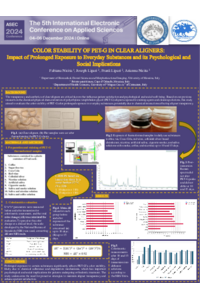
Introduction: The transparency and aesthetics of clear aligners are critical factors that influence patient satisfaction and psychological and social well-being. Based on our previous research on the chemical–physical characterization of polyethylene terephthalate glycol (PET-G) aligners exposed to staining agents and cleaning solutions, this study aimed to evaluate the color stability of PET-G after prolonged exposure to everyday substances, potentially due to chemical interactions affecting aligner transparency.
Methods: Twenty-five sheets of PET-G and a truncated pyramid-shaped thermoforming mold were used to obtain flat samples (n = 220). These samples were immersed in various substances (coffee, tea, Coca-Cola, red wine, colloidal silver-based disinfectant, nicotine, artificial saliva, cigarette smoke, and three saliva solutions mixed with plain, coffee, and nicotine). Immersion times of 10 (n = 110) and 15 days (n = 110) were randomized. L*a*b* parameters were measured before and after immersion for colorimetric assessment, and the total color change (ΔE) was calculated for evaluation. Statistical analysis included nonparametric tests, with significance set at P < 0.05.
Results: Significant colorimetric changes were detected in PET-G samples exposed to acidic or polyphenol-rich substances, suggesting that chemical interactions may drive discoloration. Pairwise comparisons highlighted significant differences between ΔE values for groups exposed to different substances, particularly coffee, tea, and Coca-Cola, at both immersion durations. In addition, highly significant colorimetric changes were demonstrated between the two times, particularly for samples exposed to coffee, tea, and Coca-Cola. Clinical evaluations revealed slight to noticeable color changes, with Coca-Cola causing more pronounced changes, especially after 15 days.
Conclusions: Prolonged exposure to certain substances significantly affects PET-G's color stability, likely due to chemical adherence and degradation mechanisms, which has important psychological and social implications for patients undergoing orthodontic treatment. This study underscores the need for proactive strategies to maintain aligner transparency and enhance patient satisfaction.
Keywords
Clear aligners
PET-G
Color stability
Daily substances
Psychological
Social
Well-being
Poster
POSTER ASEC 2024.pdf
Optical and thermal properties of lung tissue undergoing thermal treatment
Evaluation of Adaptive Laboratory Evolution (ALE) Using the Comamonas sp. C10 Strain for the Enhancement of Polyhydroxybutyrate (PHB) Degradation Capability