Event submissions
Published
This submission belongs to the session S1. Applied Biosciences and Bioengineering of the event The 5th International Electronic Conference on Applied Sciences
Published date
03 Dec, 2024
Academic Editor
'%3e%3cpath%20d='M12.6657%2010.9104C12.4185%2010.325%2012.0599%209.79327%2011.6097%209.34482C11.1609%208.89508%2010.6293%208.5365%2010.0442%208.28888C10.0389%208.28626%2010.0337%208.28495%2010.0285%208.28233C10.8446%207.69279%2011.3752%206.73249%2011.3752%205.64904C11.3752%203.8542%209.92103%202.39999%208.1262%202.39999C6.33136%202.39999%204.87715%203.8542%204.87715%205.64904C4.87715%206.73249%205.40774%207.69279%206.22393%208.28364C6.21869%208.28626%206.21345%208.28757%206.20821%208.29019C5.62129%208.5378%205.09463%208.89284%204.64265%209.34613C4.1929%209.79493%203.83432%2010.3266%203.58671%2010.9117C3.34345%2011.4845%203.21226%2012.0987%203.20023%2012.7209C3.19988%2012.7349%203.20233%2012.7488%203.20744%2012.7619C3.21255%2012.7749%203.22022%2012.7867%203.22998%2012.7968C3.23975%2012.8068%203.25142%2012.8147%203.26431%2012.8202C3.2772%2012.8256%203.29105%2012.8284%203.30504%2012.8284H4.09109C4.14874%2012.8284%204.19459%2012.7825%204.1959%2012.7262C4.2221%2011.7148%204.62823%2010.7676%205.34617%2010.0497C6.08899%209.30683%207.0755%208.89808%208.1262%208.89808C9.17689%208.89808%2010.1634%209.30683%2010.9062%2010.0497C11.6242%2010.7676%2012.0303%2011.7148%2012.0565%2012.7262C12.0578%2012.7838%2012.1037%2012.8284%2012.1613%2012.8284H12.9474C12.9613%2012.8284%2012.9752%2012.8256%2012.9881%2012.8202C13.001%2012.8147%2013.0126%2012.8068%2013.0224%2012.7968C13.0322%2012.7867%2013.0398%2012.7749%2013.0449%2012.7619C13.0501%2012.7488%2013.0525%2012.7349%2013.0522%2012.7209C13.0391%2012.0947%2012.9094%2011.4855%2012.6657%2010.9104ZM8.1262%207.9024C7.52486%207.9024%206.9589%207.6679%206.53312%207.24211C6.10733%206.81633%205.87283%206.25037%205.87283%205.64904C5.87283%205.0477%206.10733%204.48174%206.53312%204.05596C6.9589%203.63018%207.52486%203.39567%208.1262%203.39567C8.72753%203.39567%209.29349%203.63018%209.71927%204.05596C10.1451%204.48174%2010.3796%205.0477%2010.3796%205.64904C10.3796%206.25037%2010.1451%206.81633%209.71927%207.24211C9.29349%207.6679%208.72753%207.9024%208.1262%207.9024Z'%20fill='%235D1EE1'/%3e%3c/g%3e%3c/svg%3e) Paola Saccomandi
Paola SaccomandiCitation
Sanjana Dhulipalla, Giesse Albeche Duarte, Lei Wu, Palak Patel, Rogger Andrade, John Lamar, C Michael DiPersio, Whitney M Longmate, Epidermal α3β1 is required for efficient wound healing and is downregulated in aged skin, in Proceedings of The 5th International Electronic Conference on Applied Sciences, 4 December–6 December 2024, MDPI: Basel, Switzerland
Share
Email
Facebook
Twitter
LinkedIn
Epidermal α3β1 is required for efficient wound healing and is downregulated in aged skin
'%3e%3cpath%20d='M12.6647%2010.9104C12.4176%2010.325%2012.0589%209.7933%2011.6088%209.34485C11.16%208.89511%2010.6283%208.53653%2010.0432%208.28891C10.038%208.28629%2010.0327%208.28498%2010.0275%208.28236C10.8437%207.69282%2011.3743%206.73252%2011.3743%205.64907C11.3743%203.85423%209.92005%202.40002%208.12522%202.40002C6.33038%202.40002%204.87618%203.85423%204.87618%205.64907C4.87618%206.73252%205.40677%207.69282%206.22296%208.28367C6.21772%208.28629%206.21248%208.2876%206.20724%208.29022C5.62031%208.53783%205.09365%208.89287%204.64167%209.34616C4.19192%209.79496%203.83334%2010.3266%203.58573%2010.9117C3.34247%2011.4846%203.21128%2012.0987%203.19925%2012.721C3.1989%2012.735%203.20135%2012.7489%203.20646%2012.7619C3.21157%2012.7749%203.21924%2012.7868%203.22901%2012.7968C3.23877%2012.8068%203.25045%2012.8148%203.26334%2012.8202C3.27623%2012.8256%203.29007%2012.8284%203.30406%2012.8284H4.09012C4.14776%2012.8284%204.19362%2012.7825%204.19493%2012.7262C4.22113%2011.7148%204.62726%2010.7676%205.34519%2010.0497C6.08802%209.30686%207.07452%208.89811%208.12522%208.89811C9.17592%208.89811%2010.1624%209.30686%2010.9052%2010.0497C11.6232%2010.7676%2012.0293%2011.7148%2012.0555%2012.7262C12.0568%2012.7839%2012.1027%2012.8284%2012.1603%2012.8284H12.9464C12.9604%2012.8284%2012.9742%2012.8256%2012.9871%2012.8202C13%2012.8148%2013.0117%2012.8068%2013.0214%2012.7968C13.0312%2012.7868%2013.0389%2012.7749%2013.044%2012.7619C13.0491%2012.7489%2013.0515%2012.735%2013.0512%2012.721C13.0381%2012.0947%2012.9084%2011.4856%2012.6647%2010.9104ZM8.12522%207.90243C7.52388%207.90243%206.95792%207.66793%206.53214%207.24215C6.10636%206.81636%205.87185%206.2504%205.87185%205.64907C5.87185%205.04773%206.10636%204.48177%206.53214%204.05599C6.95792%203.63021%207.52388%203.3957%208.12522%203.3957C8.72655%203.3957%209.29252%203.63021%209.7183%204.05599C10.1441%204.48177%2010.3786%205.04773%2010.3786%205.64907C10.3786%206.2504%2010.1441%206.81636%209.7183%207.24215C9.29252%207.66793%208.72655%207.90243%208.12522%207.90243Z'%20fill='%235D1EE1'/%3e%3c/g%3e%3c/svg%3e)
Sanjana Dhulipalla 1
Giesse Albeche Duarte 1
Lei Wu 2
Palak Patel 1
Rogger Andrade 1

John Lamar 1
C Michael DiPersio 1,2
Whitney M Longmate 1,2
1. Department of Molecular and Cellular Physiology, Albany Medical College, Albany, NY 12208, USA
2. Department of Surgery, Albany Medical College, Albany, NY, 12208, USA
Abstract
Introduction
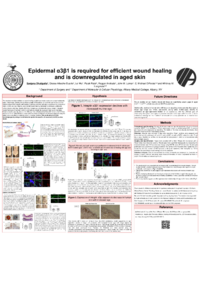
Epidermal integrin α3β1 has emerged as a promising therapeutic target in impaired wound healing as it has been shown to be highly expressed during wound healing and has been linked to keratinocyte migration in vitro. However, its role in re-epithelialization in vivo has remained unclear. This study aims to clarify this role by using a novel inducible epidermis-specific α3 knockout (iα3eKO) murine model.
Methods
Young (8-week-old) and aged (22-month-old) iα3eKO mice were treated topically with tamoxifen (4OHT) to induce α3 knockout, or with vehicle control (acetone) 5 and 3 days prior to wounding. The backs of the mice were shaved, disinfected, then wounded with 4mm full-thickness biopsy punches. Frozen sections were prepared and immunostained with anti-integrin α3, anti-K14, anti-Ki67, and DAPI. Keratinocyte proliferation and wound re-epithelialization were assessed in each age group.
Results
Young 4OHT-treated mice exhibited markedly reduced wound re-epithelialization compared to their vehicle-treated counterparts (p<0.0001). Keratinocyte proliferation was also decreased in wound-distal hair follicles in young animals (p = 0.0235), suggesting a lack of proliferating keratinocytes contributes to the reduced wound re-epithelialization. Keratinocyte proliferation was similarly decreased in aged mice, and 4OHT treatment did not further reduce healing parameters. Additionally, our findings indicate that epidermal α3β1 levels naturally decline with advanced murine age, and preliminary results indicate that this may also occur during human aging. Therefore, we hypothesize that reduced levels of α3β1 contribute to reduced capacity for wound healing observed in the aged population.
Conclusions
Overall, our work indicates that integrin α3β1 promotes wound re-epithelialization and declines with chronological age, suggesting that wound healing mechanisms may be impaired in the elderly due to a natural decrease in α3β1 levels. Future studies will reveal whether therapeutic promotion of integrin α3β1 function will aid in wound closure in the elderly and/or in hard-to-heal wounds, in general.
Keywords
Integrin
re-epithelialization
keratinocyte
proliferation
Poster
sciforum-107683.pdf
Exploring the Bioactive Benefits of Hops for Skincare and Health Applications
Development of Novel DNA Fluorescence In Situ Hybridization Probes for Rapid Detection of Microbial Contaminants in Cosmetic Products