Event submissions
Published
This submission belongs to the session S1. Applied Biosciences and Bioengineering of the event The 5th International Electronic Conference on Applied Sciences
Published date
03 Dec, 2024
Academic Editor
'%3e%3cpath%20d='M12.6657%2010.9104C12.4185%2010.325%2012.0599%209.79327%2011.6097%209.34482C11.1609%208.89508%2010.6293%208.5365%2010.0442%208.28888C10.0389%208.28626%2010.0337%208.28495%2010.0285%208.28233C10.8446%207.69279%2011.3752%206.73249%2011.3752%205.64904C11.3752%203.8542%209.92103%202.39999%208.1262%202.39999C6.33136%202.39999%204.87715%203.8542%204.87715%205.64904C4.87715%206.73249%205.40774%207.69279%206.22393%208.28364C6.21869%208.28626%206.21345%208.28757%206.20821%208.29019C5.62129%208.5378%205.09463%208.89284%204.64265%209.34613C4.1929%209.79493%203.83432%2010.3266%203.58671%2010.9117C3.34345%2011.4845%203.21226%2012.0987%203.20023%2012.7209C3.19988%2012.7349%203.20233%2012.7488%203.20744%2012.7619C3.21255%2012.7749%203.22022%2012.7867%203.22998%2012.7968C3.23975%2012.8068%203.25142%2012.8147%203.26431%2012.8202C3.2772%2012.8256%203.29105%2012.8284%203.30504%2012.8284H4.09109C4.14874%2012.8284%204.19459%2012.7825%204.1959%2012.7262C4.2221%2011.7148%204.62823%2010.7676%205.34617%2010.0497C6.08899%209.30683%207.0755%208.89808%208.1262%208.89808C9.17689%208.89808%2010.1634%209.30683%2010.9062%2010.0497C11.6242%2010.7676%2012.0303%2011.7148%2012.0565%2012.7262C12.0578%2012.7838%2012.1037%2012.8284%2012.1613%2012.8284H12.9474C12.9613%2012.8284%2012.9752%2012.8256%2012.9881%2012.8202C13.001%2012.8147%2013.0126%2012.8068%2013.0224%2012.7968C13.0322%2012.7867%2013.0398%2012.7749%2013.0449%2012.7619C13.0501%2012.7488%2013.0525%2012.7349%2013.0522%2012.7209C13.0391%2012.0947%2012.9094%2011.4855%2012.6657%2010.9104ZM8.1262%207.9024C7.52486%207.9024%206.9589%207.6679%206.53312%207.24211C6.10733%206.81633%205.87283%206.25037%205.87283%205.64904C5.87283%205.0477%206.10733%204.48174%206.53312%204.05596C6.9589%203.63018%207.52486%203.39567%208.1262%203.39567C8.72753%203.39567%209.29349%203.63018%209.71927%204.05596C10.1451%204.48174%2010.3796%205.0477%2010.3796%205.64904C10.3796%206.25037%2010.1451%206.81633%209.71927%207.24211C9.29349%207.6679%208.72753%207.9024%208.1262%207.9024Z'%20fill='%235D1EE1'/%3e%3c/g%3e%3c/svg%3e) Paola Saccomandi
Paola SaccomandiCitation
Panchali Sengupta, It’s not “Machine against Man” but “Machine for Man”: a case study on the use of robotics by vegetable farmers from the South-24 Parganas district of West Bengal, India, in Proceedings of The 5th International Electronic Conference on Applied Sciences, 4 December–6 December 2024, MDPI: Basel, Switzerland
Share
Email
Facebook
Twitter
LinkedIn
It’s not “Machine against Man” but “Machine for Man”: a case study on the use of robotics by vegetable farmers from the South-24 Parganas district of West Bengal, India

Panchali Sengupta 1
1. Department of Zoology, West Bengal State University, Berunanpukaria, Malikapur, Barasat, West Bengal, India
Abstract
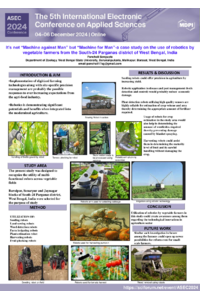
The implementation of digitized farming technologies along with site-specific precision management are possible responses to ever-increasing expectations from the agri-food industry. The field of robotics is demonstrating significant potentials and benefits when integrated into the modernized agriculture. Although still in the prototype stage, automation in agriculture has a bright future. Agri-robots are capable of performing various farming operations such as seeding, pruning, spraying, pest and disease detection, harvesting and weed control. The present study was designed to recognize the utility of multi-functional robots across vegetable fields in Baruipur, Sonarpur and Jaynagar blocks of the South-24 Parganas district, West Bengal, India. Seeding robots could offer precision in seeding functionary by augmenting plant densities to increase yield. Robotic application in disease and pest management (both detection and control) would probably contribute towards reductions in economic damage. Plant-detection robots utilizing high-quality sensors are highly reliable for estimations of crop volume and area, thereby determining the appropriate amount of fertilizer required. Such robots could also distinguish between crops and weeds on fields. The usage of such robots for crop estimation in the study area would also help in determining the accurate amount of weedicides required, thereby preventing damage caused by blanket spraying. The utilization of harvesting robots by farmers could assist them in localizing the most appropriate state of fruit and its careful handling without damaging the crop. Thus, the evolution and development of robotics could play a vital role in paving the path towards complete automation in agriculture sector with minimal human involvement.
Keywords
agriculture
harvesting
robotics
seeding
sensors
Poster
sciforum-107453.pdf
Insights into Tumors: Morphological Analysis of Spheroidal Tissue Models
Sensor ensemble for patient stress monitoring using CNT-based temperature sensor and GSR sensor