Event submissions
Published
This submission belongs to the session S1. Applied Biosciences and Bioengineering of the event The 5th International Electronic Conference on Applied Sciences
Published date
03 Dec, 2024
Academic Editor
'%3e%3cpath%20d='M12.6657%2010.9104C12.4185%2010.325%2012.0599%209.79327%2011.6097%209.34482C11.1609%208.89508%2010.6293%208.5365%2010.0442%208.28888C10.0389%208.28626%2010.0337%208.28495%2010.0285%208.28233C10.8446%207.69279%2011.3752%206.73249%2011.3752%205.64904C11.3752%203.8542%209.92103%202.39999%208.1262%202.39999C6.33136%202.39999%204.87715%203.8542%204.87715%205.64904C4.87715%206.73249%205.40774%207.69279%206.22393%208.28364C6.21869%208.28626%206.21345%208.28757%206.20821%208.29019C5.62129%208.5378%205.09463%208.89284%204.64265%209.34613C4.1929%209.79493%203.83432%2010.3266%203.58671%2010.9117C3.34345%2011.4845%203.21226%2012.0987%203.20023%2012.7209C3.19988%2012.7349%203.20233%2012.7488%203.20744%2012.7619C3.21255%2012.7749%203.22022%2012.7867%203.22998%2012.7968C3.23975%2012.8068%203.25142%2012.8147%203.26431%2012.8202C3.2772%2012.8256%203.29105%2012.8284%203.30504%2012.8284H4.09109C4.14874%2012.8284%204.19459%2012.7825%204.1959%2012.7262C4.2221%2011.7148%204.62823%2010.7676%205.34617%2010.0497C6.08899%209.30683%207.0755%208.89808%208.1262%208.89808C9.17689%208.89808%2010.1634%209.30683%2010.9062%2010.0497C11.6242%2010.7676%2012.0303%2011.7148%2012.0565%2012.7262C12.0578%2012.7838%2012.1037%2012.8284%2012.1613%2012.8284H12.9474C12.9613%2012.8284%2012.9752%2012.8256%2012.9881%2012.8202C13.001%2012.8147%2013.0126%2012.8068%2013.0224%2012.7968C13.0322%2012.7867%2013.0398%2012.7749%2013.0449%2012.7619C13.0501%2012.7488%2013.0525%2012.7349%2013.0522%2012.7209C13.0391%2012.0947%2012.9094%2011.4855%2012.6657%2010.9104ZM8.1262%207.9024C7.52486%207.9024%206.9589%207.6679%206.53312%207.24211C6.10733%206.81633%205.87283%206.25037%205.87283%205.64904C5.87283%205.0477%206.10733%204.48174%206.53312%204.05596C6.9589%203.63018%207.52486%203.39567%208.1262%203.39567C8.72753%203.39567%209.29349%203.63018%209.71927%204.05596C10.1451%204.48174%2010.3796%205.0477%2010.3796%205.64904C10.3796%206.25037%2010.1451%206.81633%209.71927%207.24211C9.29349%207.6679%208.72753%207.9024%208.1262%207.9024Z'%20fill='%235D1EE1'/%3e%3c/g%3e%3c/svg%3e) Paola Saccomandi
Paola SaccomandiCitation
Bárbara Bossa Hidalgo, Jéssica Lopes De Oliveira, Alberto Malvezzi, Paulo Lee Ho, Henrique Roman-Ramos, In Silico Structural Analysis of a Putative Class IA Phospholipase A2 from the Brazilian Coral Snake, Micrurus corallinus, in Proceedings of The 5th International Electronic Conference on Applied Sciences, 4 December–6 December 2024, MDPI: Basel, Switzerland
Share
Email
Facebook
Twitter
LinkedIn
In Silico Structural Analysis of a Putative Class IA Phospholipase A2 from the Brazilian Coral Snake, Micrurus corallinus
'%3e%3cpath%20d='M12.6647%2010.9104C12.4176%2010.325%2012.0589%209.7933%2011.6088%209.34485C11.16%208.89511%2010.6283%208.53653%2010.0432%208.28891C10.038%208.28629%2010.0327%208.28498%2010.0275%208.28236C10.8437%207.69282%2011.3743%206.73252%2011.3743%205.64907C11.3743%203.85423%209.92005%202.40002%208.12522%202.40002C6.33038%202.40002%204.87618%203.85423%204.87618%205.64907C4.87618%206.73252%205.40677%207.69282%206.22296%208.28367C6.21772%208.28629%206.21248%208.2876%206.20724%208.29022C5.62031%208.53783%205.09365%208.89287%204.64167%209.34616C4.19192%209.79496%203.83334%2010.3266%203.58573%2010.9117C3.34247%2011.4846%203.21128%2012.0987%203.19925%2012.721C3.1989%2012.735%203.20135%2012.7489%203.20646%2012.7619C3.21157%2012.7749%203.21924%2012.7868%203.22901%2012.7968C3.23877%2012.8068%203.25045%2012.8148%203.26334%2012.8202C3.27623%2012.8256%203.29007%2012.8284%203.30406%2012.8284H4.09012C4.14776%2012.8284%204.19362%2012.7825%204.19493%2012.7262C4.22113%2011.7148%204.62726%2010.7676%205.34519%2010.0497C6.08802%209.30686%207.07452%208.89811%208.12522%208.89811C9.17592%208.89811%2010.1624%209.30686%2010.9052%2010.0497C11.6232%2010.7676%2012.0293%2011.7148%2012.0555%2012.7262C12.0568%2012.7839%2012.1027%2012.8284%2012.1603%2012.8284H12.9464C12.9604%2012.8284%2012.9742%2012.8256%2012.9871%2012.8202C13%2012.8148%2013.0117%2012.8068%2013.0214%2012.7968C13.0312%2012.7868%2013.0389%2012.7749%2013.044%2012.7619C13.0491%2012.7489%2013.0515%2012.735%2013.0512%2012.721C13.0381%2012.0947%2012.9084%2011.4856%2012.6647%2010.9104ZM8.12522%207.90243C7.52388%207.90243%206.95792%207.66793%206.53214%207.24215C6.10636%206.81636%205.87185%206.2504%205.87185%205.64907C5.87185%205.04773%206.10636%204.48177%206.53214%204.05599C6.95792%203.63021%207.52388%203.3957%208.12522%203.3957C8.72655%203.3957%209.29252%203.63021%209.7183%204.05599C10.1441%204.48177%2010.3786%205.04773%2010.3786%205.64907C10.3786%206.2504%2010.1441%206.81636%209.7183%207.24215C9.29252%207.66793%208.72655%207.90243%208.12522%207.90243Z'%20fill='%235D1EE1'/%3e%3c/g%3e%3c/svg%3e)
Bárbara Bossa Hidalgo 1

Jéssica Lopes De Oliveira 2
Alberto Malvezzi 1

Paulo Lee Ho 3

Henrique Roman-Ramos 2
1. Faculdade de Medicina, Universidade Nove de Julho (UNINOVE), São Paulo 01504-001, Brazil
2. Laboratório de Biotecnologia, Programa de Pós-Graduação em Medicina, Universidade Nove de Julho (UNINOVE), São Paulo 01504-001, Brazil
3. Centro Bioindustrial, Instituto Butantan, São Paulo 05503-900, Brazil
Abstract
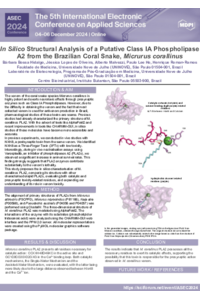
Introduction: The venom of the coral snake species Micrurus corallinus is highly potent and exerts neurotoxic effects through presynaptic enzymes such as class IA phospholipases. However, due to the difficulty in obtaining the venom and the fact that most collected venom is used for antivenom production in Brazil, pharmacological studies of these toxins are scarce. Previous studies have already characterized the primary structure of M. corallinus PLA2. With the advent of tools like AlphaFold2 and recent improvements in tools like CHARMM-GUI, in silico studies of these molecules have become more accessible and accurate. This study proposes the in silico characterization of M. corallinus PLA2, comparing its structure with other characterized elapid PLA2s, evaluating both catalytic and presynaptic toxicity-related residues. Methods: The alignment of primary structures of PLA2s from Micrurus altirostris (F5CPF0), Micrurus nigrocinctus (P81166), Naja atra (P00598), and Pseudechis australis (P04056 and P04057) was performed using ClustalW. The three-dimensional structure of M. corallinus PLA2 was modeled using AlphaFold2. The interactions of the enzyme with its substrates (phospholipid or tridecanoic acid) were analyzed using the CHARMM-GUI web interface and the PPM 2.0 server. All molecular representations were created using the PyMOL molecular graphics software package. Results: Micrurus corallinus PLA2 presents all residues necessary for catalytic action: CCXXH48D49XC in the active site and GCY28CG30X32GXG in the Ca2+ binding loop. Both catalytic mechanisms, the single-water mechanism and the assisted-water mechanism, were evaluated, with the latter being more likely due to the large distance observed between His48 and the Ca2+ ion. Conclusion: The results indicate that M. corallinus PLA2 possesses all the necessary residues to exert its catalytic effects, supporting the possibility that this toxin is responsible for the presynaptic action observed in M. corallinus venom.
Keywords
PLA2-IA
Micrurus corallinus
Coral snake
AlphaFold2
Rosetta Docking
nAChR
Poster
sciforum-107218.pdf
Unlocking neural networks: Explainability techniques for enhanced performance in automatic peripheral blood cell recognition
Evaluation of the Effect of Electrode Displacement on Hand Movement Classification