Event submissions
Published
This submission belongs to the session S1. Applied Biosciences and Bioengineering of the event The 5th International Electronic Conference on Applied Sciences
Published date
03 Dec, 2024
Academic Editor
'%3e%3cpath%20d='M12.6657%2010.9104C12.4185%2010.325%2012.0599%209.79327%2011.6097%209.34482C11.1609%208.89508%2010.6293%208.5365%2010.0442%208.28888C10.0389%208.28626%2010.0337%208.28495%2010.0285%208.28233C10.8446%207.69279%2011.3752%206.73249%2011.3752%205.64904C11.3752%203.8542%209.92103%202.39999%208.1262%202.39999C6.33136%202.39999%204.87715%203.8542%204.87715%205.64904C4.87715%206.73249%205.40774%207.69279%206.22393%208.28364C6.21869%208.28626%206.21345%208.28757%206.20821%208.29019C5.62129%208.5378%205.09463%208.89284%204.64265%209.34613C4.1929%209.79493%203.83432%2010.3266%203.58671%2010.9117C3.34345%2011.4845%203.21226%2012.0987%203.20023%2012.7209C3.19988%2012.7349%203.20233%2012.7488%203.20744%2012.7619C3.21255%2012.7749%203.22022%2012.7867%203.22998%2012.7968C3.23975%2012.8068%203.25142%2012.8147%203.26431%2012.8202C3.2772%2012.8256%203.29105%2012.8284%203.30504%2012.8284H4.09109C4.14874%2012.8284%204.19459%2012.7825%204.1959%2012.7262C4.2221%2011.7148%204.62823%2010.7676%205.34617%2010.0497C6.08899%209.30683%207.0755%208.89808%208.1262%208.89808C9.17689%208.89808%2010.1634%209.30683%2010.9062%2010.0497C11.6242%2010.7676%2012.0303%2011.7148%2012.0565%2012.7262C12.0578%2012.7838%2012.1037%2012.8284%2012.1613%2012.8284H12.9474C12.9613%2012.8284%2012.9752%2012.8256%2012.9881%2012.8202C13.001%2012.8147%2013.0126%2012.8068%2013.0224%2012.7968C13.0322%2012.7867%2013.0398%2012.7749%2013.0449%2012.7619C13.0501%2012.7488%2013.0525%2012.7349%2013.0522%2012.7209C13.0391%2012.0947%2012.9094%2011.4855%2012.6657%2010.9104ZM8.1262%207.9024C7.52486%207.9024%206.9589%207.6679%206.53312%207.24211C6.10733%206.81633%205.87283%206.25037%205.87283%205.64904C5.87283%205.0477%206.10733%204.48174%206.53312%204.05596C6.9589%203.63018%207.52486%203.39567%208.1262%203.39567C8.72753%203.39567%209.29349%203.63018%209.71927%204.05596C10.1451%204.48174%2010.3796%205.0477%2010.3796%205.64904C10.3796%206.25037%2010.1451%206.81633%209.71927%207.24211C9.29349%207.6679%208.72753%207.9024%208.1262%207.9024Z'%20fill='%235D1EE1'/%3e%3c/g%3e%3c/svg%3e) Paola Saccomandi
Paola SaccomandiCitation
Duppala Rohan, Shaik Mohammed Abdul Karrem, Gogulamudi Pradeep Reddy, Yellapragada Venkata Pavan Kumar, Kasaraneni Purna Prakash, Malathi Janapati, A Custom Convolutional Neural Network Model-Based Bioimaging Technique for Enhanced Accuracy of Alzheimer’s Disease Detection, in Proceedings of The 5th International Electronic Conference on Applied Sciences, 4 December–6 December 2024, MDPI: Basel, Switzerland
Share
Email
Facebook
Twitter
LinkedIn
A Custom Convolutional Neural Network Model-Based Bioimaging Technique for Enhanced Accuracy of Alzheimer’s Disease Detection

Duppala Rohan 1
'%3e%3cpath%20d='M12.6647%2010.9104C12.4176%2010.325%2012.0589%209.7933%2011.6088%209.34485C11.16%208.89511%2010.6283%208.53653%2010.0432%208.28891C10.038%208.28629%2010.0327%208.28498%2010.0275%208.28236C10.8437%207.69282%2011.3743%206.73252%2011.3743%205.64907C11.3743%203.85423%209.92005%202.40002%208.12522%202.40002C6.33038%202.40002%204.87618%203.85423%204.87618%205.64907C4.87618%206.73252%205.40677%207.69282%206.22296%208.28367C6.21772%208.28629%206.21248%208.2876%206.20724%208.29022C5.62031%208.53783%205.09365%208.89287%204.64167%209.34616C4.19192%209.79496%203.83334%2010.3266%203.58573%2010.9117C3.34247%2011.4846%203.21128%2012.0987%203.19925%2012.721C3.1989%2012.735%203.20135%2012.7489%203.20646%2012.7619C3.21157%2012.7749%203.21924%2012.7868%203.22901%2012.7968C3.23877%2012.8068%203.25045%2012.8148%203.26334%2012.8202C3.27623%2012.8256%203.29007%2012.8284%203.30406%2012.8284H4.09012C4.14776%2012.8284%204.19362%2012.7825%204.19493%2012.7262C4.22113%2011.7148%204.62726%2010.7676%205.34519%2010.0497C6.08802%209.30686%207.07452%208.89811%208.12522%208.89811C9.17592%208.89811%2010.1624%209.30686%2010.9052%2010.0497C11.6232%2010.7676%2012.0293%2011.7148%2012.0555%2012.7262C12.0568%2012.7839%2012.1027%2012.8284%2012.1603%2012.8284H12.9464C12.9604%2012.8284%2012.9742%2012.8256%2012.9871%2012.8202C13%2012.8148%2013.0117%2012.8068%2013.0214%2012.7968C13.0312%2012.7868%2013.0389%2012.7749%2013.044%2012.7619C13.0491%2012.7489%2013.0515%2012.735%2013.0512%2012.721C13.0381%2012.0947%2012.9084%2011.4856%2012.6647%2010.9104ZM8.12522%207.90243C7.52388%207.90243%206.95792%207.66793%206.53214%207.24215C6.10636%206.81636%205.87185%206.2504%205.87185%205.64907C5.87185%205.04773%206.10636%204.48177%206.53214%204.05599C6.95792%203.63021%207.52388%203.3957%208.12522%203.3957C8.72655%203.3957%209.29252%203.63021%209.7183%204.05599C10.1441%204.48177%2010.3786%205.04773%2010.3786%205.64907C10.3786%206.2504%2010.1441%206.81636%209.7183%207.24215C9.29252%207.66793%208.72655%207.90243%208.12522%207.90243Z'%20fill='%235D1EE1'/%3e%3c/g%3e%3c/svg%3e)
Shaik Mohammed Abdul Karrem 1

Gogulamudi Pradeep Reddy 2

Yellapragada Venkata Pavan Kumar 3

Kasaraneni Purna Prakash 4

Malathi Janapati 5
1. School of Computer Science and Engineering, VIT-AP University, Amaravati 522237, Andhra Pradesh, India
2. Department of Information and Communication Technology, Manipal Institute of Technology, Manipal Academy of Higher Education, Manipal 576104, Karnataka, India
3. School of Electronics Engineering, VIT-AP University, Amaravati 522237, Andhra Pradesh, India
4. Department of Computer Science and Engineering, Koneru Lakshmaiah Education Foundation, Vaddeswaram, Guntur 522502, Andhra Pradesh, INDIA
5. Department of Artificial Intelligence and Data Science, Velagapudi Ramakrishna Siddhartha Engineering College, Vijayawada 520007, Andhra Pradesh, India
Abstract
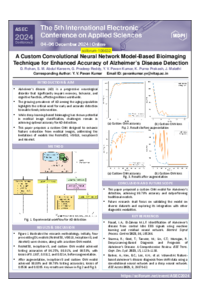
Alzheimer’s disease (AD), an intense neurological illness, severely impacts memory, behaviour, and personality, posing a growing concern worldwide due to the aging population. Early and accurate detection is crucial as it enables preventive measures and personalized healthcare strategies that can significantly improve patient conditions. However, current diagnostic methods are often inaccurate in identifying the disease in its early stages, which is essential for effective treatment. Although deep learning-based bioimaging has shown promising results in medical image classification, challenges remain in achieving the highest accuracy for detecting AD. Existing approaches such as ResNet50, VGG19, InceptionV3, and AlexNet have shown potential, but they often lack reliability and accuracy due to several issues. To address these gaps, this paper proposes a new bioimaging technique by developing a custom Convolutional Neural Network (CNN) model for AD detection. This model is designed with optimized layers to enhance feature extraction from medical images, which are pivotal in identifying subtle biomarkers associated with AD. The experiment's first phase involves the construction of the custom CNN model with three convolutional layers, three max-pooling layers, one flatten layer, and two dense layers. The Adam optimizer and categorical cross-entropy are adopted to compile the model. The model’s training is carried out on 100 epochs with the patience set to 10 epochs. The second phase involves augmentation of the dataset images and adding a dropout layer to the custom CNN model. In addition, fine-tuned hyperparameters and advanced regularization methods were integrated to prevent overfitting. A comparative analysis of the proposed model with conventional models was performed on the dataset both before and after data augmentation. The experimental results demonstrate that the proposed custom CNN model significantly outperforms the pre-existing models, achieving a training accuracy of 100% and a testing accuracy of 99.79%, with a low training loss of 1.0148×10⁻⁵ and a testing loss of 0.0205.
Keywords
AlexNet
Alzheimer’s disease
Bioimaging
Convolutional Neural Network (CNN)
Data Augmentation
InceptionV3
ResNet50
VGG19
Poster
ASEC2024_sciforum-106632_Poster.pdf
Molecular docking and ADMET prediction of compounds obtained from Stephania dinklagei roots as inhibitors of NMDA receptor
Multimodal Immersive Environment for Evaluating Reaction Time and Decision-Making in Sport Situations: A Pilot Study on Time Analysis and Learning Effects