Event submissions
Published
This submission belongs to the session S1. Applied Biosciences and Bioengineering of the event The 5th International Electronic Conference on Applied Sciences
Published date
03 Dec, 2024
Academic Editor
'%3e%3cpath%20d='M12.6657%2010.9104C12.4185%2010.325%2012.0599%209.79327%2011.6097%209.34482C11.1609%208.89508%2010.6293%208.5365%2010.0442%208.28888C10.0389%208.28626%2010.0337%208.28495%2010.0285%208.28233C10.8446%207.69279%2011.3752%206.73249%2011.3752%205.64904C11.3752%203.8542%209.92103%202.39999%208.1262%202.39999C6.33136%202.39999%204.87715%203.8542%204.87715%205.64904C4.87715%206.73249%205.40774%207.69279%206.22393%208.28364C6.21869%208.28626%206.21345%208.28757%206.20821%208.29019C5.62129%208.5378%205.09463%208.89284%204.64265%209.34613C4.1929%209.79493%203.83432%2010.3266%203.58671%2010.9117C3.34345%2011.4845%203.21226%2012.0987%203.20023%2012.7209C3.19988%2012.7349%203.20233%2012.7488%203.20744%2012.7619C3.21255%2012.7749%203.22022%2012.7867%203.22998%2012.7968C3.23975%2012.8068%203.25142%2012.8147%203.26431%2012.8202C3.2772%2012.8256%203.29105%2012.8284%203.30504%2012.8284H4.09109C4.14874%2012.8284%204.19459%2012.7825%204.1959%2012.7262C4.2221%2011.7148%204.62823%2010.7676%205.34617%2010.0497C6.08899%209.30683%207.0755%208.89808%208.1262%208.89808C9.17689%208.89808%2010.1634%209.30683%2010.9062%2010.0497C11.6242%2010.7676%2012.0303%2011.7148%2012.0565%2012.7262C12.0578%2012.7838%2012.1037%2012.8284%2012.1613%2012.8284H12.9474C12.9613%2012.8284%2012.9752%2012.8256%2012.9881%2012.8202C13.001%2012.8147%2013.0126%2012.8068%2013.0224%2012.7968C13.0322%2012.7867%2013.0398%2012.7749%2013.0449%2012.7619C13.0501%2012.7488%2013.0525%2012.7349%2013.0522%2012.7209C13.0391%2012.0947%2012.9094%2011.4855%2012.6657%2010.9104ZM8.1262%207.9024C7.52486%207.9024%206.9589%207.6679%206.53312%207.24211C6.10733%206.81633%205.87283%206.25037%205.87283%205.64904C5.87283%205.0477%206.10733%204.48174%206.53312%204.05596C6.9589%203.63018%207.52486%203.39567%208.1262%203.39567C8.72753%203.39567%209.29349%203.63018%209.71927%204.05596C10.1451%204.48174%2010.3796%205.0477%2010.3796%205.64904C10.3796%206.25037%2010.1451%206.81633%209.71927%207.24211C9.29349%207.6679%208.72753%207.9024%208.1262%207.9024Z'%20fill='%235D1EE1'/%3e%3c/g%3e%3c/svg%3e) Paola Saccomandi
Paola SaccomandiCitation
Leonardo Ariel Cano, Roberto Morollón Ruiz, Gonzalo Daniel Gerez, María Soledad García, Eduardo Oliveira Freire, Eduardo Fernández-Jover, Fernando Daniel Farfán, Multimodal Immersive Environment for Evaluating Reaction Time and Decision-Making in Sport Situations: A Pilot Study on Time Analysis and Learning Effects, in Proceedings of The 5th International Electronic Conference on Applied Sciences, 4 December–6 December 2024, MDPI: Basel, Switzerland
Share
Email
Facebook
Twitter
LinkedIn
Multimodal Immersive Environment for Evaluating Reaction Time and Decision-Making in Sport Situations: A Pilot Study on Time Analysis and Learning Effects

Leonardo Ariel Cano 1,2
'%3e%3cpath%20d='M12.6647%2010.9104C12.4176%2010.325%2012.0589%209.7933%2011.6088%209.34485C11.16%208.89511%2010.6283%208.53653%2010.0432%208.28891C10.038%208.28629%2010.0327%208.28498%2010.0275%208.28236C10.8437%207.69282%2011.3743%206.73252%2011.3743%205.64907C11.3743%203.85423%209.92005%202.40002%208.12522%202.40002C6.33038%202.40002%204.87618%203.85423%204.87618%205.64907C4.87618%206.73252%205.40677%207.69282%206.22296%208.28367C6.21772%208.28629%206.21248%208.2876%206.20724%208.29022C5.62031%208.53783%205.09365%208.89287%204.64167%209.34616C4.19192%209.79496%203.83334%2010.3266%203.58573%2010.9117C3.34247%2011.4846%203.21128%2012.0987%203.19925%2012.721C3.1989%2012.735%203.20135%2012.7489%203.20646%2012.7619C3.21157%2012.7749%203.21924%2012.7868%203.22901%2012.7968C3.23877%2012.8068%203.25045%2012.8148%203.26334%2012.8202C3.27623%2012.8256%203.29007%2012.8284%203.30406%2012.8284H4.09012C4.14776%2012.8284%204.19362%2012.7825%204.19493%2012.7262C4.22113%2011.7148%204.62726%2010.7676%205.34519%2010.0497C6.08802%209.30686%207.07452%208.89811%208.12522%208.89811C9.17592%208.89811%2010.1624%209.30686%2010.9052%2010.0497C11.6232%2010.7676%2012.0293%2011.7148%2012.0555%2012.7262C12.0568%2012.7839%2012.1027%2012.8284%2012.1603%2012.8284H12.9464C12.9604%2012.8284%2012.9742%2012.8256%2012.9871%2012.8202C13%2012.8148%2013.0117%2012.8068%2013.0214%2012.7968C13.0312%2012.7868%2013.0389%2012.7749%2013.044%2012.7619C13.0491%2012.7489%2013.0515%2012.735%2013.0512%2012.721C13.0381%2012.0947%2012.9084%2011.4856%2012.6647%2010.9104ZM8.12522%207.90243C7.52388%207.90243%206.95792%207.66793%206.53214%207.24215C6.10636%206.81636%205.87185%206.2504%205.87185%205.64907C5.87185%205.04773%206.10636%204.48177%206.53214%204.05599C6.95792%203.63021%207.52388%203.3957%208.12522%203.3957C8.72655%203.3957%209.29252%203.63021%209.7183%204.05599C10.1441%204.48177%2010.3786%205.04773%2010.3786%205.64907C10.3786%206.2504%2010.1441%206.81636%209.7183%207.24215C9.29252%207.66793%208.72655%207.90243%208.12522%207.90243Z'%20fill='%235D1EE1'/%3e%3c/g%3e%3c/svg%3e)
Roberto Morollón Ruiz 3
Gonzalo Daniel Gerez 1,2

María Soledad García 1,2

Eduardo Oliveira Freire 1,4

Eduardo Fernández-Jover 3,5

Fernando Daniel Farfán 1,3
1. Neuroscience and Applied Technologies Laboratory (LINTEC), Bioengineering Department, Faculty of Exact Sciences and Technology (FACET), National University of Tucuman (UNT), INSIBIO-CONICET, San Miguel de Tucuman, Argentina
2. Faculty of Physical Education (FACDEF), National University of Tucuman (UNT), Av. Benjamin Araoz 750, San Miguel de Tucuman 4000, Argentina
3. Institute of Bioengineering, Universidad Miguel Hernández of Elche, 03202 Elche, Spain
4. Electrical Engineering Department, Federal University of Sergipe, São Cristóvão, SE, Brazil
5. Research Networking Center in Bioengineering, Biomaterials and Nanomedicine (CIBER-BBN), 28029 Madrid, Spain
Abstract
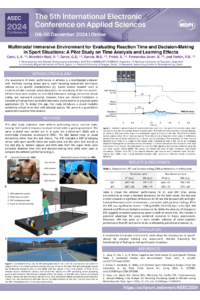
Introduction: The assessment of motor performance in athletes is a multifaceted endeavor, with methods varying across sports, each requiring assessment techniques tailored to its specific characteristics. Sports science research aims to establish reliable methods that depend on the complexity of the instruments. Athletes have been studied in controlled laboratory settings, immersive virtual reality, and real-world scenarios. However, there are inherent limitations in translating findings from controlled laboratory environments to practical sports applications. To bridge this gap, this study introduces a mixed modality, combining virtual immersion with physical objects. We present a quantitative assessment based on time analysis.
Methods: This pilot study evaluated male athletes performing motor reaction tasks, moving their hands in response to visual stimuli under a go/no-go protocol. The same protocol was carried out in a quiet laboratory environment (QLE) and a multimodal immersion environment (MIE). The QLE lacked noise or visual distractions other than the task stimuli. The MIE included a 180°-enveloping screen with sport-specific video and audio noise and the same task stimuli as the QLE. Motion capture and EMG data from the upper limbs were collected. Reaction time (RT) and decision-making time (DM) were used to compare the athletes' performance.
Results and Discussion: The two-way ANOVA showed no significant differences for RT and DM between left- and right-hand performance across environments, consistent with previous findings. The RT in the MIE was significantly shorter, ~10% (p<0.001, ES=0.52), than in the QLE. The DM showed no differences between environments. While the absence of changes in DM suggests consistent processing speed in both environments, the improved RT performance in the MIE indicates a potential advantage for using combined scenarios in future assessments.
Conclusion: A multimodal immersion environment could allow the introduction of specific stimuli for physical training and assessment, thereby improving the transferability of findings to real-world sports situations.
Keywords
immersive environment
reaction time
decision-making
sport assessment
learning effects
Poster
sciforum-104413.pdf
A Custom Convolutional Neural Network Model-Based Bioimaging Technique for Enhanced Accuracy of Alzheimer’s Disease Detection
Are 24 bits too high of a resolution for wearable sEMG devices? What open datasets say