Event submissions
Published
This submission belongs to the session S3. Computing and Artificial Intelligence of the event The 5th International Electronic Conference on Applied Sciences
Published date
03 Dec, 2024
Academic Editor
'%3e%3cpath%20d='M12.6657%2010.9104C12.4185%2010.325%2012.0599%209.79327%2011.6097%209.34482C11.1609%208.89508%2010.6293%208.5365%2010.0442%208.28888C10.0389%208.28626%2010.0337%208.28495%2010.0285%208.28233C10.8446%207.69279%2011.3752%206.73249%2011.3752%205.64904C11.3752%203.8542%209.92103%202.39999%208.1262%202.39999C6.33136%202.39999%204.87715%203.8542%204.87715%205.64904C4.87715%206.73249%205.40774%207.69279%206.22393%208.28364C6.21869%208.28626%206.21345%208.28757%206.20821%208.29019C5.62129%208.5378%205.09463%208.89284%204.64265%209.34613C4.1929%209.79493%203.83432%2010.3266%203.58671%2010.9117C3.34345%2011.4845%203.21226%2012.0987%203.20023%2012.7209C3.19988%2012.7349%203.20233%2012.7488%203.20744%2012.7619C3.21255%2012.7749%203.22022%2012.7867%203.22998%2012.7968C3.23975%2012.8068%203.25142%2012.8147%203.26431%2012.8202C3.2772%2012.8256%203.29105%2012.8284%203.30504%2012.8284H4.09109C4.14874%2012.8284%204.19459%2012.7825%204.1959%2012.7262C4.2221%2011.7148%204.62823%2010.7676%205.34617%2010.0497C6.08899%209.30683%207.0755%208.89808%208.1262%208.89808C9.17689%208.89808%2010.1634%209.30683%2010.9062%2010.0497C11.6242%2010.7676%2012.0303%2011.7148%2012.0565%2012.7262C12.0578%2012.7838%2012.1037%2012.8284%2012.1613%2012.8284H12.9474C12.9613%2012.8284%2012.9752%2012.8256%2012.9881%2012.8202C13.001%2012.8147%2013.0126%2012.8068%2013.0224%2012.7968C13.0322%2012.7867%2013.0398%2012.7749%2013.0449%2012.7619C13.0501%2012.7488%2013.0525%2012.7349%2013.0522%2012.7209C13.0391%2012.0947%2012.9094%2011.4855%2012.6657%2010.9104ZM8.1262%207.9024C7.52486%207.9024%206.9589%207.6679%206.53312%207.24211C6.10733%206.81633%205.87283%206.25037%205.87283%205.64904C5.87283%205.0477%206.10733%204.48174%206.53312%204.05596C6.9589%203.63018%207.52486%203.39567%208.1262%203.39567C8.72753%203.39567%209.29349%203.63018%209.71927%204.05596C10.1451%204.48174%2010.3796%205.0477%2010.3796%205.64904C10.3796%206.25037%2010.1451%206.81633%209.71927%207.24211C9.29349%207.6679%208.72753%207.9024%208.1262%207.9024Z'%20fill='%235D1EE1'/%3e%3c/g%3e%3c/svg%3e) Eugenio Vocaturo
Eugenio VocaturoCitation
Pedro Cesar Madureira de Godoy Camargo, Leopoldo André Dutra Lusquina Filho, Optimizing Ensemble Performance with Condorcet Voting: A Study on Weak Learners for Image Classification, in Proceedings of The 5th International Electronic Conference on Applied Sciences, 4 December–6 December 2024, MDPI: Basel, Switzerland
Share
Email
Facebook
Twitter
LinkedIn
Optimizing Ensemble Performance with Condorcet Voting: A Study on Weak Learners for Image Classification
'%3e%3cpath%20d='M12.6647%2010.9104C12.4176%2010.325%2012.0589%209.7933%2011.6088%209.34485C11.16%208.89511%2010.6283%208.53653%2010.0432%208.28891C10.038%208.28629%2010.0327%208.28498%2010.0275%208.28236C10.8437%207.69282%2011.3743%206.73252%2011.3743%205.64907C11.3743%203.85423%209.92005%202.40002%208.12522%202.40002C6.33038%202.40002%204.87618%203.85423%204.87618%205.64907C4.87618%206.73252%205.40677%207.69282%206.22296%208.28367C6.21772%208.28629%206.21248%208.2876%206.20724%208.29022C5.62031%208.53783%205.09365%208.89287%204.64167%209.34616C4.19192%209.79496%203.83334%2010.3266%203.58573%2010.9117C3.34247%2011.4846%203.21128%2012.0987%203.19925%2012.721C3.1989%2012.735%203.20135%2012.7489%203.20646%2012.7619C3.21157%2012.7749%203.21924%2012.7868%203.22901%2012.7968C3.23877%2012.8068%203.25045%2012.8148%203.26334%2012.8202C3.27623%2012.8256%203.29007%2012.8284%203.30406%2012.8284H4.09012C4.14776%2012.8284%204.19362%2012.7825%204.19493%2012.7262C4.22113%2011.7148%204.62726%2010.7676%205.34519%2010.0497C6.08802%209.30686%207.07452%208.89811%208.12522%208.89811C9.17592%208.89811%2010.1624%209.30686%2010.9052%2010.0497C11.6232%2010.7676%2012.0293%2011.7148%2012.0555%2012.7262C12.0568%2012.7839%2012.1027%2012.8284%2012.1603%2012.8284H12.9464C12.9604%2012.8284%2012.9742%2012.8256%2012.9871%2012.8202C13%2012.8148%2013.0117%2012.8068%2013.0214%2012.7968C13.0312%2012.7868%2013.0389%2012.7749%2013.044%2012.7619C13.0491%2012.7489%2013.0515%2012.735%2013.0512%2012.721C13.0381%2012.0947%2012.9084%2011.4856%2012.6647%2010.9104ZM8.12522%207.90243C7.52388%207.90243%206.95792%207.66793%206.53214%207.24215C6.10636%206.81636%205.87185%206.2504%205.87185%205.64907C5.87185%205.04773%206.10636%204.48177%206.53214%204.05599C6.95792%203.63021%207.52388%203.3957%208.12522%203.3957C8.72655%203.3957%209.29252%203.63021%209.7183%204.05599C10.1441%204.48177%2010.3786%205.04773%2010.3786%205.64907C10.3786%206.2504%2010.1441%206.81636%209.7183%207.24215C9.29252%207.66793%208.72655%207.90243%208.12522%207.90243Z'%20fill='%235D1EE1'/%3e%3c/g%3e%3c/svg%3e)
Pedro Cesar Madureira de Godoy Camargo 1,2,3
Leopoldo André Dutra Lusquina Filho 1,2,3
1. Institute of Science and Technology of Sorocaba - ICTS
2. Department of Control and Automation Engineering
3. São Paulo State University (UNESP)
Abstract
Introduction:
Convolutional neural networks (CNNs) are a primary tool for image classification. This study proposes a novel approach to enhance ensemble learning by modifying the voting rule for aggregating results from individual classifiers. Typically, simple and weighted majority rules are used, but recent literature suggests other rules may be more efficient for specific tasks, particularly in multi-classification. This project tests the Condorcet voting rule for image classification.
Methods:
Ensemble learning combines predictions from multiple classifiers into a single result based on voting. Traditional voting rules often limit the potential of these ensembles, especially with weak learners whose accuracy is below 50% in multi-classification tasks. By exploring the Condorcet voting rule, this study aims to improve accuracy without domain-specific knowledge, efficiently balancing the classifiers' achievements and weights. This approach may benefit weak learners, which consume less energy and achieve peak performance faster than traditional methods.
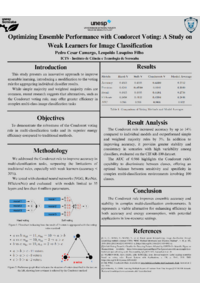
Classical networks such as VGG, ResNet, EfficientNet, and other CNNs were employed. Condorcet rule was compared against traditional simple and weighted majority rules. The CIFAR-100 dataset was used for a balanced and comprehensive evaluation of the models' performance. The models were limited to 35 layers, with average accuracy across individual models being no more than 28% (random guessing yields 1% accuracy in a 100-class setup).
Results:
The ensemble model using the Condorcet rule showed a minimum of 4% accuracy improvement compared to simple and weighted majority rules, and over 15% improvement relative to the average accuracy of individual models.
Conclusions:
This study suggests that alternative voting rules, such as the Condorcet, can improve the performance of ensemble in image classification without domain-specific knowledge, and without altering the energy spent or training time of individual classifiers. Further study on even weaker learners to optimize the balance between energy consumption and accuracy is promising for the field.
Keywords
Condorcet Voting Rule
Ensemble Learning
Weak Learners
Image Classification
Neural Networks
Voting Aggregation
Classification Accuracy
Machine Learning
VGG
ResNet
EfficientNet
Majority Voting
Weighted Majority Voting
Performance Improvement
M
Poster
Texto do seu parágrafo (3).pdf
EFFECTS OF ALLOXAN MONOHYDRATE-INDUCED COGNITIVE DECLINE ASSOCIATED WITH DIABETES IN WISTAR RATS
Preliminary assessment of temperature as a relevant factor in the pyrolysis process, for the valorization of corn cob waste (Zea mays).