Event submissions
Published
This submission belongs to the session S1. Applied Biosciences and Bioengineering of the event The 5th International Electronic Conference on Applied Sciences
Published date
03 Dec, 2024
Academic Editor
'%3e%3cpath%20d='M12.6657%2010.9104C12.4185%2010.325%2012.0599%209.79327%2011.6097%209.34482C11.1609%208.89508%2010.6293%208.5365%2010.0442%208.28888C10.0389%208.28626%2010.0337%208.28495%2010.0285%208.28233C10.8446%207.69279%2011.3752%206.73249%2011.3752%205.64904C11.3752%203.8542%209.92103%202.39999%208.1262%202.39999C6.33136%202.39999%204.87715%203.8542%204.87715%205.64904C4.87715%206.73249%205.40774%207.69279%206.22393%208.28364C6.21869%208.28626%206.21345%208.28757%206.20821%208.29019C5.62129%208.5378%205.09463%208.89284%204.64265%209.34613C4.1929%209.79493%203.83432%2010.3266%203.58671%2010.9117C3.34345%2011.4845%203.21226%2012.0987%203.20023%2012.7209C3.19988%2012.7349%203.20233%2012.7488%203.20744%2012.7619C3.21255%2012.7749%203.22022%2012.7867%203.22998%2012.7968C3.23975%2012.8068%203.25142%2012.8147%203.26431%2012.8202C3.2772%2012.8256%203.29105%2012.8284%203.30504%2012.8284H4.09109C4.14874%2012.8284%204.19459%2012.7825%204.1959%2012.7262C4.2221%2011.7148%204.62823%2010.7676%205.34617%2010.0497C6.08899%209.30683%207.0755%208.89808%208.1262%208.89808C9.17689%208.89808%2010.1634%209.30683%2010.9062%2010.0497C11.6242%2010.7676%2012.0303%2011.7148%2012.0565%2012.7262C12.0578%2012.7838%2012.1037%2012.8284%2012.1613%2012.8284H12.9474C12.9613%2012.8284%2012.9752%2012.8256%2012.9881%2012.8202C13.001%2012.8147%2013.0126%2012.8068%2013.0224%2012.7968C13.0322%2012.7867%2013.0398%2012.7749%2013.0449%2012.7619C13.0501%2012.7488%2013.0525%2012.7349%2013.0522%2012.7209C13.0391%2012.0947%2012.9094%2011.4855%2012.6657%2010.9104ZM8.1262%207.9024C7.52486%207.9024%206.9589%207.6679%206.53312%207.24211C6.10733%206.81633%205.87283%206.25037%205.87283%205.64904C5.87283%205.0477%206.10733%204.48174%206.53312%204.05596C6.9589%203.63018%207.52486%203.39567%208.1262%203.39567C8.72753%203.39567%209.29349%203.63018%209.71927%204.05596C10.1451%204.48174%2010.3796%205.0477%2010.3796%205.64904C10.3796%206.25037%2010.1451%206.81633%209.71927%207.24211C9.29349%207.6679%208.72753%207.9024%208.1262%207.9024Z'%20fill='%235D1EE1'/%3e%3c/g%3e%3c/svg%3e) Paola Saccomandi
Paola SaccomandiCitation
Osama Zeidan, Omar Abusedera, Ahmed Aldhahbi, Ahmed Aboutable, Abdulla Albalooshi, Khaled Almannai, Bindhu Nair, The Role of Genetic Polymorphisms in Modulating Beta-Blocker Response: A Comprehensive Review, in Proceedings of The 5th International Electronic Conference on Applied Sciences, 4 December–6 December 2024, MDPI: Basel, Switzerland
Share
Email
Facebook
Twitter
LinkedIn
The Role of Genetic Polymorphisms in Modulating Beta-Blocker Response: A Comprehensive Review
'%3e%3cpath%20d='M12.6647%2010.9104C12.4176%2010.325%2012.0589%209.7933%2011.6088%209.34485C11.16%208.89511%2010.6283%208.53653%2010.0432%208.28891C10.038%208.28629%2010.0327%208.28498%2010.0275%208.28236C10.8437%207.69282%2011.3743%206.73252%2011.3743%205.64907C11.3743%203.85423%209.92005%202.40002%208.12522%202.40002C6.33038%202.40002%204.87618%203.85423%204.87618%205.64907C4.87618%206.73252%205.40677%207.69282%206.22296%208.28367C6.21772%208.28629%206.21248%208.2876%206.20724%208.29022C5.62031%208.53783%205.09365%208.89287%204.64167%209.34616C4.19192%209.79496%203.83334%2010.3266%203.58573%2010.9117C3.34247%2011.4846%203.21128%2012.0987%203.19925%2012.721C3.1989%2012.735%203.20135%2012.7489%203.20646%2012.7619C3.21157%2012.7749%203.21924%2012.7868%203.22901%2012.7968C3.23877%2012.8068%203.25045%2012.8148%203.26334%2012.8202C3.27623%2012.8256%203.29007%2012.8284%203.30406%2012.8284H4.09012C4.14776%2012.8284%204.19362%2012.7825%204.19493%2012.7262C4.22113%2011.7148%204.62726%2010.7676%205.34519%2010.0497C6.08802%209.30686%207.07452%208.89811%208.12522%208.89811C9.17592%208.89811%2010.1624%209.30686%2010.9052%2010.0497C11.6232%2010.7676%2012.0293%2011.7148%2012.0555%2012.7262C12.0568%2012.7839%2012.1027%2012.8284%2012.1603%2012.8284H12.9464C12.9604%2012.8284%2012.9742%2012.8256%2012.9871%2012.8202C13%2012.8148%2013.0117%2012.8068%2013.0214%2012.7968C13.0312%2012.7868%2013.0389%2012.7749%2013.044%2012.7619C13.0491%2012.7489%2013.0515%2012.735%2013.0512%2012.721C13.0381%2012.0947%2012.9084%2011.4856%2012.6647%2010.9104ZM8.12522%207.90243C7.52388%207.90243%206.95792%207.66793%206.53214%207.24215C6.10636%206.81636%205.87185%206.2504%205.87185%205.64907C5.87185%205.04773%206.10636%204.48177%206.53214%204.05599C6.95792%203.63021%207.52388%203.3957%208.12522%203.3957C8.72655%203.3957%209.29252%203.63021%209.7183%204.05599C10.1441%204.48177%2010.3786%205.04773%2010.3786%205.64907C10.3786%206.2504%2010.1441%206.81636%209.7183%207.24215C9.29252%207.66793%208.72655%207.90243%208.12522%207.90243Z'%20fill='%235D1EE1'/%3e%3c/g%3e%3c/svg%3e)
Osama Zeidan 1
Omar Abusedera 2
Ahmed Aldhahbi 2
Ahmed Aboutable 2
Abdulla Albalooshi 2
Khaled Almannai 2
Bindhu Nair 2
1. Materials for Medicine Research Group, School of Medicine, Royal College of Surgeons in Ireland, Medical University of Bahrain, Kingdom of Bahrain
2. Royal College of Surgeons in Ireland - Bahrain, Bahrain
Abstract
Introduction: Genetic variation significantly influences individual responses to beta-blockers, a class of medications commonly used to manage cardiovascular conditions such as hypertension and heart failure. Understanding these genetic differences is crucial for optimizing treatment efficacy and minimizing adverse effects.
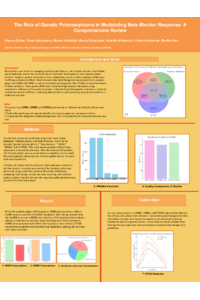
Methods: We conducted a systematic review using three online databases: PubMed, Scopus, and Web of Science. The search strategy included terms such as "genetic polymorphisms," "beta-blockers," "ADRB1," "ADRB2," and "CYP2D6." After removing duplicates, we screened 921 titles and abstracts for relevance. Full-text articles of 111 studies were assessed for eligibility based on the inclusion criteria, which required studies to report on genetic polymorphisms affecting beta-blocker response in human subjects. A quality assessment was performed using a modified Cochrane RoB1 tool, evaluating aspects such as study design, sample size, and statistical analysis.
Results: Out of the 111 full-text articles assessed, 95 studies met the inclusion criteria and were included in the final analysis. Of these, 16 studies were excluded due to poor quality or insufficient data. The 95 included studies provided comprehensive baseline data on the pharmacogenomics of beta-blockers. Key findings indicated that polymorphisms in the ADRB1 gene, particularly the Ser49Gly and Arg389Gly variants, significantly affected the therapeutic response to beta-blockers in hypertensive patients. Variants in the ADRB2 gene, such as Gly16Arg and Gln27Glu, were associated with differential responses in heart failure patients. Furthermore, CYP2D6 polymorphisms influenced the metabolism of beta-blockers, affecting drug plasma levels and clinical outcomes.
Conclusions: Our findings underscore the importance of genetic testing in the personalized prescription of beta-blockers. Genetic variations in ADRB1, ADRB2, and CYP2D6 genes were particularly influential, affecting drug efficacy and safety profiles. Incorporating pharmacogenomic data into clinical guidelines can enhance therapeutic outcomes for patients receiving beta-blockers by tailoring treatments based on individual genetic profiles.
Keywords
Genetic mutation
genetic variation
genetic polymorphisms
beta-blockers
cardiovascular pharmacology
pharmacogenomics
ADRB1
ADRB2
CYP2D6
hypertension
heart failure.
Poster
sciforum-104352.pdf
NIR photothermal immunotherapy of melanoma
Exploiting the SuperPred Tool for the Target Deconvolution of Novel Bioactivities of Drug-Like Secondary Metabolites from Aglaia Species