Event submissions
Published
This submission belongs to the session S1. Applied Biosciences and Bioengineering of the event The 5th International Electronic Conference on Applied Sciences
Published date
03 Dec, 2024
Academic Editor
'%3e%3cpath%20d='M12.6657%2010.9104C12.4185%2010.325%2012.0599%209.79327%2011.6097%209.34482C11.1609%208.89508%2010.6293%208.5365%2010.0442%208.28888C10.0389%208.28626%2010.0337%208.28495%2010.0285%208.28233C10.8446%207.69279%2011.3752%206.73249%2011.3752%205.64904C11.3752%203.8542%209.92103%202.39999%208.1262%202.39999C6.33136%202.39999%204.87715%203.8542%204.87715%205.64904C4.87715%206.73249%205.40774%207.69279%206.22393%208.28364C6.21869%208.28626%206.21345%208.28757%206.20821%208.29019C5.62129%208.5378%205.09463%208.89284%204.64265%209.34613C4.1929%209.79493%203.83432%2010.3266%203.58671%2010.9117C3.34345%2011.4845%203.21226%2012.0987%203.20023%2012.7209C3.19988%2012.7349%203.20233%2012.7488%203.20744%2012.7619C3.21255%2012.7749%203.22022%2012.7867%203.22998%2012.7968C3.23975%2012.8068%203.25142%2012.8147%203.26431%2012.8202C3.2772%2012.8256%203.29105%2012.8284%203.30504%2012.8284H4.09109C4.14874%2012.8284%204.19459%2012.7825%204.1959%2012.7262C4.2221%2011.7148%204.62823%2010.7676%205.34617%2010.0497C6.08899%209.30683%207.0755%208.89808%208.1262%208.89808C9.17689%208.89808%2010.1634%209.30683%2010.9062%2010.0497C11.6242%2010.7676%2012.0303%2011.7148%2012.0565%2012.7262C12.0578%2012.7838%2012.1037%2012.8284%2012.1613%2012.8284H12.9474C12.9613%2012.8284%2012.9752%2012.8256%2012.9881%2012.8202C13.001%2012.8147%2013.0126%2012.8068%2013.0224%2012.7968C13.0322%2012.7867%2013.0398%2012.7749%2013.0449%2012.7619C13.0501%2012.7488%2013.0525%2012.7349%2013.0522%2012.7209C13.0391%2012.0947%2012.9094%2011.4855%2012.6657%2010.9104ZM8.1262%207.9024C7.52486%207.9024%206.9589%207.6679%206.53312%207.24211C6.10733%206.81633%205.87283%206.25037%205.87283%205.64904C5.87283%205.0477%206.10733%204.48174%206.53312%204.05596C6.9589%203.63018%207.52486%203.39567%208.1262%203.39567C8.72753%203.39567%209.29349%203.63018%209.71927%204.05596C10.1451%204.48174%2010.3796%205.0477%2010.3796%205.64904C10.3796%206.25037%2010.1451%206.81633%209.71927%207.24211C9.29349%207.6679%208.72753%207.9024%208.1262%207.9024Z'%20fill='%235D1EE1'/%3e%3c/g%3e%3c/svg%3e) Paola Saccomandi
Paola SaccomandiCitation
Blessing N. Ugwu, Onyebuchi O. Offor, Blessing C. Eze, Chiamaka P. Onu, Chinonso M. Ugwu, Christian L. Iheanacho, Ebere P. Asogwa, Chigozirim E. Anyaku, Nwabueze E. Umerah, Ebubechukwu C. Ani, Emmanuel A. Kevin, Obinna K. Didigwu, Charles O. Nnadi, Wilfred O. Obonga, Exploiting the SuperPred Tool for the Target Deconvolution of Novel Bioactivities of Drug-Like Secondary Metabolites from Aglaia Species, in Proceedings of The 5th International Electronic Conference on Applied Sciences, 4 December–6 December 2024, MDPI: Basel, Switzerland
Share
Email
Facebook
Twitter
LinkedIn
Exploiting the SuperPred Tool for the Target Deconvolution of Novel Bioactivities of Drug-Like Secondary Metabolites from Aglaia Species
'%3e%3cpath%20d='M12.6647%2010.9104C12.4176%2010.325%2012.0589%209.7933%2011.6088%209.34485C11.16%208.89511%2010.6283%208.53653%2010.0432%208.28891C10.038%208.28629%2010.0327%208.28498%2010.0275%208.28236C10.8437%207.69282%2011.3743%206.73252%2011.3743%205.64907C11.3743%203.85423%209.92005%202.40002%208.12522%202.40002C6.33038%202.40002%204.87618%203.85423%204.87618%205.64907C4.87618%206.73252%205.40677%207.69282%206.22296%208.28367C6.21772%208.28629%206.21248%208.2876%206.20724%208.29022C5.62031%208.53783%205.09365%208.89287%204.64167%209.34616C4.19192%209.79496%203.83334%2010.3266%203.58573%2010.9117C3.34247%2011.4846%203.21128%2012.0987%203.19925%2012.721C3.1989%2012.735%203.20135%2012.7489%203.20646%2012.7619C3.21157%2012.7749%203.21924%2012.7868%203.22901%2012.7968C3.23877%2012.8068%203.25045%2012.8148%203.26334%2012.8202C3.27623%2012.8256%203.29007%2012.8284%203.30406%2012.8284H4.09012C4.14776%2012.8284%204.19362%2012.7825%204.19493%2012.7262C4.22113%2011.7148%204.62726%2010.7676%205.34519%2010.0497C6.08802%209.30686%207.07452%208.89811%208.12522%208.89811C9.17592%208.89811%2010.1624%209.30686%2010.9052%2010.0497C11.6232%2010.7676%2012.0293%2011.7148%2012.0555%2012.7262C12.0568%2012.7839%2012.1027%2012.8284%2012.1603%2012.8284H12.9464C12.9604%2012.8284%2012.9742%2012.8256%2012.9871%2012.8202C13%2012.8148%2013.0117%2012.8068%2013.0214%2012.7968C13.0312%2012.7868%2013.0389%2012.7749%2013.044%2012.7619C13.0491%2012.7489%2013.0515%2012.735%2013.0512%2012.721C13.0381%2012.0947%2012.9084%2011.4856%2012.6647%2010.9104ZM8.12522%207.90243C7.52388%207.90243%206.95792%207.66793%206.53214%207.24215C6.10636%206.81636%205.87185%206.2504%205.87185%205.64907C5.87185%205.04773%206.10636%204.48177%206.53214%204.05599C6.95792%203.63021%207.52388%203.3957%208.12522%203.3957C8.72655%203.3957%209.29252%203.63021%209.7183%204.05599C10.1441%204.48177%2010.3786%205.04773%2010.3786%205.64907C10.3786%206.2504%2010.1441%206.81636%209.7183%207.24215C9.29252%207.66793%208.72655%207.90243%208.12522%207.90243Z'%20fill='%235D1EE1'/%3e%3c/g%3e%3c/svg%3e)
Blessing N. Ugwu 1
Onyebuchi O. Offor 1
Blessing C. Eze 1
Chiamaka P. Onu 1
Chinonso M. Ugwu 1
Christian L. Iheanacho 1
Ebere P. Asogwa 1
Chigozirim E. Anyaku 1
Nwabueze E. Umerah 1
Ebubechukwu C. Ani 1
Emmanuel A. Kevin 1
Obinna K. Didigwu 1

Charles O. Nnadi 1
Wilfred O. Obonga 1
1. Department of Pharmaceutical and Medicinal Chemistry, Faculty of Pharmaceutical Sciences, University of Nigeria Nsukka, 410001 Enugu State, Nigeria
Abstract
Several alkaloids, terpenoids, limonoids, steroids, lignans and flavaglines have been isolated from the genus Aglaia. A significant number of them have not been tested for any biological activities, while those already screened for activities may have limited phenotypic targets, are under-utilized or may require validation. This study exploited the SuperPred tool for prospective and retrospective drug target fishing for novel bioactivities of drug-like molecules derived from Aglaia species. A total of 291 secondary metabolites were obtained from a review of the literature. The simplified molecular input line entry system (SMILES) canonical strings were subjected to drug-likeness prediction using the SwissADME tool. The anatomical therapeutic chemical class and potential targets of the compounds were deconvoluted by SuperPred logistic regression machine learning models, based on Morgan fingerprints with a length of 2048 and with a probability and model accuracy cut-off of ≥90%. Of the 291 secondary metabolites, 25 displayed the most favourable pharmacokinetic, physicochemical and toxicological properties. The 25 drug-like compounds comprised a lignan (lariciresinol acetate), a triterpenoid (17,24-epoxy-20α,25-dihydroxy-21-norbaccharan-3-one), three flavaglines (pyrimidinone, dihydropyrimidinone and rocagloic acid) and steroids ((E)-aglawone, 2β,3β,4α-trihydroxypregnan-16-one and androst-1,4-dien-3,17-dione), five sesquiterpenoids and twelve alkaloids. The compounds were found to interact with many targets, such as the NF-κB p105 subunit, cannabinoid CB2 receptor, MAP kinase ERK2, hypoxia-inducible factor 1α, G-protein coupled receptor 55, tyrosyl-DNA phosphodiesterase 1, p53-binding protein Mdm-2, cathepsin D, COX-1 and arachidonate 12-lipoxygenase. The target fishing of the secondary metabolites provided insights into the potential novel activities, polypharmacology and possible unintended off-target binding of Aglaia molecules.
Keywords
Secondary Metabolites
targets
prediction
drug-likeness
Aglaia
Poster
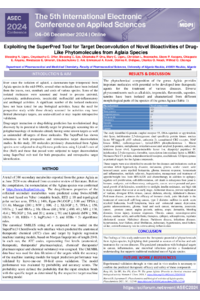
ASEC 2024.pdf
The Role of Genetic Polymorphisms in Modulating Beta-Blocker Response: A Comprehensive Review
A Single-Dose Treatment of Alstonia boonei Stem Bark Extract Elicits Anti-inflammatory Effect in vivo