Event submissions
Published
This submission belongs to the session S1. Applied Biosciences and Bioengineering of the event The 5th International Electronic Conference on Applied Sciences
Published date
03 Dec, 2024
Academic Editor
'%3e%3cpath%20d='M12.6657%2010.9104C12.4185%2010.325%2012.0599%209.79327%2011.6097%209.34482C11.1609%208.89508%2010.6293%208.5365%2010.0442%208.28888C10.0389%208.28626%2010.0337%208.28495%2010.0285%208.28233C10.8446%207.69279%2011.3752%206.73249%2011.3752%205.64904C11.3752%203.8542%209.92103%202.39999%208.1262%202.39999C6.33136%202.39999%204.87715%203.8542%204.87715%205.64904C4.87715%206.73249%205.40774%207.69279%206.22393%208.28364C6.21869%208.28626%206.21345%208.28757%206.20821%208.29019C5.62129%208.5378%205.09463%208.89284%204.64265%209.34613C4.1929%209.79493%203.83432%2010.3266%203.58671%2010.9117C3.34345%2011.4845%203.21226%2012.0987%203.20023%2012.7209C3.19988%2012.7349%203.20233%2012.7488%203.20744%2012.7619C3.21255%2012.7749%203.22022%2012.7867%203.22998%2012.7968C3.23975%2012.8068%203.25142%2012.8147%203.26431%2012.8202C3.2772%2012.8256%203.29105%2012.8284%203.30504%2012.8284H4.09109C4.14874%2012.8284%204.19459%2012.7825%204.1959%2012.7262C4.2221%2011.7148%204.62823%2010.7676%205.34617%2010.0497C6.08899%209.30683%207.0755%208.89808%208.1262%208.89808C9.17689%208.89808%2010.1634%209.30683%2010.9062%2010.0497C11.6242%2010.7676%2012.0303%2011.7148%2012.0565%2012.7262C12.0578%2012.7838%2012.1037%2012.8284%2012.1613%2012.8284H12.9474C12.9613%2012.8284%2012.9752%2012.8256%2012.9881%2012.8202C13.001%2012.8147%2013.0126%2012.8068%2013.0224%2012.7968C13.0322%2012.7867%2013.0398%2012.7749%2013.0449%2012.7619C13.0501%2012.7488%2013.0525%2012.7349%2013.0522%2012.7209C13.0391%2012.0947%2012.9094%2011.4855%2012.6657%2010.9104ZM8.1262%207.9024C7.52486%207.9024%206.9589%207.6679%206.53312%207.24211C6.10733%206.81633%205.87283%206.25037%205.87283%205.64904C5.87283%205.0477%206.10733%204.48174%206.53312%204.05596C6.9589%203.63018%207.52486%203.39567%208.1262%203.39567C8.72753%203.39567%209.29349%203.63018%209.71927%204.05596C10.1451%204.48174%2010.3796%205.0477%2010.3796%205.64904C10.3796%206.25037%2010.1451%206.81633%209.71927%207.24211C9.29349%207.6679%208.72753%207.9024%208.1262%207.9024Z'%20fill='%235D1EE1'/%3e%3c/g%3e%3c/svg%3e) Takahito Ohshiro
Takahito OhshiroCitation
Polina Olegovna Levshukova, Denis Andreevich Kolesnik, Igor Pavlovich Yakovlev, Gleb Valentinovich Kondratiev, Elena Vladimirovna Kuvaeva, Egor Vyacheslavovich Morozov, Study of the antimicrobial activity of new 1,3,5-triazine derivatives, in Proceedings of The 5th International Electronic Conference on Applied Sciences, 4 December–6 December 2024, MDPI: Basel, Switzerland
Share
Email
Facebook
Twitter
LinkedIn
Study of the antimicrobial activity of new 1,3,5-triazine derivatives
'%3e%3cpath%20d='M12.6647%2010.9104C12.4176%2010.325%2012.0589%209.7933%2011.6088%209.34485C11.16%208.89511%2010.6283%208.53653%2010.0432%208.28891C10.038%208.28629%2010.0327%208.28498%2010.0275%208.28236C10.8437%207.69282%2011.3743%206.73252%2011.3743%205.64907C11.3743%203.85423%209.92005%202.40002%208.12522%202.40002C6.33038%202.40002%204.87618%203.85423%204.87618%205.64907C4.87618%206.73252%205.40677%207.69282%206.22296%208.28367C6.21772%208.28629%206.21248%208.2876%206.20724%208.29022C5.62031%208.53783%205.09365%208.89287%204.64167%209.34616C4.19192%209.79496%203.83334%2010.3266%203.58573%2010.9117C3.34247%2011.4846%203.21128%2012.0987%203.19925%2012.721C3.1989%2012.735%203.20135%2012.7489%203.20646%2012.7619C3.21157%2012.7749%203.21924%2012.7868%203.22901%2012.7968C3.23877%2012.8068%203.25045%2012.8148%203.26334%2012.8202C3.27623%2012.8256%203.29007%2012.8284%203.30406%2012.8284H4.09012C4.14776%2012.8284%204.19362%2012.7825%204.19493%2012.7262C4.22113%2011.7148%204.62726%2010.7676%205.34519%2010.0497C6.08802%209.30686%207.07452%208.89811%208.12522%208.89811C9.17592%208.89811%2010.1624%209.30686%2010.9052%2010.0497C11.6232%2010.7676%2012.0293%2011.7148%2012.0555%2012.7262C12.0568%2012.7839%2012.1027%2012.8284%2012.1603%2012.8284H12.9464C12.9604%2012.8284%2012.9742%2012.8256%2012.9871%2012.8202C13%2012.8148%2013.0117%2012.8068%2013.0214%2012.7968C13.0312%2012.7868%2013.0389%2012.7749%2013.044%2012.7619C13.0491%2012.7489%2013.0515%2012.735%2013.0512%2012.721C13.0381%2012.0947%2012.9084%2011.4856%2012.6647%2010.9104ZM8.12522%207.90243C7.52388%207.90243%206.95792%207.66793%206.53214%207.24215C6.10636%206.81636%205.87185%206.2504%205.87185%205.64907C5.87185%205.04773%206.10636%204.48177%206.53214%204.05599C6.95792%203.63021%207.52388%203.3957%208.12522%203.3957C8.72655%203.3957%209.29252%203.63021%209.7183%204.05599C10.1441%204.48177%2010.3786%205.04773%2010.3786%205.64907C10.3786%206.2504%2010.1441%206.81636%209.7183%207.24215C9.29252%207.66793%208.72655%207.90243%208.12522%207.90243Z'%20fill='%235D1EE1'/%3e%3c/g%3e%3c/svg%3e)
Polina Olegovna Levshukova 1
Denis Andreevich Kolesnik 1
Igor Pavlovich Yakovlev 1
Gleb Valentinovich Kondratiev 2
Elena Vladimirovna Kuvaeva 1
Egor Vyacheslavovich Morozov 1
1. State Federal-Funded Educational Institution of Higher Education «Saint Petersburg State Chemical and Pharmaceutical University of the Ministry of Healthcare of the Russian Federation», Department of Organic Chemistry
2. Federal State Budgetary Educational Institution of Higher Education St. Petersburg State Pediatric Medical University of the Ministry of Health of Russia, Department of Oncology, Pediatric Oncology and Radiation Therapy
Abstract
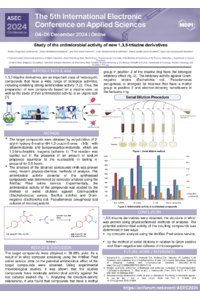
Introduction: 1,3,5-triazine derivatives are an important class of heterocyclic compounds that have a wide range of biological activities, including exhibiting strong antimicrobial activity. Thus, the preparation of new compounds based on a triazine core, as well as the study of their antimicrobial activity, is an urgent task. Methods: The target compounds were obtained by the recyclization of 2-aryl-4-hydroxy-5-methyl-6H-1,3-oxazin-6-ones (1-3) with ethanimidamide and benzenecarboximidamide, which are 1,3-binucleophilic reagents. The reaction was carried out in the presence of an amount of sodium propoxide equimolar to the nucleophile in boiling n-propanol for 2-5 hours. The structure of the obtained compounds (4-9) was proven using modern physico-chemical methods of analysis: 1H and 13C NMR spectroscopy, IR spectroscopy, and mass spectrometry. The antimicrobial activity potential of the synthesized compounds was determined by computer analysis using the AntiBac Pred online service. Experimentally, the antimicrobial activity of the compounds was studied by the method of serial dilutions against Gram-positive (Staphylococcus aureus, Bacillus subtilis) and Gram-negative (Escherichia coli, Pseudomonas aeruginosa) test cultures of microorganisms. Results and conclusions: The target compounds were obtained in 58-88% yield. As a result of in silico computer screening using the AntiBac Pred online service, data on the potential antimicrobial effect of the target compounds were obtained. Using experimental microbiological studies, it was shown that the studied compounds have moderate antimicrobial activity against the test cultures studied. Analyzing the structure–activity relationship, it was found that compounds that have a methyl group in position 2 of the triazine ring have the strongest inhibitory effect. The inhibitory activity against Gram-negative strains (Escherichia coli, Pseudomonas aeruginosa) is strongest for triazines that have a methyl group in position 2 and electron-donating substituents in the benzene ring.
Keywords
1,3,5-triazines
antimicrobial activity
AntiBac Pred
structure-activity relationship
Poster
LevshukovaPO et al.pdf
Affective Temperaments and Depressive Rumination in an Italian–Spanish sample with bruxism
Polymeric matrices for target delivery of mangiferin