Event submissions
Published
This submission belongs to the session S4. Electrical, Electronics and Communications Engineering of the event The 5th International Electronic Conference on Applied Sciences
Published date
03 Dec, 2024
Academic Editor
'%3e%3cpath%20d='M12.6657%2010.9104C12.4185%2010.325%2012.0599%209.79327%2011.6097%209.34482C11.1609%208.89508%2010.6293%208.5365%2010.0442%208.28888C10.0389%208.28626%2010.0337%208.28495%2010.0285%208.28233C10.8446%207.69279%2011.3752%206.73249%2011.3752%205.64904C11.3752%203.8542%209.92103%202.39999%208.1262%202.39999C6.33136%202.39999%204.87715%203.8542%204.87715%205.64904C4.87715%206.73249%205.40774%207.69279%206.22393%208.28364C6.21869%208.28626%206.21345%208.28757%206.20821%208.29019C5.62129%208.5378%205.09463%208.89284%204.64265%209.34613C4.1929%209.79493%203.83432%2010.3266%203.58671%2010.9117C3.34345%2011.4845%203.21226%2012.0987%203.20023%2012.7209C3.19988%2012.7349%203.20233%2012.7488%203.20744%2012.7619C3.21255%2012.7749%203.22022%2012.7867%203.22998%2012.7968C3.23975%2012.8068%203.25142%2012.8147%203.26431%2012.8202C3.2772%2012.8256%203.29105%2012.8284%203.30504%2012.8284H4.09109C4.14874%2012.8284%204.19459%2012.7825%204.1959%2012.7262C4.2221%2011.7148%204.62823%2010.7676%205.34617%2010.0497C6.08899%209.30683%207.0755%208.89808%208.1262%208.89808C9.17689%208.89808%2010.1634%209.30683%2010.9062%2010.0497C11.6242%2010.7676%2012.0303%2011.7148%2012.0565%2012.7262C12.0578%2012.7838%2012.1037%2012.8284%2012.1613%2012.8284H12.9474C12.9613%2012.8284%2012.9752%2012.8256%2012.9881%2012.8202C13.001%2012.8147%2013.0126%2012.8068%2013.0224%2012.7968C13.0322%2012.7867%2013.0398%2012.7749%2013.0449%2012.7619C13.0501%2012.7488%2013.0525%2012.7349%2013.0522%2012.7209C13.0391%2012.0947%2012.9094%2011.4855%2012.6657%2010.9104ZM8.1262%207.9024C7.52486%207.9024%206.9589%207.6679%206.53312%207.24211C6.10733%206.81633%205.87283%206.25037%205.87283%205.64904C5.87283%205.0477%206.10733%204.48174%206.53312%204.05596C6.9589%203.63018%207.52486%203.39567%208.1262%203.39567C8.72753%203.39567%209.29349%203.63018%209.71927%204.05596C10.1451%204.48174%2010.3796%205.0477%2010.3796%205.64904C10.3796%206.25037%2010.1451%206.81633%209.71927%207.24211C9.29349%207.6679%208.72753%207.9024%208.1262%207.9024Z'%20fill='%235D1EE1'/%3e%3c/g%3e%3c/svg%3e) Stefania Campopiano
Stefania CampopianoCitation
Oussama Lahmar, Latifa Abdou, Imam Barket Ghiloubi, Abdelhakim Drid, Robustness Analysis of LQR-PID Controller Based on Particle Swarm Optimization and Grey Wolf Optimization for Quadcopter Attitude Stabilization, in Proceedings of The 5th International Electronic Conference on Applied Sciences, 4 December–6 December 2024, MDPI: Basel, Switzerland
Share
Email
Facebook
Twitter
LinkedIn
Robustness Analysis of LQR-PID Controller Based on Particle Swarm Optimization and Grey Wolf Optimization for Quadcopter Attitude Stabilization
'%3e%3cpath%20d='M12.6647%2010.9104C12.4176%2010.325%2012.0589%209.7933%2011.6088%209.34485C11.16%208.89511%2010.6283%208.53653%2010.0432%208.28891C10.038%208.28629%2010.0327%208.28498%2010.0275%208.28236C10.8437%207.69282%2011.3743%206.73252%2011.3743%205.64907C11.3743%203.85423%209.92005%202.40002%208.12522%202.40002C6.33038%202.40002%204.87618%203.85423%204.87618%205.64907C4.87618%206.73252%205.40677%207.69282%206.22296%208.28367C6.21772%208.28629%206.21248%208.2876%206.20724%208.29022C5.62031%208.53783%205.09365%208.89287%204.64167%209.34616C4.19192%209.79496%203.83334%2010.3266%203.58573%2010.9117C3.34247%2011.4846%203.21128%2012.0987%203.19925%2012.721C3.1989%2012.735%203.20135%2012.7489%203.20646%2012.7619C3.21157%2012.7749%203.21924%2012.7868%203.22901%2012.7968C3.23877%2012.8068%203.25045%2012.8148%203.26334%2012.8202C3.27623%2012.8256%203.29007%2012.8284%203.30406%2012.8284H4.09012C4.14776%2012.8284%204.19362%2012.7825%204.19493%2012.7262C4.22113%2011.7148%204.62726%2010.7676%205.34519%2010.0497C6.08802%209.30686%207.07452%208.89811%208.12522%208.89811C9.17592%208.89811%2010.1624%209.30686%2010.9052%2010.0497C11.6232%2010.7676%2012.0293%2011.7148%2012.0555%2012.7262C12.0568%2012.7839%2012.1027%2012.8284%2012.1603%2012.8284H12.9464C12.9604%2012.8284%2012.9742%2012.8256%2012.9871%2012.8202C13%2012.8148%2013.0117%2012.8068%2013.0214%2012.7968C13.0312%2012.7868%2013.0389%2012.7749%2013.044%2012.7619C13.0491%2012.7489%2013.0515%2012.735%2013.0512%2012.721C13.0381%2012.0947%2012.9084%2011.4856%2012.6647%2010.9104ZM8.12522%207.90243C7.52388%207.90243%206.95792%207.66793%206.53214%207.24215C6.10636%206.81636%205.87185%206.2504%205.87185%205.64907C5.87185%205.04773%206.10636%204.48177%206.53214%204.05599C6.95792%203.63021%207.52388%203.3957%208.12522%203.3957C8.72655%203.3957%209.29252%203.63021%209.7183%204.05599C10.1441%204.48177%2010.3786%205.04773%2010.3786%205.64907C10.3786%206.2504%2010.1441%206.81636%209.7183%207.24215C9.29252%207.66793%208.72655%207.90243%208.12522%207.90243Z'%20fill='%235D1EE1'/%3e%3c/g%3e%3c/svg%3e)
Oussama Lahmar 1
Latifa Abdou 1
Imam Barket Ghiloubi 1
Abdelhakim Drid 1
1. Identification, Command, Control and Communication (LI3CUB) laboratory - Mohamed Khider university of Biskra - Algeria
Abstract
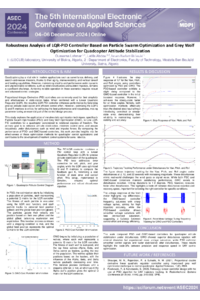
The robust control of quadcopters is crucial for maintaining stability and performance in dynamic and unpredictable environments. This paper investigates the effectiveness of two optimization techniques, Particle Swarm Optimization (PSO) and Grey Wolf Optimization (GWO), for tuning LQR-PID controllers specifically designed for a constrained quadcopter limited to rotational degrees of freedom. The objective is to enhance attitude stabilization and perform a comparative robustness analysis of these optimized controllers under various disturbance conditions.
LQR-PID controllers are designed for the quadcopter model using PSO and GWO to optimize the Q and R matrices of the LQR controller. Both algorithms aim to minimize a cost function based on the quadcopter’s attitude error and control effort. The optimized controllers are tested in a Simulink environment where disturbances such as wind, initial condition perturbations, and sudden impulse disturbances are introduced. Wind disturbances represent varying external forces, initial condition perturbations simulate small deviations from the expected starting state, and sudden impulse disturbances model unexpected sharp forces. These disturbance types were selected to reflect real-world operational challenges faced by quadcopters and are introduced by perturbing the feedback vector of the quadcopter’s control system.
The comparative analysis shows that while both PSO- and GWO-optimized controllers achieve effective attitude stabilization, they display different robustness characteristics. The PSO-optimized LQR-PID controller demonstrates better performance in terms of faster convergence and higher sensitivity to disturbances, whereas the GWO-optimized controller excels under extreme parameter variations.
This study contributes to the current state of the art by providing a detailed comparison of PSO and GWO for LQR-PID tuning in quadcopter attitude control. The results offer valuable insights for selecting the most suitable optimization method based on specific performance and robustness criteria, ultimately aiding in the development of more resilient and reliable quadcopter control systems.
Keywords
Nonlinear Systems
Quadcopter
Robust Control
Optimization Algorithms.
Poster
MDPI_Oussama_Lahmar.pdf
AI-Driven Optimization of Hybrid Energy Systems: Integrating Wind Turbines, Batteries, and the Grid
Advanced quadrotor cooperation: PSO-enhanced backstepping and PID-based inter-distance control.