Event submissions
Published
This submission belongs to the session S6. Energy, Environmental and Earth Science of the event The 5th International Electronic Conference on Applied Sciences
Published date
03 Dec, 2024
Academic Editor
'%3e%3cpath%20d='M12.6657%2010.9104C12.4185%2010.325%2012.0599%209.79327%2011.6097%209.34482C11.1609%208.89508%2010.6293%208.5365%2010.0442%208.28888C10.0389%208.28626%2010.0337%208.28495%2010.0285%208.28233C10.8446%207.69279%2011.3752%206.73249%2011.3752%205.64904C11.3752%203.8542%209.92103%202.39999%208.1262%202.39999C6.33136%202.39999%204.87715%203.8542%204.87715%205.64904C4.87715%206.73249%205.40774%207.69279%206.22393%208.28364C6.21869%208.28626%206.21345%208.28757%206.20821%208.29019C5.62129%208.5378%205.09463%208.89284%204.64265%209.34613C4.1929%209.79493%203.83432%2010.3266%203.58671%2010.9117C3.34345%2011.4845%203.21226%2012.0987%203.20023%2012.7209C3.19988%2012.7349%203.20233%2012.7488%203.20744%2012.7619C3.21255%2012.7749%203.22022%2012.7867%203.22998%2012.7968C3.23975%2012.8068%203.25142%2012.8147%203.26431%2012.8202C3.2772%2012.8256%203.29105%2012.8284%203.30504%2012.8284H4.09109C4.14874%2012.8284%204.19459%2012.7825%204.1959%2012.7262C4.2221%2011.7148%204.62823%2010.7676%205.34617%2010.0497C6.08899%209.30683%207.0755%208.89808%208.1262%208.89808C9.17689%208.89808%2010.1634%209.30683%2010.9062%2010.0497C11.6242%2010.7676%2012.0303%2011.7148%2012.0565%2012.7262C12.0578%2012.7838%2012.1037%2012.8284%2012.1613%2012.8284H12.9474C12.9613%2012.8284%2012.9752%2012.8256%2012.9881%2012.8202C13.001%2012.8147%2013.0126%2012.8068%2013.0224%2012.7968C13.0322%2012.7867%2013.0398%2012.7749%2013.0449%2012.7619C13.0501%2012.7488%2013.0525%2012.7349%2013.0522%2012.7209C13.0391%2012.0947%2012.9094%2011.4855%2012.6657%2010.9104ZM8.1262%207.9024C7.52486%207.9024%206.9589%207.6679%206.53312%207.24211C6.10733%206.81633%205.87283%206.25037%205.87283%205.64904C5.87283%205.0477%206.10733%204.48174%206.53312%204.05596C6.9589%203.63018%207.52486%203.39567%208.1262%203.39567C8.72753%203.39567%209.29349%203.63018%209.71927%204.05596C10.1451%204.48174%2010.3796%205.0477%2010.3796%205.64904C10.3796%206.25037%2010.1451%206.81633%209.71927%207.24211C9.29349%207.6679%208.72753%207.9024%208.1262%207.9024Z'%20fill='%235D1EE1'/%3e%3c/g%3e%3c/svg%3e) Ning Li
Ning LiCitation
Brigite Marques, Miguel Oliveira, Carolina Frazão, Isabel Lopes, Comparative assessment of the toxicity of bisphenol A and its alternatives: an in vitro study, in Proceedings of The 5th International Electronic Conference on Applied Sciences, 4 December–6 December 2024, MDPI: Basel, Switzerland
Share
Email
Facebook
Twitter
LinkedIn
Comparative assessment of the toxicity of bisphenol A and its alternatives: an in vitro study
'%3e%3cpath%20d='M12.6647%2010.9104C12.4176%2010.325%2012.0589%209.7933%2011.6088%209.34485C11.16%208.89511%2010.6283%208.53653%2010.0432%208.28891C10.038%208.28629%2010.0327%208.28498%2010.0275%208.28236C10.8437%207.69282%2011.3743%206.73252%2011.3743%205.64907C11.3743%203.85423%209.92005%202.40002%208.12522%202.40002C6.33038%202.40002%204.87618%203.85423%204.87618%205.64907C4.87618%206.73252%205.40677%207.69282%206.22296%208.28367C6.21772%208.28629%206.21248%208.2876%206.20724%208.29022C5.62031%208.53783%205.09365%208.89287%204.64167%209.34616C4.19192%209.79496%203.83334%2010.3266%203.58573%2010.9117C3.34247%2011.4846%203.21128%2012.0987%203.19925%2012.721C3.1989%2012.735%203.20135%2012.7489%203.20646%2012.7619C3.21157%2012.7749%203.21924%2012.7868%203.22901%2012.7968C3.23877%2012.8068%203.25045%2012.8148%203.26334%2012.8202C3.27623%2012.8256%203.29007%2012.8284%203.30406%2012.8284H4.09012C4.14776%2012.8284%204.19362%2012.7825%204.19493%2012.7262C4.22113%2011.7148%204.62726%2010.7676%205.34519%2010.0497C6.08802%209.30686%207.07452%208.89811%208.12522%208.89811C9.17592%208.89811%2010.1624%209.30686%2010.9052%2010.0497C11.6232%2010.7676%2012.0293%2011.7148%2012.0555%2012.7262C12.0568%2012.7839%2012.1027%2012.8284%2012.1603%2012.8284H12.9464C12.9604%2012.8284%2012.9742%2012.8256%2012.9871%2012.8202C13%2012.8148%2013.0117%2012.8068%2013.0214%2012.7968C13.0312%2012.7868%2013.0389%2012.7749%2013.044%2012.7619C13.0491%2012.7489%2013.0515%2012.735%2013.0512%2012.721C13.0381%2012.0947%2012.9084%2011.4856%2012.6647%2010.9104ZM8.12522%207.90243C7.52388%207.90243%206.95792%207.66793%206.53214%207.24215C6.10636%206.81636%205.87185%206.2504%205.87185%205.64907C5.87185%205.04773%206.10636%204.48177%206.53214%204.05599C6.95792%203.63021%207.52388%203.3957%208.12522%203.3957C8.72655%203.3957%209.29252%203.63021%209.7183%204.05599C10.1441%204.48177%2010.3786%205.04773%2010.3786%205.64907C10.3786%206.2504%2010.1441%206.81636%209.7183%207.24215C9.29252%207.66793%208.72655%207.90243%208.12522%207.90243Z'%20fill='%235D1EE1'/%3e%3c/g%3e%3c/svg%3e)
Brigite Marques 1

Miguel Oliveira 2
Carolina Frazão 2

Isabel Lopes 2
1. Department of Biology, University of Aveiro, Aveiro, Portugal
2. CESAM - Centre for Environmental and Marine Studies, Departmant of Biology, University of Aveiro, Aveiro, Portugal
Abstract
Plastic additives comprise many substances that serve numerous purposes in the plastic industry, such as assisting in the moulding of plastics and improving optimal performance. One of the bisphenols, namely, bisphenol A (BPA), is a widely used additive in the plastic industry and is now restricted by the European Union due to its proved toxicity. This additive is being replaced by analogues such as bisphenol E (BPE) and bisphenol Z (BPZ). However, there is a need to better understand their potential toxic effects to validate if they constitute safer alternatives. Thus, this study aimed at making a comparative assessment of the cytotoxicity of BPA, BPE, and BPZ to amphibian cell lines (A6 and XTC-2 - cell lines of Xenopus laevis), as Amphibia is the class of vertebrates with the highest proportion of species threatened with extinction. The cell lines were exposed for 24 h, 48 h, and 72 h to eight concentrations of each bisphenol and cell viability was assessed through each time point. Overall, the median lethal concentrations (LC50) revealed that A6 cells are more sensitive to these chemicals than XTC-2. The obtained data support the premise that BPE and BPZ are less toxic to amphibian cell lines than BPA. Thus, based on the 72h LC50, the cytotoxicity can be ranked as BPA>BPZ>BPE (45.48 mg/L, 57.1 mg/L, and 64.7 mg/L, respectively) for XTC-2 cells. A similar trend was observed for A6 cells (24.6 mg/L, 32.1 mg/L, and 41.6 mg/L for BPA, BPZ, and BPE, respectively). Thus, the data support that these BPA alternatives appear less toxic, but more studies must be performed and other endpoints assessed to fully understand their highest environmental safety.
Keywords
Amphibian cell lines
Xenopus laevis
plastic additives
cytotoxicity
Poster
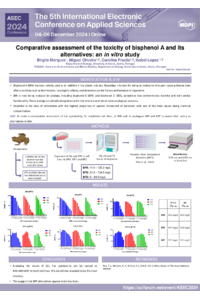
Poster_ASEC2024_Brigite_Marques.pdf
Ecotoxicity of a mixture of polyhydroxybutyrate (biological-based) and polymethylmethacrylate (petroleum-based) micro(nano)plastics: implications for the physiology and behavior of Danio rerio
Circularity assessment of municipal waste management scenarios using a MFA-LCA based approach: A case study in Brazil