Event submissions
Published
This submission belongs to the session S6. Energy, Environmental and Earth Science of the event The 5th International Electronic Conference on Applied Sciences
Published date
03 Dec, 2024
Academic Editor
'%3e%3cpath%20d='M12.6657%2010.9104C12.4185%2010.325%2012.0599%209.79327%2011.6097%209.34482C11.1609%208.89508%2010.6293%208.5365%2010.0442%208.28888C10.0389%208.28626%2010.0337%208.28495%2010.0285%208.28233C10.8446%207.69279%2011.3752%206.73249%2011.3752%205.64904C11.3752%203.8542%209.92103%202.39999%208.1262%202.39999C6.33136%202.39999%204.87715%203.8542%204.87715%205.64904C4.87715%206.73249%205.40774%207.69279%206.22393%208.28364C6.21869%208.28626%206.21345%208.28757%206.20821%208.29019C5.62129%208.5378%205.09463%208.89284%204.64265%209.34613C4.1929%209.79493%203.83432%2010.3266%203.58671%2010.9117C3.34345%2011.4845%203.21226%2012.0987%203.20023%2012.7209C3.19988%2012.7349%203.20233%2012.7488%203.20744%2012.7619C3.21255%2012.7749%203.22022%2012.7867%203.22998%2012.7968C3.23975%2012.8068%203.25142%2012.8147%203.26431%2012.8202C3.2772%2012.8256%203.29105%2012.8284%203.30504%2012.8284H4.09109C4.14874%2012.8284%204.19459%2012.7825%204.1959%2012.7262C4.2221%2011.7148%204.62823%2010.7676%205.34617%2010.0497C6.08899%209.30683%207.0755%208.89808%208.1262%208.89808C9.17689%208.89808%2010.1634%209.30683%2010.9062%2010.0497C11.6242%2010.7676%2012.0303%2011.7148%2012.0565%2012.7262C12.0578%2012.7838%2012.1037%2012.8284%2012.1613%2012.8284H12.9474C12.9613%2012.8284%2012.9752%2012.8256%2012.9881%2012.8202C13.001%2012.8147%2013.0126%2012.8068%2013.0224%2012.7968C13.0322%2012.7867%2013.0398%2012.7749%2013.0449%2012.7619C13.0501%2012.7488%2013.0525%2012.7349%2013.0522%2012.7209C13.0391%2012.0947%2012.9094%2011.4855%2012.6657%2010.9104ZM8.1262%207.9024C7.52486%207.9024%206.9589%207.6679%206.53312%207.24211C6.10733%206.81633%205.87283%206.25037%205.87283%205.64904C5.87283%205.0477%206.10733%204.48174%206.53312%204.05596C6.9589%203.63018%207.52486%203.39567%208.1262%203.39567C8.72753%203.39567%209.29349%203.63018%209.71927%204.05596C10.1451%204.48174%2010.3796%205.0477%2010.3796%205.64904C10.3796%206.25037%2010.1451%206.81633%209.71927%207.24211C9.29349%207.6679%208.72753%207.9024%208.1262%207.9024Z'%20fill='%235D1EE1'/%3e%3c/g%3e%3c/svg%3e) Grazia Leonzio
Grazia LeonzioCitation
Anna Tzamaria, Eleni Despina Chasapi, Maria Antonopoulou, Tetrabromobisphenol A (TBBPA): Ecotoxicity Assessment and Interactions with Low-Density Polyethylene Microplastics, in Proceedings of The 5th International Electronic Conference on Applied Sciences, 4 December–6 December 2024, MDPI: Basel, Switzerland
Share
Email
Facebook
Twitter
LinkedIn
Tetrabromobisphenol A (TBBPA): Ecotoxicity Assessment and Interactions with Low-Density Polyethylene Microplastics
'%3e%3cpath%20d='M12.6647%2010.9104C12.4176%2010.325%2012.0589%209.7933%2011.6088%209.34485C11.16%208.89511%2010.6283%208.53653%2010.0432%208.28891C10.038%208.28629%2010.0327%208.28498%2010.0275%208.28236C10.8437%207.69282%2011.3743%206.73252%2011.3743%205.64907C11.3743%203.85423%209.92005%202.40002%208.12522%202.40002C6.33038%202.40002%204.87618%203.85423%204.87618%205.64907C4.87618%206.73252%205.40677%207.69282%206.22296%208.28367C6.21772%208.28629%206.21248%208.2876%206.20724%208.29022C5.62031%208.53783%205.09365%208.89287%204.64167%209.34616C4.19192%209.79496%203.83334%2010.3266%203.58573%2010.9117C3.34247%2011.4846%203.21128%2012.0987%203.19925%2012.721C3.1989%2012.735%203.20135%2012.7489%203.20646%2012.7619C3.21157%2012.7749%203.21924%2012.7868%203.22901%2012.7968C3.23877%2012.8068%203.25045%2012.8148%203.26334%2012.8202C3.27623%2012.8256%203.29007%2012.8284%203.30406%2012.8284H4.09012C4.14776%2012.8284%204.19362%2012.7825%204.19493%2012.7262C4.22113%2011.7148%204.62726%2010.7676%205.34519%2010.0497C6.08802%209.30686%207.07452%208.89811%208.12522%208.89811C9.17592%208.89811%2010.1624%209.30686%2010.9052%2010.0497C11.6232%2010.7676%2012.0293%2011.7148%2012.0555%2012.7262C12.0568%2012.7839%2012.1027%2012.8284%2012.1603%2012.8284H12.9464C12.9604%2012.8284%2012.9742%2012.8256%2012.9871%2012.8202C13%2012.8148%2013.0117%2012.8068%2013.0214%2012.7968C13.0312%2012.7868%2013.0389%2012.7749%2013.044%2012.7619C13.0491%2012.7489%2013.0515%2012.735%2013.0512%2012.721C13.0381%2012.0947%2012.9084%2011.4856%2012.6647%2010.9104ZM8.12522%207.90243C7.52388%207.90243%206.95792%207.66793%206.53214%207.24215C6.10636%206.81636%205.87185%206.2504%205.87185%205.64907C5.87185%205.04773%206.10636%204.48177%206.53214%204.05599C6.95792%203.63021%207.52388%203.3957%208.12522%203.3957C8.72655%203.3957%209.29252%203.63021%209.7183%204.05599C10.1441%204.48177%2010.3786%205.04773%2010.3786%205.64907C10.3786%206.2504%2010.1441%206.81636%209.7183%207.24215C9.29252%207.66793%208.72655%207.90243%208.12522%207.90243Z'%20fill='%235D1EE1'/%3e%3c/g%3e%3c/svg%3e)
Anna Tzamaria 1
Eleni Despina Chasapi 1

Maria Antonopoulou 1
1. Department of Sustainable Agriculture, Seferi 2, Agrinio, GR30131, University of Patras, Greece
Abstract
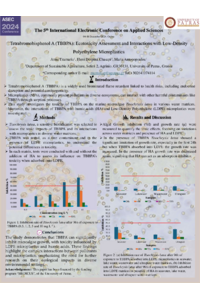
Tetrabromobisphenol A (TBBPA), a widely used brominated flame retardant, is prevalent in various environmental matrices due to its extensive use and release from plastic products. TBBPA exposure is linked to endocrine disruption, reproductive toxicity, and potential carcinogenicity. Microplastics (MPs), defined as plastic particles smaller than 5 mm, have become common persistent pollutants in marine, inland, and freshwater environments, including remote regions like the polar areas. Ionic strength and dissolved organic matter (DOM) can influence the sorption behavior of MPs, which due to their small size and large areas can significantly facilitate the transfer and accumulation of hydrophobic organic contaminants (HOCs) and heavy metals (HMs). Humic acid (HA), a mainly negatively charged natural organic matter, can interact with MPs, creating new sorption sites and potentially altering contaminant dynamics.
This study investigates the toxicity of TBBPA on the seawater microalgae Tisochrysis lutea. Additionally, the study evaluates the toxicity of TBBPA after adsorption onto LDPE MPs, both in the presence and absence of humic acid (HA) in four water matrices (seawater, lake water, wastewater and ultra-pure water), on Tisochrysis lutea.
The results showed significant inhibition of microalgae growth due to TBBPA exposure. The toxicity decreased in the presence of LDPE microplastics due to the potential adsorption of TBBPA onto the LDPE. In contrast, the presence of humic acid increased the toxicity of TBBPA, possibly by altering its sorption behavior on LDPE, making it more bioavailable. The findings aim to elucidate the complex interactions between MPs, TBBPA, and environmental factors, contributing to a better understanding of the ecological impact of these co-existing contaminants.
Keywords
Tetrabromobisphenol A
Plastic Pollution
Microplastics
Sorption
Humic acid
Poster
sciforum-103616.pdf
Evaluation of Internal and External Radiation Exposure Doses from Concrete Samples Using a Computer Code (RESRAD-Build)
Evaluation of ecotoxic effects of PFOS, PFOA, and their mixture on aquatic organisms