Event submissions
Published
This submission belongs to the session S2. Nanosciences, Chemistry and Materials Science of the event The 5th International Electronic Conference on Applied Sciences
Published date
04 Dec, 2024
Academic Editor
'%3e%3cpath%20d='M12.6657%2010.9104C12.4185%2010.325%2012.0599%209.79327%2011.6097%209.34482C11.1609%208.89508%2010.6293%208.5365%2010.0442%208.28888C10.0389%208.28626%2010.0337%208.28495%2010.0285%208.28233C10.8446%207.69279%2011.3752%206.73249%2011.3752%205.64904C11.3752%203.8542%209.92103%202.39999%208.1262%202.39999C6.33136%202.39999%204.87715%203.8542%204.87715%205.64904C4.87715%206.73249%205.40774%207.69279%206.22393%208.28364C6.21869%208.28626%206.21345%208.28757%206.20821%208.29019C5.62129%208.5378%205.09463%208.89284%204.64265%209.34613C4.1929%209.79493%203.83432%2010.3266%203.58671%2010.9117C3.34345%2011.4845%203.21226%2012.0987%203.20023%2012.7209C3.19988%2012.7349%203.20233%2012.7488%203.20744%2012.7619C3.21255%2012.7749%203.22022%2012.7867%203.22998%2012.7968C3.23975%2012.8068%203.25142%2012.8147%203.26431%2012.8202C3.2772%2012.8256%203.29105%2012.8284%203.30504%2012.8284H4.09109C4.14874%2012.8284%204.19459%2012.7825%204.1959%2012.7262C4.2221%2011.7148%204.62823%2010.7676%205.34617%2010.0497C6.08899%209.30683%207.0755%208.89808%208.1262%208.89808C9.17689%208.89808%2010.1634%209.30683%2010.9062%2010.0497C11.6242%2010.7676%2012.0303%2011.7148%2012.0565%2012.7262C12.0578%2012.7838%2012.1037%2012.8284%2012.1613%2012.8284H12.9474C12.9613%2012.8284%2012.9752%2012.8256%2012.9881%2012.8202C13.001%2012.8147%2013.0126%2012.8068%2013.0224%2012.7968C13.0322%2012.7867%2013.0398%2012.7749%2013.0449%2012.7619C13.0501%2012.7488%2013.0525%2012.7349%2013.0522%2012.7209C13.0391%2012.0947%2012.9094%2011.4855%2012.6657%2010.9104ZM8.1262%207.9024C7.52486%207.9024%206.9589%207.6679%206.53312%207.24211C6.10733%206.81633%205.87283%206.25037%205.87283%205.64904C5.87283%205.0477%206.10733%204.48174%206.53312%204.05596C6.9589%203.63018%207.52486%203.39567%208.1262%203.39567C8.72753%203.39567%209.29349%203.63018%209.71927%204.05596C10.1451%204.48174%2010.3796%205.0477%2010.3796%205.64904C10.3796%206.25037%2010.1451%206.81633%209.71927%207.24211C9.29349%207.6679%208.72753%207.9024%208.1262%207.9024Z'%20fill='%235D1EE1'/%3e%3c/g%3e%3c/svg%3e) Francesco Arcadio
Francesco ArcadioCitation
Yasser Bouchebcheb, Aya Alem, Dalila Fedaoui, Messaoud Liacha, Green synthesis of benzothiazolinone Schiff base derivative ADME prediction study, in Proceedings of The 5th International Electronic Conference on Applied Sciences, 4 December–6 December 2024, MDPI: Basel, Switzerland
Share
Email
Facebook
Twitter
LinkedIn
Green synthesis of benzothiazolinone Schiff base derivative ADME prediction study
'%3e%3cpath%20d='M12.6647%2010.9104C12.4176%2010.325%2012.0589%209.7933%2011.6088%209.34485C11.16%208.89511%2010.6283%208.53653%2010.0432%208.28891C10.038%208.28629%2010.0327%208.28498%2010.0275%208.28236C10.8437%207.69282%2011.3743%206.73252%2011.3743%205.64907C11.3743%203.85423%209.92005%202.40002%208.12522%202.40002C6.33038%202.40002%204.87618%203.85423%204.87618%205.64907C4.87618%206.73252%205.40677%207.69282%206.22296%208.28367C6.21772%208.28629%206.21248%208.2876%206.20724%208.29022C5.62031%208.53783%205.09365%208.89287%204.64167%209.34616C4.19192%209.79496%203.83334%2010.3266%203.58573%2010.9117C3.34247%2011.4846%203.21128%2012.0987%203.19925%2012.721C3.1989%2012.735%203.20135%2012.7489%203.20646%2012.7619C3.21157%2012.7749%203.21924%2012.7868%203.22901%2012.7968C3.23877%2012.8068%203.25045%2012.8148%203.26334%2012.8202C3.27623%2012.8256%203.29007%2012.8284%203.30406%2012.8284H4.09012C4.14776%2012.8284%204.19362%2012.7825%204.19493%2012.7262C4.22113%2011.7148%204.62726%2010.7676%205.34519%2010.0497C6.08802%209.30686%207.07452%208.89811%208.12522%208.89811C9.17592%208.89811%2010.1624%209.30686%2010.9052%2010.0497C11.6232%2010.7676%2012.0293%2011.7148%2012.0555%2012.7262C12.0568%2012.7839%2012.1027%2012.8284%2012.1603%2012.8284H12.9464C12.9604%2012.8284%2012.9742%2012.8256%2012.9871%2012.8202C13%2012.8148%2013.0117%2012.8068%2013.0214%2012.7968C13.0312%2012.7868%2013.0389%2012.7749%2013.044%2012.7619C13.0491%2012.7489%2013.0515%2012.735%2013.0512%2012.721C13.0381%2012.0947%2012.9084%2011.4856%2012.6647%2010.9104ZM8.12522%207.90243C7.52388%207.90243%206.95792%207.66793%206.53214%207.24215C6.10636%206.81636%205.87185%206.2504%205.87185%205.64907C5.87185%205.04773%206.10636%204.48177%206.53214%204.05599C6.95792%203.63021%207.52388%203.3957%208.12522%203.3957C8.72655%203.3957%209.29252%203.63021%209.7183%204.05599C10.1441%204.48177%2010.3786%205.04773%2010.3786%205.64907C10.3786%206.2504%2010.1441%206.81636%209.7183%207.24215C9.29252%207.66793%208.72655%207.90243%208.12522%207.90243Z'%20fill='%235D1EE1'/%3e%3c/g%3e%3c/svg%3e)
Yasser Bouchebcheb 1
Aya Alem 1
Dalila Fedaoui 1
Messaoud Liacha 1
1. Laboratory of Synthesis and Organic Biocatalysis (LSBO), Organic Synthesis and Medicinal Chemistry Group, Department Of Chemistry, Faculty of science, BADJI Mokhtar-Annaba University, P.O. Box 12, Annaba 23000, Algeria
Abstract
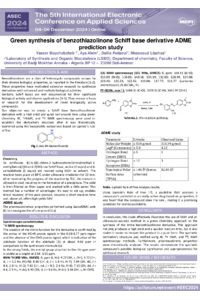
Benzothiazolines are a class of heterocyclic compounds known for their diverse biological properties, as reported in the literature [1-2]. These properties have motivated extensive research to synthesize derivatives with enhanced and multiple biological activities.
Similarly, Schiff bases are well documented for their significant biological activity and diverse applications [3-5]. They remain a focus of research for the development of novel biologically active compounds.
In this study, we synthesized a Schiff base derivative of benzothiazolone, (E)-6-(((5-chloro-2-hydroxyphenyl)imino)methyl)-3-methylbenzo[d]thiazol-2(3H)-one, (1a), using a green chemistry approach. The reaction employed ultrasound-assisted synthesis in ethanol, resulting in an appreciable yield. Starting materials included 3-methyl-2-benzothiazolinone and 5-chloro-2-hydroxybenzaldehyde. The structure of SBM was confirmed using IR, ¹H NMR, and ¹³C NMR spectroscopic techniques.
Additionally, the pharmacokinetic and drug-likeness features of (1a) were evaluated using Lipinski's Rule of Five, a guideline that assesses a compound's potential as an orally active drug based on properties such as molecular weight, lipophilicity, and hydrogen bond donors/acceptors. The findings highlight the synthesized compound's potential biological relevance and suitability for further development.
[1] M. Erdogan et al., “Design, synthesis and biological evaluation of new benzoxazolone/benzothiazolone derivatives as multi-target agents against Alzheimer’s disease,” European J. of Med Chem, vol. 212, p. 113124, Feb. 2021, doi: 10.1016/j.ejmech.2020.113124.
[2] S. H. Ferreira, et al., “S14080, a peripheral analgesic acting by release of an endogenous circulating opioid‐like substance,” British J Pharmacology, vol. 114, no. 2, pp. 303–308, Jan. 1995, doi: 10.1111/j.1476-5381.1995.tb13227.x.
[3] N. Dharmaraj, et al., “Ruthenium(II) complexes containing bidentate Schi bases and their antifungal activity”.
[4] R. S. Joseyphus and M. S. Nair, “Antibacterial and Antifungal Studies on Some Schiff Base Complexes of Zinc(II),” Mycobiology, vol. 36, no. 2, pp. 93–98, Jun. 2008.
[5] A. Jarrahpour, et al., Molecules, vol. 12, no. 8, pp. 1720–1730, Aug. 2007, doi: 10.3390/12081720.
Keywords
benzothiazolinone
Schiff bases
ADME study
ultrasound
green chemistry.
Poster
sciforum-107830.pdf
Phytosorption of some heavy metals from industrial wastewater using cabbage peels and banana trunk
Green Synthesis Of New (E)-3-methyl-6-((naphthalene-1-ylimino)methyl)benzo[d]thiazol-2(3h)-one Schiff Base, ADME Study