Event submissions
Published
This submission belongs to the session S2. Nanosciences, Chemistry and Materials Science of the event The 5th International Electronic Conference on Applied Sciences
Published date
04 Dec, 2024
Academic Editor
'%3e%3cpath%20d='M12.6657%2010.9104C12.4185%2010.325%2012.0599%209.79327%2011.6097%209.34482C11.1609%208.89508%2010.6293%208.5365%2010.0442%208.28888C10.0389%208.28626%2010.0337%208.28495%2010.0285%208.28233C10.8446%207.69279%2011.3752%206.73249%2011.3752%205.64904C11.3752%203.8542%209.92103%202.39999%208.1262%202.39999C6.33136%202.39999%204.87715%203.8542%204.87715%205.64904C4.87715%206.73249%205.40774%207.69279%206.22393%208.28364C6.21869%208.28626%206.21345%208.28757%206.20821%208.29019C5.62129%208.5378%205.09463%208.89284%204.64265%209.34613C4.1929%209.79493%203.83432%2010.3266%203.58671%2010.9117C3.34345%2011.4845%203.21226%2012.0987%203.20023%2012.7209C3.19988%2012.7349%203.20233%2012.7488%203.20744%2012.7619C3.21255%2012.7749%203.22022%2012.7867%203.22998%2012.7968C3.23975%2012.8068%203.25142%2012.8147%203.26431%2012.8202C3.2772%2012.8256%203.29105%2012.8284%203.30504%2012.8284H4.09109C4.14874%2012.8284%204.19459%2012.7825%204.1959%2012.7262C4.2221%2011.7148%204.62823%2010.7676%205.34617%2010.0497C6.08899%209.30683%207.0755%208.89808%208.1262%208.89808C9.17689%208.89808%2010.1634%209.30683%2010.9062%2010.0497C11.6242%2010.7676%2012.0303%2011.7148%2012.0565%2012.7262C12.0578%2012.7838%2012.1037%2012.8284%2012.1613%2012.8284H12.9474C12.9613%2012.8284%2012.9752%2012.8256%2012.9881%2012.8202C13.001%2012.8147%2013.0126%2012.8068%2013.0224%2012.7968C13.0322%2012.7867%2013.0398%2012.7749%2013.0449%2012.7619C13.0501%2012.7488%2013.0525%2012.7349%2013.0522%2012.7209C13.0391%2012.0947%2012.9094%2011.4855%2012.6657%2010.9104ZM8.1262%207.9024C7.52486%207.9024%206.9589%207.6679%206.53312%207.24211C6.10733%206.81633%205.87283%206.25037%205.87283%205.64904C5.87283%205.0477%206.10733%204.48174%206.53312%204.05596C6.9589%203.63018%207.52486%203.39567%208.1262%203.39567C8.72753%203.39567%209.29349%203.63018%209.71927%204.05596C10.1451%204.48174%2010.3796%205.0477%2010.3796%205.64904C10.3796%206.25037%2010.1451%206.81633%209.71927%207.24211C9.29349%207.6679%208.72753%207.9024%208.1262%207.9024Z'%20fill='%235D1EE1'/%3e%3c/g%3e%3c/svg%3e) Luis Cerdán
Luis CerdánCitation
Shriya Tripathi, Narendra Kumar Pandey, Vernica Verma, Synthesis and characterization of nanostructured α-MnO₂ and its composites with SnO₂ and TiO₂ for efficient gas sensing, in Proceedings of The 5th International Electronic Conference on Applied Sciences, 4 December–6 December 2024, MDPI: Basel, Switzerland
Share
Email
Facebook
Twitter
LinkedIn
Synthesis and characterization of nanostructured α-MnO2 and its composites with SnO2 and TiO2 for efficient gas sensing
'%3e%3cpath%20d='M12.6647%2010.9104C12.4176%2010.325%2012.0589%209.7933%2011.6088%209.34485C11.16%208.89511%2010.6283%208.53653%2010.0432%208.28891C10.038%208.28629%2010.0327%208.28498%2010.0275%208.28236C10.8437%207.69282%2011.3743%206.73252%2011.3743%205.64907C11.3743%203.85423%209.92005%202.40002%208.12522%202.40002C6.33038%202.40002%204.87618%203.85423%204.87618%205.64907C4.87618%206.73252%205.40677%207.69282%206.22296%208.28367C6.21772%208.28629%206.21248%208.2876%206.20724%208.29022C5.62031%208.53783%205.09365%208.89287%204.64167%209.34616C4.19192%209.79496%203.83334%2010.3266%203.58573%2010.9117C3.34247%2011.4846%203.21128%2012.0987%203.19925%2012.721C3.1989%2012.735%203.20135%2012.7489%203.20646%2012.7619C3.21157%2012.7749%203.21924%2012.7868%203.22901%2012.7968C3.23877%2012.8068%203.25045%2012.8148%203.26334%2012.8202C3.27623%2012.8256%203.29007%2012.8284%203.30406%2012.8284H4.09012C4.14776%2012.8284%204.19362%2012.7825%204.19493%2012.7262C4.22113%2011.7148%204.62726%2010.7676%205.34519%2010.0497C6.08802%209.30686%207.07452%208.89811%208.12522%208.89811C9.17592%208.89811%2010.1624%209.30686%2010.9052%2010.0497C11.6232%2010.7676%2012.0293%2011.7148%2012.0555%2012.7262C12.0568%2012.7839%2012.1027%2012.8284%2012.1603%2012.8284H12.9464C12.9604%2012.8284%2012.9742%2012.8256%2012.9871%2012.8202C13%2012.8148%2013.0117%2012.8068%2013.0214%2012.7968C13.0312%2012.7868%2013.0389%2012.7749%2013.044%2012.7619C13.0491%2012.7489%2013.0515%2012.735%2013.0512%2012.721C13.0381%2012.0947%2012.9084%2011.4856%2012.6647%2010.9104ZM8.12522%207.90243C7.52388%207.90243%206.95792%207.66793%206.53214%207.24215C6.10636%206.81636%205.87185%206.2504%205.87185%205.64907C5.87185%205.04773%206.10636%204.48177%206.53214%204.05599C6.95792%203.63021%207.52388%203.3957%208.12522%203.3957C8.72655%203.3957%209.29252%203.63021%209.7183%204.05599C10.1441%204.48177%2010.3786%205.04773%2010.3786%205.64907C10.3786%206.2504%2010.1441%206.81636%209.7183%207.24215C9.29252%207.66793%208.72655%207.90243%208.12522%207.90243Z'%20fill='%235D1EE1'/%3e%3c/g%3e%3c/svg%3e)
Shriya Tripathi 1
Narendra Kumar Pandey 1
Vernica Verma 1
1. Department of Physics, University of Lucknow, Lucknow-226007, U.P. India
Abstract
INTRODUCTION
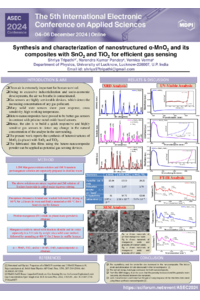
Manganese dioxide exhibits polymorphism. Attributing to its unique framework, abundant oxygen species, catalytic nature, large surface area, nanostructured MnO2 is considered a vital gas sensing material. This study focuses on the synthesis of α-MnO2, its composites and their structural, optical, morphological analysis via X-ray diffraction, UV-Visible, FT-IR, FE-SEM respectively.
METHOD
α-MnO2 is synthesized via a co-precipitate route. For this purpose 2M solution of KMnO4 and 3M solution of Mn(NO3)2 are prepared separately in 20ml deionized water under vigorous stirring. KMnO4 solution is added to Mn(NO3)2 followed by the drop wise addition of 4M solution of NaOH. The precipitate obtained is filtered, dried at 1200C overnight and annealed at 4000C for 4 hours to obtain the MnO2 powder. Composites of α-MnO2 is obtained via solid state reaction method wherein α-MnO2 is grinded (1:1 ratio by weight) respectively with SnO2 and TiO2 using agate mortar and pestle followed by annealing them at 4000C for 2 hours.
RESULTS
The structural analysis reveals the formation of tetragonal α-MnO2, SnO2, TiO2. The average crystallite size of α-MnO2, α-MnO2-TiO2 and α-MnO2-SnO2 is 15.04nm, 24.25nm and 19.33nm respectively. The crystallinity increased from 81% in α-MnO2 to 92.98% α-MnO2-TiO2 and 94.75% in α-MnO2-SnO2. The optical band gap of 5.05eV for α-MnO2 decreased to 3.16eV and 3.4eV for α-MnO2 –TiO2 and α-MnO2-SnO2 respectively. The morphology discloses the formation of nanorods of α-MnO2, granular structure of SnO2 and TiO2. The gas sensing is due to adsorption of gas on the surface of thin film and depends on the crystallite size, morphology, porosity.
CONCLUSION
The gas sensing can be enhanced by the formation of nanocomposites with small crystallite size, increased crystallinity, reduced optical band gap, porous morphology and abundant oxygen species. The thin films fabricated using the nanocomposite can be used to detect analyte gas at room temperature.
Keywords
Polymorphism
nanocomposites
co-precipitation route
nanorod morphology
room temperature gas sensing
Poster
Poster MDPI.pdf
Impact of PCBM on charge transport dynamics in ternary organic thin films for solar cell applications
Modelling coagulant dosage in drinking water treatment plant using hybrid machine learning based on empirical wavelet transform