Event submissions
Published
This submission belongs to the session S2. Nanosciences, Chemistry and Materials Science of the event The 5th International Electronic Conference on Applied Sciences
Published date
04 Dec, 2024
Academic Editor
'%3e%3cpath%20d='M12.6657%2010.9104C12.4185%2010.325%2012.0599%209.79327%2011.6097%209.34482C11.1609%208.89508%2010.6293%208.5365%2010.0442%208.28888C10.0389%208.28626%2010.0337%208.28495%2010.0285%208.28233C10.8446%207.69279%2011.3752%206.73249%2011.3752%205.64904C11.3752%203.8542%209.92103%202.39999%208.1262%202.39999C6.33136%202.39999%204.87715%203.8542%204.87715%205.64904C4.87715%206.73249%205.40774%207.69279%206.22393%208.28364C6.21869%208.28626%206.21345%208.28757%206.20821%208.29019C5.62129%208.5378%205.09463%208.89284%204.64265%209.34613C4.1929%209.79493%203.83432%2010.3266%203.58671%2010.9117C3.34345%2011.4845%203.21226%2012.0987%203.20023%2012.7209C3.19988%2012.7349%203.20233%2012.7488%203.20744%2012.7619C3.21255%2012.7749%203.22022%2012.7867%203.22998%2012.7968C3.23975%2012.8068%203.25142%2012.8147%203.26431%2012.8202C3.2772%2012.8256%203.29105%2012.8284%203.30504%2012.8284H4.09109C4.14874%2012.8284%204.19459%2012.7825%204.1959%2012.7262C4.2221%2011.7148%204.62823%2010.7676%205.34617%2010.0497C6.08899%209.30683%207.0755%208.89808%208.1262%208.89808C9.17689%208.89808%2010.1634%209.30683%2010.9062%2010.0497C11.6242%2010.7676%2012.0303%2011.7148%2012.0565%2012.7262C12.0578%2012.7838%2012.1037%2012.8284%2012.1613%2012.8284H12.9474C12.9613%2012.8284%2012.9752%2012.8256%2012.9881%2012.8202C13.001%2012.8147%2013.0126%2012.8068%2013.0224%2012.7968C13.0322%2012.7867%2013.0398%2012.7749%2013.0449%2012.7619C13.0501%2012.7488%2013.0525%2012.7349%2013.0522%2012.7209C13.0391%2012.0947%2012.9094%2011.4855%2012.6657%2010.9104ZM8.1262%207.9024C7.52486%207.9024%206.9589%207.6679%206.53312%207.24211C6.10733%206.81633%205.87283%206.25037%205.87283%205.64904C5.87283%205.0477%206.10733%204.48174%206.53312%204.05596C6.9589%203.63018%207.52486%203.39567%208.1262%203.39567C8.72753%203.39567%209.29349%203.63018%209.71927%204.05596C10.1451%204.48174%2010.3796%205.0477%2010.3796%205.64904C10.3796%206.25037%2010.1451%206.81633%209.71927%207.24211C9.29349%207.6679%208.72753%207.9024%208.1262%207.9024Z'%20fill='%235D1EE1'/%3e%3c/g%3e%3c/svg%3e) Luis Cerdán
Luis CerdánCitation
Drai Ikram, Bachir Cherifa, Keddou Adel, Elomari Kawthar, Optimization of Malachite Green Adsorption onto Biocomposite Beads: A Sustainable Approach for Wastewater Treatment, in Proceedings of The 5th International Electronic Conference on Applied Sciences, 4 December–6 December 2024, MDPI: Basel, Switzerland
Share
Email
Facebook
Twitter
LinkedIn
Optimization of Malachite Green Adsorption onto Biocomposite Beads: A Sustainable Approach for Wastewater Treatment
'%3e%3cpath%20d='M12.6647%2010.9104C12.4176%2010.325%2012.0589%209.7933%2011.6088%209.34485C11.16%208.89511%2010.6283%208.53653%2010.0432%208.28891C10.038%208.28629%2010.0327%208.28498%2010.0275%208.28236C10.8437%207.69282%2011.3743%206.73252%2011.3743%205.64907C11.3743%203.85423%209.92005%202.40002%208.12522%202.40002C6.33038%202.40002%204.87618%203.85423%204.87618%205.64907C4.87618%206.73252%205.40677%207.69282%206.22296%208.28367C6.21772%208.28629%206.21248%208.2876%206.20724%208.29022C5.62031%208.53783%205.09365%208.89287%204.64167%209.34616C4.19192%209.79496%203.83334%2010.3266%203.58573%2010.9117C3.34247%2011.4846%203.21128%2012.0987%203.19925%2012.721C3.1989%2012.735%203.20135%2012.7489%203.20646%2012.7619C3.21157%2012.7749%203.21924%2012.7868%203.22901%2012.7968C3.23877%2012.8068%203.25045%2012.8148%203.26334%2012.8202C3.27623%2012.8256%203.29007%2012.8284%203.30406%2012.8284H4.09012C4.14776%2012.8284%204.19362%2012.7825%204.19493%2012.7262C4.22113%2011.7148%204.62726%2010.7676%205.34519%2010.0497C6.08802%209.30686%207.07452%208.89811%208.12522%208.89811C9.17592%208.89811%2010.1624%209.30686%2010.9052%2010.0497C11.6232%2010.7676%2012.0293%2011.7148%2012.0555%2012.7262C12.0568%2012.7839%2012.1027%2012.8284%2012.1603%2012.8284H12.9464C12.9604%2012.8284%2012.9742%2012.8256%2012.9871%2012.8202C13%2012.8148%2013.0117%2012.8068%2013.0214%2012.7968C13.0312%2012.7868%2013.0389%2012.7749%2013.044%2012.7619C13.0491%2012.7489%2013.0515%2012.735%2013.0512%2012.721C13.0381%2012.0947%2012.9084%2011.4856%2012.6647%2010.9104ZM8.12522%207.90243C7.52388%207.90243%206.95792%207.66793%206.53214%207.24215C6.10636%206.81636%205.87185%206.2504%205.87185%205.64907C5.87185%205.04773%206.10636%204.48177%206.53214%204.05599C6.95792%203.63021%207.52388%203.3957%208.12522%203.3957C8.72655%203.3957%209.29252%203.63021%209.7183%204.05599C10.1441%204.48177%2010.3786%205.04773%2010.3786%205.64907C10.3786%206.2504%2010.1441%206.81636%209.7183%207.24215C9.29252%207.66793%208.72655%207.90243%208.12522%207.90243Z'%20fill='%235D1EE1'/%3e%3c/g%3e%3c/svg%3e)
Drai Ikram 1
Bachir Cherifa 1
Keddou Adel 2
Elomari Kawthar 3
1. Laboratory of Applied Chemistry LAC, Institute of Science and Technology, University of Ain-Temouchent, Algeria.
2. Laboratoire de Matériaux et Environnement LME, Université de Médea, Médea, Algérie
3. Laboratoire de Matériaux LABMAT, Ecole National polytechnique d’Oran Maurice-Audin ENPO-MA, Oran, Algérie
Abstract
Technology has always been inspired by nature. This is one of the reasons why new technologies continually seek environmentally friendly composite materials. In recent years, there has been a growing interest in developing green bio-composites for industrial wastewater treatment.
In this work, we prepared a type of green, low-cost hybrid composite material comprising volcanic rock (VR), a natural Algerian siliceous volcanic filler from Ain-Temouchent, and the biopolymer alginate (Alg).
The Alginate/Volcanic Rock (Alg/VR) beads were prepared using a simple mixing method in the form of beads, produced with a syringe pump and a cross-linking agent. Detailed characterization of the beads and their initial reagents was carried out using X-Ray Diffraction (XRD), Fourier Transform Infrared spectroscopy (FTIR), and Thermogravimetric Analysis (TGA). The results confirmed the incorporation of the biopolymer into the natural volcanic rock matrix, with clear evidence of interaction between alginate and volcanic rock.
Furthermore, the beads were tested as effective and alternative adsorbents for the removal of the cationic dye Malachite Green (MG) using a Flow-through cell apparatus. The influence of different experimental parameters, such as pH, contact time, adsorbent dose, and initial dye concentration, was investigated. The adsorption results showed that the highest removal efficiency of 95% was achieved at pH 6, with a contact time of 60 minutes, using 0.8 g/L of the composite for a 25 ppm dye solution.
These findings highlight the significant potential of Alg/VR beads as a low-cost, sustainable, and efficient adsorbent for industrial wastewater treatment. By combining locally sourced natural materials with biopolymers, this work not only contributes to green chemistry and sustainable environmental management but also offers a practical solution for addressing global water pollution challenges. This innovative approach aligns with the increasing demand for eco-friendly technologies and reinforces the importance of developing scalable, cost-effective solutions for industrial applications.
Keywords
Biocomposite
Alginate
Volcanic Rock
Adsorption
shallow bed
Malachite Green
Poster
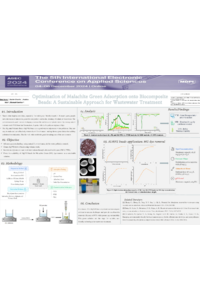
DRAI IKRAM poster.pdf
Exploring ethosomal technology to preserve bioactive plants by-product extracts for cosmetic purposes
Kojic-Acid-Driven Innovation: Developing Biocompatible and Versatile Catalysts for Sustainable CO2 Conversion