Event submissions
Published
This submission belongs to the session S2. Nanosciences, Chemistry and Materials Science of the event The 5th International Electronic Conference on Applied Sciences
Published date
04 Dec, 2024
Academic Editor
'%3e%3cpath%20d='M12.6657%2010.9104C12.4185%2010.325%2012.0599%209.79327%2011.6097%209.34482C11.1609%208.89508%2010.6293%208.5365%2010.0442%208.28888C10.0389%208.28626%2010.0337%208.28495%2010.0285%208.28233C10.8446%207.69279%2011.3752%206.73249%2011.3752%205.64904C11.3752%203.8542%209.92103%202.39999%208.1262%202.39999C6.33136%202.39999%204.87715%203.8542%204.87715%205.64904C4.87715%206.73249%205.40774%207.69279%206.22393%208.28364C6.21869%208.28626%206.21345%208.28757%206.20821%208.29019C5.62129%208.5378%205.09463%208.89284%204.64265%209.34613C4.1929%209.79493%203.83432%2010.3266%203.58671%2010.9117C3.34345%2011.4845%203.21226%2012.0987%203.20023%2012.7209C3.19988%2012.7349%203.20233%2012.7488%203.20744%2012.7619C3.21255%2012.7749%203.22022%2012.7867%203.22998%2012.7968C3.23975%2012.8068%203.25142%2012.8147%203.26431%2012.8202C3.2772%2012.8256%203.29105%2012.8284%203.30504%2012.8284H4.09109C4.14874%2012.8284%204.19459%2012.7825%204.1959%2012.7262C4.2221%2011.7148%204.62823%2010.7676%205.34617%2010.0497C6.08899%209.30683%207.0755%208.89808%208.1262%208.89808C9.17689%208.89808%2010.1634%209.30683%2010.9062%2010.0497C11.6242%2010.7676%2012.0303%2011.7148%2012.0565%2012.7262C12.0578%2012.7838%2012.1037%2012.8284%2012.1613%2012.8284H12.9474C12.9613%2012.8284%2012.9752%2012.8256%2012.9881%2012.8202C13.001%2012.8147%2013.0126%2012.8068%2013.0224%2012.7968C13.0322%2012.7867%2013.0398%2012.7749%2013.0449%2012.7619C13.0501%2012.7488%2013.0525%2012.7349%2013.0522%2012.7209C13.0391%2012.0947%2012.9094%2011.4855%2012.6657%2010.9104ZM8.1262%207.9024C7.52486%207.9024%206.9589%207.6679%206.53312%207.24211C6.10733%206.81633%205.87283%206.25037%205.87283%205.64904C5.87283%205.0477%206.10733%204.48174%206.53312%204.05596C6.9589%203.63018%207.52486%203.39567%208.1262%203.39567C8.72753%203.39567%209.29349%203.63018%209.71927%204.05596C10.1451%204.48174%2010.3796%205.0477%2010.3796%205.64904C10.3796%206.25037%2010.1451%206.81633%209.71927%207.24211C9.29349%207.6679%208.72753%207.9024%208.1262%207.9024Z'%20fill='%235D1EE1'/%3e%3c/g%3e%3c/svg%3e) Luis Cerdán
Luis CerdánCitation
Diego-Antonio Corona-Martinez, Lourdes Díaz-Jiménez, Audberto Reyes-Rosas, Alejandro Zermeño-González, Luis Samaniego-Moreno, Sasirot Khamkure, Solvothermal Synthesis of Nanomagnetite-Coated Biochar for Efficient Arsenic Adsorption, in Proceedings of The 5th International Electronic Conference on Applied Sciences, 4 December–6 December 2024, MDPI: Basel, Switzerland
Share
Email
Facebook
Twitter
LinkedIn
Solvothermal Synthesis of Nanomagnetite-Coated Biochar for Efficient Arsenic Adsorption
'%3e%3cpath%20d='M12.6647%2010.9104C12.4176%2010.325%2012.0589%209.7933%2011.6088%209.34485C11.16%208.89511%2010.6283%208.53653%2010.0432%208.28891C10.038%208.28629%2010.0327%208.28498%2010.0275%208.28236C10.8437%207.69282%2011.3743%206.73252%2011.3743%205.64907C11.3743%203.85423%209.92005%202.40002%208.12522%202.40002C6.33038%202.40002%204.87618%203.85423%204.87618%205.64907C4.87618%206.73252%205.40677%207.69282%206.22296%208.28367C6.21772%208.28629%206.21248%208.2876%206.20724%208.29022C5.62031%208.53783%205.09365%208.89287%204.64167%209.34616C4.19192%209.79496%203.83334%2010.3266%203.58573%2010.9117C3.34247%2011.4846%203.21128%2012.0987%203.19925%2012.721C3.1989%2012.735%203.20135%2012.7489%203.20646%2012.7619C3.21157%2012.7749%203.21924%2012.7868%203.22901%2012.7968C3.23877%2012.8068%203.25045%2012.8148%203.26334%2012.8202C3.27623%2012.8256%203.29007%2012.8284%203.30406%2012.8284H4.09012C4.14776%2012.8284%204.19362%2012.7825%204.19493%2012.7262C4.22113%2011.7148%204.62726%2010.7676%205.34519%2010.0497C6.08802%209.30686%207.07452%208.89811%208.12522%208.89811C9.17592%208.89811%2010.1624%209.30686%2010.9052%2010.0497C11.6232%2010.7676%2012.0293%2011.7148%2012.0555%2012.7262C12.0568%2012.7839%2012.1027%2012.8284%2012.1603%2012.8284H12.9464C12.9604%2012.8284%2012.9742%2012.8256%2012.9871%2012.8202C13%2012.8148%2013.0117%2012.8068%2013.0214%2012.7968C13.0312%2012.7868%2013.0389%2012.7749%2013.044%2012.7619C13.0491%2012.7489%2013.0515%2012.735%2013.0512%2012.721C13.0381%2012.0947%2012.9084%2011.4856%2012.6647%2010.9104ZM8.12522%207.90243C7.52388%207.90243%206.95792%207.66793%206.53214%207.24215C6.10636%206.81636%205.87185%206.2504%205.87185%205.64907C5.87185%205.04773%206.10636%204.48177%206.53214%204.05599C6.95792%203.63021%207.52388%203.3957%208.12522%203.3957C8.72655%203.3957%209.29252%203.63021%209.7183%204.05599C10.1441%204.48177%2010.3786%205.04773%2010.3786%205.64907C10.3786%206.2504%2010.1441%206.81636%209.7183%207.24215C9.29252%207.66793%208.72655%207.90243%208.12522%207.90243Z'%20fill='%235D1EE1'/%3e%3c/g%3e%3c/svg%3e)
Diego-Antonio Corona-Martinez 1

Lourdes Díaz-Jiménez 2
Audberto Reyes-Rosas 3
Alejandro Zermeño-González 4
Luis Samaniego-Moreno 4
Sasirot Khamkure 5
1. Soil Science Department, Universidad Autónoma Agraria Antonio Narro, Saltillo, 25315 Coahuila, Mexico
2. Sustainability of Natural Resources and Energy, Centro de Investigación y de Estudios Avanzados del Instituto Politécnico Nacional, Saltillo, 25900 Coahuila, Mexico
3. Department of Bioscience and Agrotechnology, Research Center of Applied Chemistry, Mexico
4. Irrigation and Drainage Department, Universidad Autónoma Agraria Antonio Narro, Saltillo, 25315 Coahuila, Mexico
5. CONAHCYT-Universidad Autónoma Agraria Antonio Narro, Mexico
Abstract
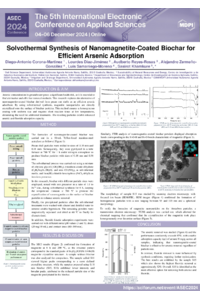
Arsenic contamination in water poses a significant health risk, making effective removal methods essential. Low-cost biosorbents and easy magnetic separation are desirable for this purpose. While various magnetic adsorbents have been developed using the coprecipitation method, challenges remain due to arsenic's toxicity and WHO limitations. This study introduces nanomagnetite-coated biochar derived from pecan nutshells as an efficient arsenic adsorbent, utilizing a solvothermal method. This controlled synthesis enables the precise growth of magnetite crystals on biochar, resulting in uniform particle size and morphology. The process occurs in Teflon-lined stainless-steel autoclaves at 200°C, with reaction times ranging from 6 to 12 hours. Iron chloride acts as the iron ion precursor, and ethylene glycol serves as the solvothermal medium. Pecan nutshell biochar particles, sized 0.10-0.18 mm and 0.18-0.38 mm, are produced via pyrolysis at 700°C for 1 h under nitrogen. Following solvothermal treatment, the resulting particles are magnetically separated from the solution. Characterization via XRD, SEM, TEM, and FTIR confirms the formation of homogeneously magnetite-coated biochar particles. This method yields homogeneous nucleation and the growth of nanometric magnetite crystals on the surface of biochar particles, leading to a narrow size distribution and consistent morphology without other crystalline phases, enabling high arsenic adsorption rates (97.30-98.76%) from water. Notably, biochar with varied particle sizes synthesized at a short reaction time (200°C, 6 h) demonstrates the highest arsenic removal efficiency (98.76%) and adsorption capacity (7.974 mg/g), comparable to magnetite nanoparticles. The development of nanomagnetite-coated biochar derived from pecan nutshells showcases significant innovative potential in addressing arsenic contamination. This is due to several factors: the sustainable use of biochar from pecan nutshells, nanomagnetite coating for efficient arsenic removal, the controlled synthesis process, high adsorption capacity, low-cost biosorbents, ease of magnetic separation, and versatility for removing other contaminants.
Keywords
Arsenic contaminant
Biochar
Nanomagnetite
Solvothermal.
Poster
ASEC.pdf
Study of factors affecting the process of complexation of nimesulide - γ-cyclodextrin
Impact of Pressure on the Physical, Mechanical, and Thermal Properties of the Ternary Halide Perovskite AgCaCl3: A First-Principles Investigation