Event submissions
Published
This submission belongs to the session S2. Nanosciences, Chemistry and Materials Science of the event The 5th International Electronic Conference on Applied Sciences
Published date
04 Dec, 2024
Academic Editor
'%3e%3cpath%20d='M12.6657%2010.9104C12.4185%2010.325%2012.0599%209.79327%2011.6097%209.34482C11.1609%208.89508%2010.6293%208.5365%2010.0442%208.28888C10.0389%208.28626%2010.0337%208.28495%2010.0285%208.28233C10.8446%207.69279%2011.3752%206.73249%2011.3752%205.64904C11.3752%203.8542%209.92103%202.39999%208.1262%202.39999C6.33136%202.39999%204.87715%203.8542%204.87715%205.64904C4.87715%206.73249%205.40774%207.69279%206.22393%208.28364C6.21869%208.28626%206.21345%208.28757%206.20821%208.29019C5.62129%208.5378%205.09463%208.89284%204.64265%209.34613C4.1929%209.79493%203.83432%2010.3266%203.58671%2010.9117C3.34345%2011.4845%203.21226%2012.0987%203.20023%2012.7209C3.19988%2012.7349%203.20233%2012.7488%203.20744%2012.7619C3.21255%2012.7749%203.22022%2012.7867%203.22998%2012.7968C3.23975%2012.8068%203.25142%2012.8147%203.26431%2012.8202C3.2772%2012.8256%203.29105%2012.8284%203.30504%2012.8284H4.09109C4.14874%2012.8284%204.19459%2012.7825%204.1959%2012.7262C4.2221%2011.7148%204.62823%2010.7676%205.34617%2010.0497C6.08899%209.30683%207.0755%208.89808%208.1262%208.89808C9.17689%208.89808%2010.1634%209.30683%2010.9062%2010.0497C11.6242%2010.7676%2012.0303%2011.7148%2012.0565%2012.7262C12.0578%2012.7838%2012.1037%2012.8284%2012.1613%2012.8284H12.9474C12.9613%2012.8284%2012.9752%2012.8256%2012.9881%2012.8202C13.001%2012.8147%2013.0126%2012.8068%2013.0224%2012.7968C13.0322%2012.7867%2013.0398%2012.7749%2013.0449%2012.7619C13.0501%2012.7488%2013.0525%2012.7349%2013.0522%2012.7209C13.0391%2012.0947%2012.9094%2011.4855%2012.6657%2010.9104ZM8.1262%207.9024C7.52486%207.9024%206.9589%207.6679%206.53312%207.24211C6.10733%206.81633%205.87283%206.25037%205.87283%205.64904C5.87283%205.0477%206.10733%204.48174%206.53312%204.05596C6.9589%203.63018%207.52486%203.39567%208.1262%203.39567C8.72753%203.39567%209.29349%203.63018%209.71927%204.05596C10.1451%204.48174%2010.3796%205.0477%2010.3796%205.64904C10.3796%206.25037%2010.1451%206.81633%209.71927%207.24211C9.29349%207.6679%208.72753%207.9024%208.1262%207.9024Z'%20fill='%235D1EE1'/%3e%3c/g%3e%3c/svg%3e) Luis Cerdán
Luis CerdánCitation
Theodora Adamantidi, Marios Finos, Anastasia D. Meretoudi, Ioanna Koumentakou, George Z. Kyzas, Synthesis and characterization of chitosan/PVA/starch/ZnO/camphor and chitosan/PVA/carboxymethyl cellulose/ZnO/camphor patches for potential hemostatic application, in Proceedings of The 5th International Electronic Conference on Applied Sciences, 4 December–6 December 2024, MDPI: Basel, Switzerland
Share
Email
Facebook
Twitter
LinkedIn
Synthesis and characterization of chitosan/PVA/starch/ZnO/camphor and chitosan/PVA/carboxymethyl cellulose/ZnO/camphor patches for potential hemostatic application

Theodora Adamantidi 1
'%3e%3cpath%20d='M12.6647%2010.9104C12.4176%2010.325%2012.0589%209.7933%2011.6088%209.34485C11.16%208.89511%2010.6283%208.53653%2010.0432%208.28891C10.038%208.28629%2010.0327%208.28498%2010.0275%208.28236C10.8437%207.69282%2011.3743%206.73252%2011.3743%205.64907C11.3743%203.85423%209.92005%202.40002%208.12522%202.40002C6.33038%202.40002%204.87618%203.85423%204.87618%205.64907C4.87618%206.73252%205.40677%207.69282%206.22296%208.28367C6.21772%208.28629%206.21248%208.2876%206.20724%208.29022C5.62031%208.53783%205.09365%208.89287%204.64167%209.34616C4.19192%209.79496%203.83334%2010.3266%203.58573%2010.9117C3.34247%2011.4846%203.21128%2012.0987%203.19925%2012.721C3.1989%2012.735%203.20135%2012.7489%203.20646%2012.7619C3.21157%2012.7749%203.21924%2012.7868%203.22901%2012.7968C3.23877%2012.8068%203.25045%2012.8148%203.26334%2012.8202C3.27623%2012.8256%203.29007%2012.8284%203.30406%2012.8284H4.09012C4.14776%2012.8284%204.19362%2012.7825%204.19493%2012.7262C4.22113%2011.7148%204.62726%2010.7676%205.34519%2010.0497C6.08802%209.30686%207.07452%208.89811%208.12522%208.89811C9.17592%208.89811%2010.1624%209.30686%2010.9052%2010.0497C11.6232%2010.7676%2012.0293%2011.7148%2012.0555%2012.7262C12.0568%2012.7839%2012.1027%2012.8284%2012.1603%2012.8284H12.9464C12.9604%2012.8284%2012.9742%2012.8256%2012.9871%2012.8202C13%2012.8148%2013.0117%2012.8068%2013.0214%2012.7968C13.0312%2012.7868%2013.0389%2012.7749%2013.044%2012.7619C13.0491%2012.7489%2013.0515%2012.735%2013.0512%2012.721C13.0381%2012.0947%2012.9084%2011.4856%2012.6647%2010.9104ZM8.12522%207.90243C7.52388%207.90243%206.95792%207.66793%206.53214%207.24215C6.10636%206.81636%205.87185%206.2504%205.87185%205.64907C5.87185%205.04773%206.10636%204.48177%206.53214%204.05599C6.95792%203.63021%207.52388%203.3957%208.12522%203.3957C8.72655%203.3957%209.29252%203.63021%209.7183%204.05599C10.1441%204.48177%2010.3786%205.04773%2010.3786%205.64907C10.3786%206.2504%2010.1441%206.81636%209.7183%207.24215C9.29252%207.66793%208.72655%207.90243%208.12522%207.90243Z'%20fill='%235D1EE1'/%3e%3c/g%3e%3c/svg%3e)
Marios Finos 1
Anastasia D. Meretoudi 1
Ioanna Koumentakou 1

George Z. Kyzas 1
1. Hephaestus Laboratory, School of Chemistry, Faculty of Sciences, Democritus University of Thrace, Kavala, Greece
Abstract
Hemostasis is the first stage of the wound healing process activated upon injury, that results in the control of bleeding and the formation of a protective barrier. The mechanism of hemostasis includes 1) vasoconstriction, 2) the formation of a platelet plug, and 3) blood coagulation. During the hemostasis process, wound infection can exist, inhibiting epidermal maturation, and may cause bacteremia, sepsis, and multiple-organ dysfunction syndrome. In cases of severe wounds, the use of hemostatic products with antimicrobial properties is necessary to compensate for the compromised first step of wound closure. Chitosan (CS) is a naturally derived polymer that plays a leading role in the development of new hemostatic products. CS is a cationic polysaccharide with bactericidal properties; it is renewable, nontoxic, biodegradable, and hydrophilic with high reactivity, and promotes coagulation, flocculation, and biosorption. The hemostatic properties of chitosan are due to direct electrostatic interactions between negatively charged red blood cells and platelets and the positively charged CS. Researchers and pharmaceutical companies are focusing on the hemostatic properties of CS by formulating it into several hemostatic products. Ongoing research is focusing on advanced hemostatic CS-based materials with enhanced antimicrobial properties, good biocompatibility, rapid hemostatic ability, and low manufacturing cost. Hence, in this work, CS was combined with polyvinyl alcohol (PVA) and carboxymethyl cellulose or starch to prepare well-cross-linked patches with enhanced mechanical properties and blood sorption as well as immediate hemostatic properties. Additionally, ZnO and Camphor were added as natural antimicrobial agents to ensure a healthy environment, avoiding potential infections during hemostasis treatment. The successful synthesis of the fabricated CS-based patches was confirmed by FTIR, their crystallinity was researched by XRD, and water swelling was also investigated. Moreover, an investigation of the hemostatic capacity of the dressings was carried out via hemolysis and blood clotting time experiments.
Keywords
chitosan
PVA
starch
carboxymethyl cellulose
hemostatic products
Poster
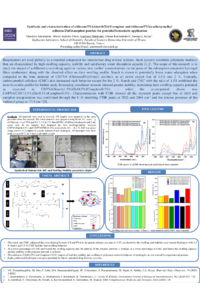
Poster_Adamantidi MDPI_Final.pdf
Ultra-thin High-sensitivity Carbon Nanofiber Membranes: Innovations in Health Monitoring and Emergency Communications
Novel chitosan/PVA@hyaluronic acid and chitosan/PVA@hyaluronic acid/curcumin films for wound healing