Event submissions
Published
This submission belongs to the session S2. Nanosciences, Chemistry and Materials Science of the event The 5th International Electronic Conference on Applied Sciences
Published date
04 Dec, 2024
Academic Editor
'%3e%3cpath%20d='M12.6657%2010.9104C12.4185%2010.325%2012.0599%209.79327%2011.6097%209.34482C11.1609%208.89508%2010.6293%208.5365%2010.0442%208.28888C10.0389%208.28626%2010.0337%208.28495%2010.0285%208.28233C10.8446%207.69279%2011.3752%206.73249%2011.3752%205.64904C11.3752%203.8542%209.92103%202.39999%208.1262%202.39999C6.33136%202.39999%204.87715%203.8542%204.87715%205.64904C4.87715%206.73249%205.40774%207.69279%206.22393%208.28364C6.21869%208.28626%206.21345%208.28757%206.20821%208.29019C5.62129%208.5378%205.09463%208.89284%204.64265%209.34613C4.1929%209.79493%203.83432%2010.3266%203.58671%2010.9117C3.34345%2011.4845%203.21226%2012.0987%203.20023%2012.7209C3.19988%2012.7349%203.20233%2012.7488%203.20744%2012.7619C3.21255%2012.7749%203.22022%2012.7867%203.22998%2012.7968C3.23975%2012.8068%203.25142%2012.8147%203.26431%2012.8202C3.2772%2012.8256%203.29105%2012.8284%203.30504%2012.8284H4.09109C4.14874%2012.8284%204.19459%2012.7825%204.1959%2012.7262C4.2221%2011.7148%204.62823%2010.7676%205.34617%2010.0497C6.08899%209.30683%207.0755%208.89808%208.1262%208.89808C9.17689%208.89808%2010.1634%209.30683%2010.9062%2010.0497C11.6242%2010.7676%2012.0303%2011.7148%2012.0565%2012.7262C12.0578%2012.7838%2012.1037%2012.8284%2012.1613%2012.8284H12.9474C12.9613%2012.8284%2012.9752%2012.8256%2012.9881%2012.8202C13.001%2012.8147%2013.0126%2012.8068%2013.0224%2012.7968C13.0322%2012.7867%2013.0398%2012.7749%2013.0449%2012.7619C13.0501%2012.7488%2013.0525%2012.7349%2013.0522%2012.7209C13.0391%2012.0947%2012.9094%2011.4855%2012.6657%2010.9104ZM8.1262%207.9024C7.52486%207.9024%206.9589%207.6679%206.53312%207.24211C6.10733%206.81633%205.87283%206.25037%205.87283%205.64904C5.87283%205.0477%206.10733%204.48174%206.53312%204.05596C6.9589%203.63018%207.52486%203.39567%208.1262%203.39567C8.72753%203.39567%209.29349%203.63018%209.71927%204.05596C10.1451%204.48174%2010.3796%205.0477%2010.3796%205.64904C10.3796%206.25037%2010.1451%206.81633%209.71927%207.24211C9.29349%207.6679%208.72753%207.9024%208.1262%207.9024Z'%20fill='%235D1EE1'/%3e%3c/g%3e%3c/svg%3e) Luis Cerdán
Luis CerdánCitation
Ahmed Fatimi, Hydrogel Electrolytes in Zinc-Ion Batteries: Patent Analysis and Future Prospects for Wearable and Flexible Electronics, in Proceedings of The 5th International Electronic Conference on Applied Sciences, 4 December–6 December 2024, MDPI: Basel, Switzerland
Share
Email
Facebook
Twitter
LinkedIn
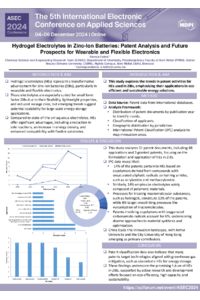
Hydrogel Electrolytes in Zinc-Ion Batteries: Patent Analysis and Future Prospects for Wearable and Flexible Electronics

Ahmed Fatimi 1
1. Chemical Science and Engineering Research Team (ERSIC), Department of Chemistry, Polydisciplinary Faculty of Beni Mellal (FPBM), Sultan Moulay Slimane University (USMS), P.O. Box 592 Mghila, Beni Mellal 23000, Morocco
Abstract
Hydrogel electrolytes (HEs) represent a transformative advancement for zinc-ion batteries (ZIBs), particularly in wearable and flexible electronics. These electrolytes are especially suited for small form factor ZIBs due to their flexibility, lightweight properties, and reduced leakage risks, but emerging trends suggest potential scalability for large-scale energy storage applications. Compared to state-of-the-art aqueous electrolytes, HEs offer significant advantages, including a reduction in side reactions, an increase in energy density, and enhanced compatibility with flexible substrates. This study analyzes 51 patent documents, including 48 applications and 3 granted patents, focusing on the formulation and application of HEs in ZIBs. International Patent Classification (IPC) data reveal that 14% of the patents pertain to HEs based on copolymers derived from compounds with unsaturated aliphatic radicals containing amides, such as acrylamide and methacrylamide. Similarly, 14% emphasize electrolytes solely composed of polymeric materials (e.g., gel-type or solid-type). Processes for treating macromolecular substances, such as hydrogels, constitute 12% of the patents, while 8% target crosslinking processes like the vulcanization of macromolecules. Patents involving copolymers with oxygenated carbonamido radicals account for 6%, underscoring diverse approaches to material synthesis and optimization. China leads this innovation landscape, with Anhui University and the City University of Hong Kong emerging as primary contributors. Patent classification data also indicate that many patents target technologies aligned with greenhouse gas mitigation, such as viscoelastic HEs for energy storage. These findings underscore the promising future of HEs in ZIBs, supported by active research and development efforts focused on eco-efficiency, high capacity, and sustainability.
Keywords
zinc-ion battery
electrolyte
flexibility
lightweight
viscoelastic hydrogels
innovation
patent analysis
Poster
ASEC2024_Poster_Hydrogels.pdf
Experiment design for copper corrosion inhibition using an expired drug
HYGROTHERMAL STUDIES OF DIFFERENT ARRANGEMENTS OF A BRICK AND ADOBE WALL ON COMSOL MULTYPHISICS.