Event submissions
Published
This submission belongs to the session S2. Nanosciences, Chemistry and Materials Science of the event The 5th International Electronic Conference on Applied Sciences
Published date
04 Dec, 2024
Academic Editor
'%3e%3cpath%20d='M12.6657%2010.9104C12.4185%2010.325%2012.0599%209.79327%2011.6097%209.34482C11.1609%208.89508%2010.6293%208.5365%2010.0442%208.28888C10.0389%208.28626%2010.0337%208.28495%2010.0285%208.28233C10.8446%207.69279%2011.3752%206.73249%2011.3752%205.64904C11.3752%203.8542%209.92103%202.39999%208.1262%202.39999C6.33136%202.39999%204.87715%203.8542%204.87715%205.64904C4.87715%206.73249%205.40774%207.69279%206.22393%208.28364C6.21869%208.28626%206.21345%208.28757%206.20821%208.29019C5.62129%208.5378%205.09463%208.89284%204.64265%209.34613C4.1929%209.79493%203.83432%2010.3266%203.58671%2010.9117C3.34345%2011.4845%203.21226%2012.0987%203.20023%2012.7209C3.19988%2012.7349%203.20233%2012.7488%203.20744%2012.7619C3.21255%2012.7749%203.22022%2012.7867%203.22998%2012.7968C3.23975%2012.8068%203.25142%2012.8147%203.26431%2012.8202C3.2772%2012.8256%203.29105%2012.8284%203.30504%2012.8284H4.09109C4.14874%2012.8284%204.19459%2012.7825%204.1959%2012.7262C4.2221%2011.7148%204.62823%2010.7676%205.34617%2010.0497C6.08899%209.30683%207.0755%208.89808%208.1262%208.89808C9.17689%208.89808%2010.1634%209.30683%2010.9062%2010.0497C11.6242%2010.7676%2012.0303%2011.7148%2012.0565%2012.7262C12.0578%2012.7838%2012.1037%2012.8284%2012.1613%2012.8284H12.9474C12.9613%2012.8284%2012.9752%2012.8256%2012.9881%2012.8202C13.001%2012.8147%2013.0126%2012.8068%2013.0224%2012.7968C13.0322%2012.7867%2013.0398%2012.7749%2013.0449%2012.7619C13.0501%2012.7488%2013.0525%2012.7349%2013.0522%2012.7209C13.0391%2012.0947%2012.9094%2011.4855%2012.6657%2010.9104ZM8.1262%207.9024C7.52486%207.9024%206.9589%207.6679%206.53312%207.24211C6.10733%206.81633%205.87283%206.25037%205.87283%205.64904C5.87283%205.0477%206.10733%204.48174%206.53312%204.05596C6.9589%203.63018%207.52486%203.39567%208.1262%203.39567C8.72753%203.39567%209.29349%203.63018%209.71927%204.05596C10.1451%204.48174%2010.3796%205.0477%2010.3796%205.64904C10.3796%206.25037%2010.1451%206.81633%209.71927%207.24211C9.29349%207.6679%208.72753%207.9024%208.1262%207.9024Z'%20fill='%235D1EE1'/%3e%3c/g%3e%3c/svg%3e) Luis Cerdán
Luis CerdánCitation
Robert Mbedzi, Pascal Mwenge, Hilary Rutto, Tumisang Seodigeng, Machine Learning Predictive Modelling of Calcium Removal from Cooling Tower Water Using Amberlite IR120 Resins, in Proceedings of The 5th International Electronic Conference on Applied Sciences, 4 December–6 December 2024, MDPI: Basel, Switzerland
Share
Email
Facebook
Twitter
LinkedIn
Machine Learning Predictive Modelling of Calcium Removal from Cooling Tower Water Using Amberlite IR120 Resins
'%3e%3cpath%20d='M12.6647%2010.9104C12.4176%2010.325%2012.0589%209.7933%2011.6088%209.34485C11.16%208.89511%2010.6283%208.53653%2010.0432%208.28891C10.038%208.28629%2010.0327%208.28498%2010.0275%208.28236C10.8437%207.69282%2011.3743%206.73252%2011.3743%205.64907C11.3743%203.85423%209.92005%202.40002%208.12522%202.40002C6.33038%202.40002%204.87618%203.85423%204.87618%205.64907C4.87618%206.73252%205.40677%207.69282%206.22296%208.28367C6.21772%208.28629%206.21248%208.2876%206.20724%208.29022C5.62031%208.53783%205.09365%208.89287%204.64167%209.34616C4.19192%209.79496%203.83334%2010.3266%203.58573%2010.9117C3.34247%2011.4846%203.21128%2012.0987%203.19925%2012.721C3.1989%2012.735%203.20135%2012.7489%203.20646%2012.7619C3.21157%2012.7749%203.21924%2012.7868%203.22901%2012.7968C3.23877%2012.8068%203.25045%2012.8148%203.26334%2012.8202C3.27623%2012.8256%203.29007%2012.8284%203.30406%2012.8284H4.09012C4.14776%2012.8284%204.19362%2012.7825%204.19493%2012.7262C4.22113%2011.7148%204.62726%2010.7676%205.34519%2010.0497C6.08802%209.30686%207.07452%208.89811%208.12522%208.89811C9.17592%208.89811%2010.1624%209.30686%2010.9052%2010.0497C11.6232%2010.7676%2012.0293%2011.7148%2012.0555%2012.7262C12.0568%2012.7839%2012.1027%2012.8284%2012.1603%2012.8284H12.9464C12.9604%2012.8284%2012.9742%2012.8256%2012.9871%2012.8202C13%2012.8148%2013.0117%2012.8068%2013.0214%2012.7968C13.0312%2012.7868%2013.0389%2012.7749%2013.044%2012.7619C13.0491%2012.7489%2013.0515%2012.735%2013.0512%2012.721C13.0381%2012.0947%2012.9084%2011.4856%2012.6647%2010.9104ZM8.12522%207.90243C7.52388%207.90243%206.95792%207.66793%206.53214%207.24215C6.10636%206.81636%205.87185%206.2504%205.87185%205.64907C5.87185%205.04773%206.10636%204.48177%206.53214%204.05599C6.95792%203.63021%207.52388%203.3957%208.12522%203.3957C8.72655%203.3957%209.29252%203.63021%209.7183%204.05599C10.1441%204.48177%2010.3786%205.04773%2010.3786%205.64907C10.3786%206.2504%2010.1441%206.81636%209.7183%207.24215C9.29252%207.66793%208.72655%207.90243%208.12522%207.90243Z'%20fill='%235D1EE1'/%3e%3c/g%3e%3c/svg%3e)
Robert Mbedzi 1

Pascal Mwenge 1
Hilary Rutto 1
Tumisang Seodigeng 1
1. Department of Chemical and Metallurgical Engineering, Vaal University of Technology, Private Bag X021, South Africa
Abstract
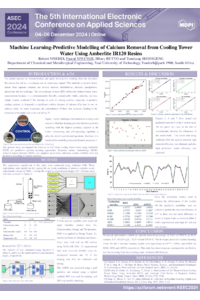
The buildup of scale in cooling systems, especially evaporative cooling systems, is frequently a significant problem because of calcium (Ca) ions in raw or makeup water. As water evaporates, the concentration of these ions increases, leading to the formation of insoluble salts such as calcium carbonate (CaCO₃). This scaling may decrease heat transfer, inefficiencies, and increased energy usage. The calcium must be removed for the cooling system to operate best. The present study investigated the removal of Ca2+ from cooling tower water using Amberlite IR120 and predictive machine learning approaches. A lab-scale ion exchange column was used in this study. Response surface methodology (RSM), artificial neural networks (ANNs), and adaptive neuro-fuzzy inference systems (ANFISs) were used to optimise and model calcium removal using Amberlite IR120. The effects of the following process parameters were studied: contact time (min), pH, concentration (mg/L), dosage (ml), and temperature (K). RSM was used for process optimisation. The ANN model construction used 70% of the data for training, 15% for testing, and 15% for validation. The network was trained using feed-forward propagation and the Levenberg–Marquardt algorithm. The ANFIS was generated using a grid partition and trained using a hybrid method; 80% was used for training, and 20% was used for checking. Regression (R2), mean square error (MSE), mean absolute error (MAE), mean absolute percentage error (MAPE), and average relative error (ARE) were also used. Numerical optimisation yielded an optimal removal percentage of Ca2+ of 99.07% at 89.55 minutes, 4.17, 452.83 mg/L, 132.57 ml, and 295.58 K. The developed predictive machine learning model fits the three machine learning models with regressions of 0.9777, 0.9994, and 0.9903 for RSM, ANN, and ANFIS, respectively. This study has shown that machine learning is an effective tool for removing Ca2+ from cooling water Amberlite IR120 resins.
Keywords
Amberlite IR120
Cooling tower water
Ca2+
Machine Learning
Predictive Modelling
Poster
sciforum-102058 Ca removal ML.pdf
REPERCUSSIONS ON THE SHEAR FORCE OF AN INTERNAL BEAM–COLUMN CONNECTION FROM TWO SYMMETRICAL UNIFORMLY DISTRIBUTED LOADS AT DIFFERENT POSITIONS ON THE BEAM
Green Synthesis of Silver Nanoparticles Using Phyllanthus emblica and Adhatoda vasica Leaf Extract and their comparative study on microbes.