Event submissions
Published
This submission belongs to the session S2. Nanosciences, Chemistry and Materials Science of the event The 5th International Electronic Conference on Applied Sciences
Published date
04 Dec, 2024
Academic Editor
'%3e%3cpath%20d='M12.6657%2010.9104C12.4185%2010.325%2012.0599%209.79327%2011.6097%209.34482C11.1609%208.89508%2010.6293%208.5365%2010.0442%208.28888C10.0389%208.28626%2010.0337%208.28495%2010.0285%208.28233C10.8446%207.69279%2011.3752%206.73249%2011.3752%205.64904C11.3752%203.8542%209.92103%202.39999%208.1262%202.39999C6.33136%202.39999%204.87715%203.8542%204.87715%205.64904C4.87715%206.73249%205.40774%207.69279%206.22393%208.28364C6.21869%208.28626%206.21345%208.28757%206.20821%208.29019C5.62129%208.5378%205.09463%208.89284%204.64265%209.34613C4.1929%209.79493%203.83432%2010.3266%203.58671%2010.9117C3.34345%2011.4845%203.21226%2012.0987%203.20023%2012.7209C3.19988%2012.7349%203.20233%2012.7488%203.20744%2012.7619C3.21255%2012.7749%203.22022%2012.7867%203.22998%2012.7968C3.23975%2012.8068%203.25142%2012.8147%203.26431%2012.8202C3.2772%2012.8256%203.29105%2012.8284%203.30504%2012.8284H4.09109C4.14874%2012.8284%204.19459%2012.7825%204.1959%2012.7262C4.2221%2011.7148%204.62823%2010.7676%205.34617%2010.0497C6.08899%209.30683%207.0755%208.89808%208.1262%208.89808C9.17689%208.89808%2010.1634%209.30683%2010.9062%2010.0497C11.6242%2010.7676%2012.0303%2011.7148%2012.0565%2012.7262C12.0578%2012.7838%2012.1037%2012.8284%2012.1613%2012.8284H12.9474C12.9613%2012.8284%2012.9752%2012.8256%2012.9881%2012.8202C13.001%2012.8147%2013.0126%2012.8068%2013.0224%2012.7968C13.0322%2012.7867%2013.0398%2012.7749%2013.0449%2012.7619C13.0501%2012.7488%2013.0525%2012.7349%2013.0522%2012.7209C13.0391%2012.0947%2012.9094%2011.4855%2012.6657%2010.9104ZM8.1262%207.9024C7.52486%207.9024%206.9589%207.6679%206.53312%207.24211C6.10733%206.81633%205.87283%206.25037%205.87283%205.64904C5.87283%205.0477%206.10733%204.48174%206.53312%204.05596C6.9589%203.63018%207.52486%203.39567%208.1262%203.39567C8.72753%203.39567%209.29349%203.63018%209.71927%204.05596C10.1451%204.48174%2010.3796%205.0477%2010.3796%205.64904C10.3796%206.25037%2010.1451%206.81633%209.71927%207.24211C9.29349%207.6679%208.72753%207.9024%208.1262%207.9024Z'%20fill='%235D1EE1'/%3e%3c/g%3e%3c/svg%3e) Luis Cerdán
Luis CerdánCitation
Kulsum Hashmi, Satya Satya, Priya Mishra, Sakshi Gupta, Ekhlakh Veg, Tahmeena Khan, Seema Joshi, The Potentiality of Vanadium Complexes as Antibacterial Agents, in Proceedings of The 5th International Electronic Conference on Applied Sciences, 4 December–6 December 2024, MDPI: Basel, Switzerland
Share
Email
Facebook
Twitter
LinkedIn
The Potentiality of Vanadium Complexes as Antibacterial Agents
'%3e%3cpath%20d='M12.6647%2010.9104C12.4176%2010.325%2012.0589%209.7933%2011.6088%209.34485C11.16%208.89511%2010.6283%208.53653%2010.0432%208.28891C10.038%208.28629%2010.0327%208.28498%2010.0275%208.28236C10.8437%207.69282%2011.3743%206.73252%2011.3743%205.64907C11.3743%203.85423%209.92005%202.40002%208.12522%202.40002C6.33038%202.40002%204.87618%203.85423%204.87618%205.64907C4.87618%206.73252%205.40677%207.69282%206.22296%208.28367C6.21772%208.28629%206.21248%208.2876%206.20724%208.29022C5.62031%208.53783%205.09365%208.89287%204.64167%209.34616C4.19192%209.79496%203.83334%2010.3266%203.58573%2010.9117C3.34247%2011.4846%203.21128%2012.0987%203.19925%2012.721C3.1989%2012.735%203.20135%2012.7489%203.20646%2012.7619C3.21157%2012.7749%203.21924%2012.7868%203.22901%2012.7968C3.23877%2012.8068%203.25045%2012.8148%203.26334%2012.8202C3.27623%2012.8256%203.29007%2012.8284%203.30406%2012.8284H4.09012C4.14776%2012.8284%204.19362%2012.7825%204.19493%2012.7262C4.22113%2011.7148%204.62726%2010.7676%205.34519%2010.0497C6.08802%209.30686%207.07452%208.89811%208.12522%208.89811C9.17592%208.89811%2010.1624%209.30686%2010.9052%2010.0497C11.6232%2010.7676%2012.0293%2011.7148%2012.0555%2012.7262C12.0568%2012.7839%2012.1027%2012.8284%2012.1603%2012.8284H12.9464C12.9604%2012.8284%2012.9742%2012.8256%2012.9871%2012.8202C13%2012.8148%2013.0117%2012.8068%2013.0214%2012.7968C13.0312%2012.7868%2013.0389%2012.7749%2013.044%2012.7619C13.0491%2012.7489%2013.0515%2012.735%2013.0512%2012.721C13.0381%2012.0947%2012.9084%2011.4856%2012.6647%2010.9104ZM8.12522%207.90243C7.52388%207.90243%206.95792%207.66793%206.53214%207.24215C6.10636%206.81636%205.87185%206.2504%205.87185%205.64907C5.87185%205.04773%206.10636%204.48177%206.53214%204.05599C6.95792%203.63021%207.52388%203.3957%208.12522%203.3957C8.72655%203.3957%209.29252%203.63021%209.7183%204.05599C10.1441%204.48177%2010.3786%205.04773%2010.3786%205.64907C10.3786%206.2504%2010.1441%206.81636%209.7183%207.24215C9.29252%207.66793%208.72655%207.90243%208.12522%207.90243Z'%20fill='%235D1EE1'/%3e%3c/g%3e%3c/svg%3e)
Kulsum Hashmi 1

Satya Satya 1
Priya Mishra 1
Sakshi Gupta 1
Ekhlakh Veg 1,2
Tahmeena Khan 2
Seema Joshi 1
1. Department of Chemistry, Isabella Thoburn College, Lucknow, UP 226007, India
2. Department of Chemistry, Integral University, Lucknow, UP 226026, India
Abstract
Metal ions and metal-ion binding substances are crucial in various biological processes, and their rational design can be used to develop novel therapeutic drugs and diagnostic tools. Metal atoms are soluble in biological fluids due to their ability to easily lose electrons and form positively charged ions. Because of their electron deficiency they can interact with electron-rich biomolecules like proteins and DNA, and potentially participating in catalytic mechanism or stabilizing their tertiary or quaternary structures. Metal ions are important for cellular processes and biological functions in microorganisms. Antibacterial resistance is an increasingly major concern to global public health, requiring novel strategies to combat new resistance mechanisms emerging and spreading globally in infectious microbes. Inorganic and organometallic complexes offer an opportunity to develop novel antimicrobial agents due to their diverse three-dimensional shapes and extensive design options, which can impact factors like substitution kinetics, charge, lipophilicity, biological targets, and mechanisms of action. This paper explores the antibacterial activity of vanadium complexes. Research in this field focuses on the potential antibacterial activity of vanadium-based drugs. Vanadium is a well-known transition metal, and its complexes have been extensively studied for their medicinal properties. Vanadium complexes of 2-(salicylideneimine)benzimidazole, aminophen and bromosalycilaldehyde, dimalonitrial-based Schiff base, 1,2,4-triazole Schiff base, and fluoro-substituted Schiff base and vanadium stilbene complex, etc., exhibited antibacterial activity. Research on antimicrobial metallodrugs is crucial to combat antibiotic resistance, but mechanisms of toxicity remain uncertain, and limited in vivo data hinder further development due to limited bacterial targets. Future multidisciplinary research on vanadium complexes as antibacterial potential offers opportunities to explore biochemistry, design novel, and improve solubility, bioavailability, and toxicity and focus on developing novel strategies for targeting toxic metals and developing nanostructured antimicrobials for better understanding metal complex behaviour in living organisms.
Keywords
Schiff base
vanadium complexes
biochemistry
antibacterial activity
mechanism of action
Poster
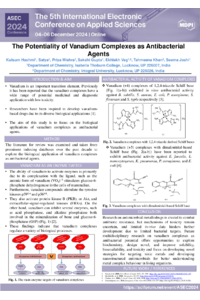
Poster.pdf
Phytosome-Based Nanocarriers Enhanced with Seaweed Extracts: Overcoming the Blood–Brain Barrier
Electrospinning poly(acrylonitrile) (PAN) nanofiber mats with mushroom mycelium powder