Event submissions
Published
This submission belongs to the session S2. Nanosciences, Chemistry and Materials Science of the event The 5th International Electronic Conference on Applied Sciences
Published date
04 Dec, 2024
Academic Editor
'%3e%3cpath%20d='M12.6657%2010.9104C12.4185%2010.325%2012.0599%209.79327%2011.6097%209.34482C11.1609%208.89508%2010.6293%208.5365%2010.0442%208.28888C10.0389%208.28626%2010.0337%208.28495%2010.0285%208.28233C10.8446%207.69279%2011.3752%206.73249%2011.3752%205.64904C11.3752%203.8542%209.92103%202.39999%208.1262%202.39999C6.33136%202.39999%204.87715%203.8542%204.87715%205.64904C4.87715%206.73249%205.40774%207.69279%206.22393%208.28364C6.21869%208.28626%206.21345%208.28757%206.20821%208.29019C5.62129%208.5378%205.09463%208.89284%204.64265%209.34613C4.1929%209.79493%203.83432%2010.3266%203.58671%2010.9117C3.34345%2011.4845%203.21226%2012.0987%203.20023%2012.7209C3.19988%2012.7349%203.20233%2012.7488%203.20744%2012.7619C3.21255%2012.7749%203.22022%2012.7867%203.22998%2012.7968C3.23975%2012.8068%203.25142%2012.8147%203.26431%2012.8202C3.2772%2012.8256%203.29105%2012.8284%203.30504%2012.8284H4.09109C4.14874%2012.8284%204.19459%2012.7825%204.1959%2012.7262C4.2221%2011.7148%204.62823%2010.7676%205.34617%2010.0497C6.08899%209.30683%207.0755%208.89808%208.1262%208.89808C9.17689%208.89808%2010.1634%209.30683%2010.9062%2010.0497C11.6242%2010.7676%2012.0303%2011.7148%2012.0565%2012.7262C12.0578%2012.7838%2012.1037%2012.8284%2012.1613%2012.8284H12.9474C12.9613%2012.8284%2012.9752%2012.8256%2012.9881%2012.8202C13.001%2012.8147%2013.0126%2012.8068%2013.0224%2012.7968C13.0322%2012.7867%2013.0398%2012.7749%2013.0449%2012.7619C13.0501%2012.7488%2013.0525%2012.7349%2013.0522%2012.7209C13.0391%2012.0947%2012.9094%2011.4855%2012.6657%2010.9104ZM8.1262%207.9024C7.52486%207.9024%206.9589%207.6679%206.53312%207.24211C6.10733%206.81633%205.87283%206.25037%205.87283%205.64904C5.87283%205.0477%206.10733%204.48174%206.53312%204.05596C6.9589%203.63018%207.52486%203.39567%208.1262%203.39567C8.72753%203.39567%209.29349%203.63018%209.71927%204.05596C10.1451%204.48174%2010.3796%205.0477%2010.3796%205.64904C10.3796%206.25037%2010.1451%206.81633%209.71927%207.24211C9.29349%207.6679%208.72753%207.9024%208.1262%207.9024Z'%20fill='%235D1EE1'/%3e%3c/g%3e%3c/svg%3e) Luis Cerdán
Luis CerdánCitation
Bekzod Ravshan ugli Eshkulov, Ruzimurod Sattorovich Jurayev, The optimization of processes of electrochemical synthesis of ortho- and para-hydroxybenzoic acids in the presence of CO2, in Proceedings of The 5th International Electronic Conference on Applied Sciences, 4 December–6 December 2024, MDPI: Basel, Switzerland
Share
Email
Facebook
Twitter
LinkedIn
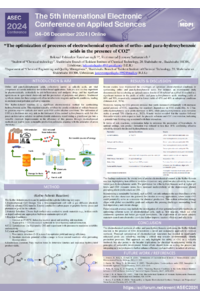
The optimization of processes of electrochemical synthesis of ortho- and para-hydroxybenzoic acids in the presence of CO2

Bekzod Ravshan ugli Eshkulov 1

Ruzimurod Sattorovich Jurayev 2
1. Student of “Chemical technology”, Shakhrisabz Branch of Tashkent Institute of Chemical Technology, 20, Shahrisabz str., Shakhrisabz 181306, Uzbekistan
2. Department of “Chemical Engineering and Quality Management”, Shakhrisabz Branch of Tashkent Institute of Chemical Technology, 20, Shahrisabz str., Shakhrisabz 181306, Uzbekistan
Abstract
The electrochemical synthesis of ortho- and para-hydroxybenzoic acids (HBAs) using CO2 presents a sustainable alternative to traditional methods. These acids, essential intermediates in the production of pharmaceuticals such as aspirin and in polymer manufacturing, are typically synthesized through energy-intensive processes. Given increasing concerns over carbon emissions, optimizing electrochemical approaches that incorporate CO2 as a reactant is vital for improving both economic and environmental sustainability. This study focuses on optimizing the electrochemical synthesis of ortho- and para-HBAs in CO2-saturated environments, aiming to enhance reaction efficiency, and selectivity, and reduce energy consumption. Cyclic voltammetry and constant potential electrolysis were employed, with various electrode materials tested to improve process efficiency. Results indicate that electrode material significantly influences both product selectivity and reaction efficiency. Platinum electrodes exhibited a 15% higher current efficiency and favored para-hydroxybenzoic acid, while carbon-based electrodes showed a 20% increased selectivity for ortho-hydroxybenzoic acid. Additionally, CO2 improved the electrochemical environment by stabilizing radical intermediates and reducing overpotential by 30%. These findings suggest that utilizing CO2 as a reactant not only enhances the sustainability of the process but also improves overall performance. In conclusion, this work offers a promising route for the electrochemical synthesis of hydroxybenzoic acids with reduced environmental impact. Further studies should focus on scaling the process and optimizing electrode materials to facilitate industrial applications, contributing to a greener chemical industry.
Keywords
CO₂ utilization
Electrochemical synthesis
Green chemistry
Hydroxybenzoic acids
Electrode materials
Poster
Poster 1.pdf
Synthesis, characterization, and application of Iron copper phosphate nanoparticles
Analysis of Performance of Flexible Polymer Nano-Sized Layered Humidity Sensor