Event submissions
Published
This submission belongs to the session S2. Nanosciences, Chemistry and Materials Science of the event The 5th International Electronic Conference on Applied Sciences
Published date
04 Dec, 2024
Academic Editor
'%3e%3cpath%20d='M12.6657%2010.9104C12.4185%2010.325%2012.0599%209.79327%2011.6097%209.34482C11.1609%208.89508%2010.6293%208.5365%2010.0442%208.28888C10.0389%208.28626%2010.0337%208.28495%2010.0285%208.28233C10.8446%207.69279%2011.3752%206.73249%2011.3752%205.64904C11.3752%203.8542%209.92103%202.39999%208.1262%202.39999C6.33136%202.39999%204.87715%203.8542%204.87715%205.64904C4.87715%206.73249%205.40774%207.69279%206.22393%208.28364C6.21869%208.28626%206.21345%208.28757%206.20821%208.29019C5.62129%208.5378%205.09463%208.89284%204.64265%209.34613C4.1929%209.79493%203.83432%2010.3266%203.58671%2010.9117C3.34345%2011.4845%203.21226%2012.0987%203.20023%2012.7209C3.19988%2012.7349%203.20233%2012.7488%203.20744%2012.7619C3.21255%2012.7749%203.22022%2012.7867%203.22998%2012.7968C3.23975%2012.8068%203.25142%2012.8147%203.26431%2012.8202C3.2772%2012.8256%203.29105%2012.8284%203.30504%2012.8284H4.09109C4.14874%2012.8284%204.19459%2012.7825%204.1959%2012.7262C4.2221%2011.7148%204.62823%2010.7676%205.34617%2010.0497C6.08899%209.30683%207.0755%208.89808%208.1262%208.89808C9.17689%208.89808%2010.1634%209.30683%2010.9062%2010.0497C11.6242%2010.7676%2012.0303%2011.7148%2012.0565%2012.7262C12.0578%2012.7838%2012.1037%2012.8284%2012.1613%2012.8284H12.9474C12.9613%2012.8284%2012.9752%2012.8256%2012.9881%2012.8202C13.001%2012.8147%2013.0126%2012.8068%2013.0224%2012.7968C13.0322%2012.7867%2013.0398%2012.7749%2013.0449%2012.7619C13.0501%2012.7488%2013.0525%2012.7349%2013.0522%2012.7209C13.0391%2012.0947%2012.9094%2011.4855%2012.6657%2010.9104ZM8.1262%207.9024C7.52486%207.9024%206.9589%207.6679%206.53312%207.24211C6.10733%206.81633%205.87283%206.25037%205.87283%205.64904C5.87283%205.0477%206.10733%204.48174%206.53312%204.05596C6.9589%203.63018%207.52486%203.39567%208.1262%203.39567C8.72753%203.39567%209.29349%203.63018%209.71927%204.05596C10.1451%204.48174%2010.3796%205.0477%2010.3796%205.64904C10.3796%206.25037%2010.1451%206.81633%209.71927%207.24211C9.29349%207.6679%208.72753%207.9024%208.1262%207.9024Z'%20fill='%235D1EE1'/%3e%3c/g%3e%3c/svg%3e) Luis Cerdán
Luis CerdánCitation
Omphemetse Johosheba Machaze, Bongiwe Mbele, Musamba Banza, Tumisang Seodigeng, OPTIMISATION OF COPPER (II) REMOVAL FROM WASTEWATER ONTO MODIFFIED CELLULOSE NANOCRYSTALS USING THE BOX-BEHNKEN DESIGN, in Proceedings of The 5th International Electronic Conference on Applied Sciences, 4 December–6 December 2024, MDPI: Basel, Switzerland
Share
Email
Facebook
Twitter
LinkedIn
OPTIMISATION OF COPPER (II) REMOVAL FROM WASTEWATER ONTO MODIFFIED CELLULOSE NANOCRYSTALS USING THE BOX-BEHNKEN DESIGN
'%3e%3cpath%20d='M12.6647%2010.9104C12.4176%2010.325%2012.0589%209.7933%2011.6088%209.34485C11.16%208.89511%2010.6283%208.53653%2010.0432%208.28891C10.038%208.28629%2010.0327%208.28498%2010.0275%208.28236C10.8437%207.69282%2011.3743%206.73252%2011.3743%205.64907C11.3743%203.85423%209.92005%202.40002%208.12522%202.40002C6.33038%202.40002%204.87618%203.85423%204.87618%205.64907C4.87618%206.73252%205.40677%207.69282%206.22296%208.28367C6.21772%208.28629%206.21248%208.2876%206.20724%208.29022C5.62031%208.53783%205.09365%208.89287%204.64167%209.34616C4.19192%209.79496%203.83334%2010.3266%203.58573%2010.9117C3.34247%2011.4846%203.21128%2012.0987%203.19925%2012.721C3.1989%2012.735%203.20135%2012.7489%203.20646%2012.7619C3.21157%2012.7749%203.21924%2012.7868%203.22901%2012.7968C3.23877%2012.8068%203.25045%2012.8148%203.26334%2012.8202C3.27623%2012.8256%203.29007%2012.8284%203.30406%2012.8284H4.09012C4.14776%2012.8284%204.19362%2012.7825%204.19493%2012.7262C4.22113%2011.7148%204.62726%2010.7676%205.34519%2010.0497C6.08802%209.30686%207.07452%208.89811%208.12522%208.89811C9.17592%208.89811%2010.1624%209.30686%2010.9052%2010.0497C11.6232%2010.7676%2012.0293%2011.7148%2012.0555%2012.7262C12.0568%2012.7839%2012.1027%2012.8284%2012.1603%2012.8284H12.9464C12.9604%2012.8284%2012.9742%2012.8256%2012.9871%2012.8202C13%2012.8148%2013.0117%2012.8068%2013.0214%2012.7968C13.0312%2012.7868%2013.0389%2012.7749%2013.044%2012.7619C13.0491%2012.7489%2013.0515%2012.735%2013.0512%2012.721C13.0381%2012.0947%2012.9084%2011.4856%2012.6647%2010.9104ZM8.12522%207.90243C7.52388%207.90243%206.95792%207.66793%206.53214%207.24215C6.10636%206.81636%205.87185%206.2504%205.87185%205.64907C5.87185%205.04773%206.10636%204.48177%206.53214%204.05599C6.95792%203.63021%207.52388%203.3957%208.12522%203.3957C8.72655%203.3957%209.29252%203.63021%209.7183%204.05599C10.1441%204.48177%2010.3786%205.04773%2010.3786%205.64907C10.3786%206.2504%2010.1441%206.81636%209.7183%207.24215C9.29252%207.66793%208.72655%207.90243%208.12522%207.90243Z'%20fill='%235D1EE1'/%3e%3c/g%3e%3c/svg%3e)
Omphemetse Johosheba Machaze 1
Bongiwe Mbele 1
Musamba Banza 2
Tumisang Seodigeng 1
1. Vaal University of Technology, South Africa
2. Department of Chemical and Metallurgical Engineering, Vaal University of Technology, Private Bag X021,
Vanderbijlpark, Gauteng, 1900, South Africa
Abstract
This studied aimed to remove Cu (II) from waste water onto the modified cellulose nanocrystals using the Box-Benken design in RSM. The Cellulose nanocrystals derived from waste paper was characterized and compared with the modified cellulose nanocrystals by FTIR. The adsorption peaks 3367 and 3420 found in the modified CNC and unmodified CNC spectra, respectively, revealed the characteristics for the stretching of –OH found in the polysaccharide. The strong absorption peak 1551 was found to be present in the unmodified spectra, confirming the characteristics of the asymmetric and symmetric of CO in COO-, and giving evidence for the successful incorporation of EDTA and cellulose nanocrystals. Four parameters pH, contact time, initial concentration and adsorbent dosage were optimized with the use of response surface methodology (RSM) with a quadratic model box-Benken design. Twenty-nine experimental runs were conducted to get the desired response. The results showed that CNCs effectively removed Copper (II) ions, with a maximum removal efficiency of 99.78%. The optimised conditions were pH 6, initial Cu (II) concentration of 125mg/L adsorbent dosage of 6 mg/200mL, and contact time of 30 minutes. The quadratic model developed through RSM showed a moderate to strong correlation, with an R-squared value of 0.988, indicating that 98.88% of the variation removal efficiency can be explained by the predictor variables and their interactions. This study demonstrates the potential of CNCs as an eco-friendly adsorbent for heavy metal removal and highlights the effectiveness of RSM in optimising adsorption processes.
Keywords
Cellulose nanocrystals
Box-Benken design
Response surface methodology
Copper (II)
Optimisation
Poster
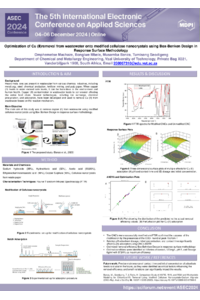
Optmization of Cu2+ removal from wastewater onto modified CNCs using BBD in RSM.pdf
LEAD (II) ADSORPTION FROM WASTEWATER USING MODIFIED CELLULOSE NANOCRYSTALS: KINETICS AND QUANTUM CHEMICAL FUNCTIONALITY
Visible (VIS) Spectrophotometric Analysis of Phenobarbital from Pharmaceuticals through a Quantitative Coupling Reaction with diazonium salt of Beta-Naphthylamine