Event submissions
Published
This submission belongs to the session S2. Nanosciences, Chemistry and Materials Science of the event The 5th International Electronic Conference on Applied Sciences
Published date
04 Dec, 2024
Academic Editor
'%3e%3cpath%20d='M12.6657%2010.9104C12.4185%2010.325%2012.0599%209.79327%2011.6097%209.34482C11.1609%208.89508%2010.6293%208.5365%2010.0442%208.28888C10.0389%208.28626%2010.0337%208.28495%2010.0285%208.28233C10.8446%207.69279%2011.3752%206.73249%2011.3752%205.64904C11.3752%203.8542%209.92103%202.39999%208.1262%202.39999C6.33136%202.39999%204.87715%203.8542%204.87715%205.64904C4.87715%206.73249%205.40774%207.69279%206.22393%208.28364C6.21869%208.28626%206.21345%208.28757%206.20821%208.29019C5.62129%208.5378%205.09463%208.89284%204.64265%209.34613C4.1929%209.79493%203.83432%2010.3266%203.58671%2010.9117C3.34345%2011.4845%203.21226%2012.0987%203.20023%2012.7209C3.19988%2012.7349%203.20233%2012.7488%203.20744%2012.7619C3.21255%2012.7749%203.22022%2012.7867%203.22998%2012.7968C3.23975%2012.8068%203.25142%2012.8147%203.26431%2012.8202C3.2772%2012.8256%203.29105%2012.8284%203.30504%2012.8284H4.09109C4.14874%2012.8284%204.19459%2012.7825%204.1959%2012.7262C4.2221%2011.7148%204.62823%2010.7676%205.34617%2010.0497C6.08899%209.30683%207.0755%208.89808%208.1262%208.89808C9.17689%208.89808%2010.1634%209.30683%2010.9062%2010.0497C11.6242%2010.7676%2012.0303%2011.7148%2012.0565%2012.7262C12.0578%2012.7838%2012.1037%2012.8284%2012.1613%2012.8284H12.9474C12.9613%2012.8284%2012.9752%2012.8256%2012.9881%2012.8202C13.001%2012.8147%2013.0126%2012.8068%2013.0224%2012.7968C13.0322%2012.7867%2013.0398%2012.7749%2013.0449%2012.7619C13.0501%2012.7488%2013.0525%2012.7349%2013.0522%2012.7209C13.0391%2012.0947%2012.9094%2011.4855%2012.6657%2010.9104ZM8.1262%207.9024C7.52486%207.9024%206.9589%207.6679%206.53312%207.24211C6.10733%206.81633%205.87283%206.25037%205.87283%205.64904C5.87283%205.0477%206.10733%204.48174%206.53312%204.05596C6.9589%203.63018%207.52486%203.39567%208.1262%203.39567C8.72753%203.39567%209.29349%203.63018%209.71927%204.05596C10.1451%204.48174%2010.3796%205.0477%2010.3796%205.64904C10.3796%206.25037%2010.1451%206.81633%209.71927%207.24211C9.29349%207.6679%208.72753%207.9024%208.1262%207.9024Z'%20fill='%235D1EE1'/%3e%3c/g%3e%3c/svg%3e) Luis Cerdán
Luis CerdánCitation
King-Pong YU, Kim-Ming Tsoi, Tsz-Yan Yeung, Riggs Ng, Ka-Leung Chan, Exploring the Trade-off between Printing Time and Mechanical Properties: Optimization of Three-Dimensional Printing Parameters for Clinical Aids Fabrication, in Proceedings of The 5th International Electronic Conference on Applied Sciences, 4 December–6 December 2024, MDPI: Basel, Switzerland
Share
Email
Facebook
Twitter
LinkedIn
Exploring the Trade-off between Printing Time and Mechanical Properties: Optimization of Three-Dimensional Printing Parameters for Clinical Aids Fabrication
'%3e%3cpath%20d='M12.6647%2010.9104C12.4176%2010.325%2012.0589%209.7933%2011.6088%209.34485C11.16%208.89511%2010.6283%208.53653%2010.0432%208.28891C10.038%208.28629%2010.0327%208.28498%2010.0275%208.28236C10.8437%207.69282%2011.3743%206.73252%2011.3743%205.64907C11.3743%203.85423%209.92005%202.40002%208.12522%202.40002C6.33038%202.40002%204.87618%203.85423%204.87618%205.64907C4.87618%206.73252%205.40677%207.69282%206.22296%208.28367C6.21772%208.28629%206.21248%208.2876%206.20724%208.29022C5.62031%208.53783%205.09365%208.89287%204.64167%209.34616C4.19192%209.79496%203.83334%2010.3266%203.58573%2010.9117C3.34247%2011.4846%203.21128%2012.0987%203.19925%2012.721C3.1989%2012.735%203.20135%2012.7489%203.20646%2012.7619C3.21157%2012.7749%203.21924%2012.7868%203.22901%2012.7968C3.23877%2012.8068%203.25045%2012.8148%203.26334%2012.8202C3.27623%2012.8256%203.29007%2012.8284%203.30406%2012.8284H4.09012C4.14776%2012.8284%204.19362%2012.7825%204.19493%2012.7262C4.22113%2011.7148%204.62726%2010.7676%205.34519%2010.0497C6.08802%209.30686%207.07452%208.89811%208.12522%208.89811C9.17592%208.89811%2010.1624%209.30686%2010.9052%2010.0497C11.6232%2010.7676%2012.0293%2011.7148%2012.0555%2012.7262C12.0568%2012.7839%2012.1027%2012.8284%2012.1603%2012.8284H12.9464C12.9604%2012.8284%2012.9742%2012.8256%2012.9871%2012.8202C13%2012.8148%2013.0117%2012.8068%2013.0214%2012.7968C13.0312%2012.7868%2013.0389%2012.7749%2013.044%2012.7619C13.0491%2012.7489%2013.0515%2012.735%2013.0512%2012.721C13.0381%2012.0947%2012.9084%2011.4856%2012.6647%2010.9104ZM8.12522%207.90243C7.52388%207.90243%206.95792%207.66793%206.53214%207.24215C6.10636%206.81636%205.87185%206.2504%205.87185%205.64907C5.87185%205.04773%206.10636%204.48177%206.53214%204.05599C6.95792%203.63021%207.52388%203.3957%208.12522%203.3957C8.72655%203.3957%209.29252%203.63021%209.7183%204.05599C10.1441%204.48177%2010.3786%205.04773%2010.3786%205.64907C10.3786%206.2504%2010.1441%206.81636%209.7183%207.24215C9.29252%207.66793%208.72655%207.90243%208.12522%207.90243Z'%20fill='%235D1EE1'/%3e%3c/g%3e%3c/svg%3e)
King-Pong YU 1
Kim-Ming Tsoi 1
Tsz-Yan Yeung 1
Riggs Ng 1
Ka-Leung Chan 1
1. The Hospital Authority Community Rehabilitation Service Support Center (CRSSC), Hong Kong
Abstract
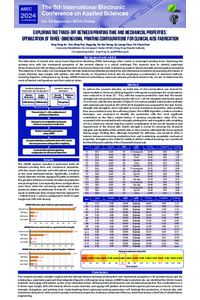
Rehabilitation engineering plays a vital role in developing assistive tools for individuals with diverse abilities, enabling them to perform activities of daily living (ADL) independently. However, the fabrication of clinical aids using Fused Deposition Modeling (FDM) technology often results in prolonged printing times. Balancing the printing time with the mechanical properties of the printed objects is a critical challenge. This research aims to identify optimized 3D printing parameters that minimize printing time while maintaining superior tensile strength and elongation properties.
To achieve the research objective, an initial plan of 256 combinations was devised for experimentation. However, utilizing Taguchi's orthogonal array design, the combinations were reduced to 16 trials, with five samples printed for each trial. Tensile strength and elongation were evaluated as crucial mechanical properties, while printing time was considered a key time efficiency factor. The mRMR algorithm, a feature selection technique, was employed to identify the parameters with the most significant contribution to the three output factors. Subsequently, linear regression analysis was conducted to ascertain the major influencing input parameters.
The mRMR analysis revealed a prominent trade-off between printing time and mechanical properties, with the nozzle diameter and infill pattern emerging as the most dominant factors. Specifically, a 0.6mm nozzle diameter and the zigzag infill pattern exhibited the greatest influence on both mechanical properties and printing time. By employing a systematic approach that integrates Taguchi's orthogonal array design, mRMR feature selection, and linear regression analysis, we identified the combination of a 0.16mm layer height, 30% infill density, 0.6mm nozzle diameter, and zigzag infill pattern demonstrated superior performance in terms of tensile strength, elongation, and printing time. Understanding these optimized printing parameters will facilitate the production of clinical aids with reduced printing times while preserving high mechanical properties, leading to enhanced efficiency and effectiveness in the field of rehabilitation engineering.
Keywords
Optimization
clinical aids
3D Printing
Rehabilitation
Mechanical Properties
Poster
ASEC2024_ sciforum-105429.pdf
Visible (VIS) Spectrophotometric Analysis of Phenobarbital from Pharmaceuticals through a Quantitative Coupling Reaction with diazonium salt of Beta-Naphthylamine
Development of Anticancer Silver-Incorporated PVDF Nanofibrous Scaffold