Event submissions
Published
This submission belongs to the session S2. Nanosciences, Chemistry and Materials Science of the event The 5th International Electronic Conference on Applied Sciences
Published date
04 Dec, 2024
Academic Editor
'%3e%3cpath%20d='M12.6657%2010.9104C12.4185%2010.325%2012.0599%209.79327%2011.6097%209.34482C11.1609%208.89508%2010.6293%208.5365%2010.0442%208.28888C10.0389%208.28626%2010.0337%208.28495%2010.0285%208.28233C10.8446%207.69279%2011.3752%206.73249%2011.3752%205.64904C11.3752%203.8542%209.92103%202.39999%208.1262%202.39999C6.33136%202.39999%204.87715%203.8542%204.87715%205.64904C4.87715%206.73249%205.40774%207.69279%206.22393%208.28364C6.21869%208.28626%206.21345%208.28757%206.20821%208.29019C5.62129%208.5378%205.09463%208.89284%204.64265%209.34613C4.1929%209.79493%203.83432%2010.3266%203.58671%2010.9117C3.34345%2011.4845%203.21226%2012.0987%203.20023%2012.7209C3.19988%2012.7349%203.20233%2012.7488%203.20744%2012.7619C3.21255%2012.7749%203.22022%2012.7867%203.22998%2012.7968C3.23975%2012.8068%203.25142%2012.8147%203.26431%2012.8202C3.2772%2012.8256%203.29105%2012.8284%203.30504%2012.8284H4.09109C4.14874%2012.8284%204.19459%2012.7825%204.1959%2012.7262C4.2221%2011.7148%204.62823%2010.7676%205.34617%2010.0497C6.08899%209.30683%207.0755%208.89808%208.1262%208.89808C9.17689%208.89808%2010.1634%209.30683%2010.9062%2010.0497C11.6242%2010.7676%2012.0303%2011.7148%2012.0565%2012.7262C12.0578%2012.7838%2012.1037%2012.8284%2012.1613%2012.8284H12.9474C12.9613%2012.8284%2012.9752%2012.8256%2012.9881%2012.8202C13.001%2012.8147%2013.0126%2012.8068%2013.0224%2012.7968C13.0322%2012.7867%2013.0398%2012.7749%2013.0449%2012.7619C13.0501%2012.7488%2013.0525%2012.7349%2013.0522%2012.7209C13.0391%2012.0947%2012.9094%2011.4855%2012.6657%2010.9104ZM8.1262%207.9024C7.52486%207.9024%206.9589%207.6679%206.53312%207.24211C6.10733%206.81633%205.87283%206.25037%205.87283%205.64904C5.87283%205.0477%206.10733%204.48174%206.53312%204.05596C6.9589%203.63018%207.52486%203.39567%208.1262%203.39567C8.72753%203.39567%209.29349%203.63018%209.71927%204.05596C10.1451%204.48174%2010.3796%205.0477%2010.3796%205.64904C10.3796%206.25037%2010.1451%206.81633%209.71927%207.24211C9.29349%207.6679%208.72753%207.9024%208.1262%207.9024Z'%20fill='%235D1EE1'/%3e%3c/g%3e%3c/svg%3e) Luis Cerdán
Luis CerdánCitation
Toyese Oyegoke, Mitigating Environmental Risks: Efficient Removal of Metronidazole from Pharmaceutical Wastewater Using Functionalized Graphene Membrane, in Proceedings of The 5th International Electronic Conference on Applied Sciences, 4 December–6 December 2024, MDPI: Basel, Switzerland
Share
Email
Facebook
Twitter
LinkedIn
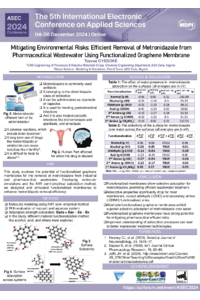
Mitigating Environmental Risks: Efficient Removal of Metronidazole from Pharmaceutical Wastewater Using Functionalized Graphene Membrane

Toyese Oyegoke 1,2
1. CAD-Engineering of Processes and Reactive Materials Group, Chemical Engineering Department, Ahmadu Bello University, Zaria, Nigeria
2. Green Science - Modeling & Simulation, Pencil Team, Ahmadu Bello University, Zaria, Nigeria
Abstract
Metronidazole, an antibiotic widely used in human and veterinary medicine, poses significant environmental risks when discharged into aquatic environments. This study explores the potential of functionalized graphene membranes for the removal of metronidazole from industrial and pharmaceutical wastewater. Employing molecular simulations and the AM1 semi-empirical calculation method, we designed and simulated functionalized membranes to enhance metronidazole removal efficiency. Pharmaceutical effluent containing metronidazole can have detrimental effects on aquatic ecosystems, including toxicity to aquatic organisms and the potential development of antibiotic-resistant bacteria. Our findings show that specific functionalized membranes exhibit selective adsorption for metronidazole, indicating promising results for efficient wastewater treatment. In gas phase simulations, the aldehyde function demonstrates the superior selective adsorption of metronidazole over water, suggesting a lower affinity for water. In aqueous phase simulations, although the adsorption strength of the aldehyde function weakens in the presence of water, functionalization of the membrane surface enhances its overall affinity for metronidazole. Furthermore, the presence of metronidazole in water bodies can lead to bioaccumulation in aquatic organisms, posing risks to human health and the environment. The discharge of pharmaceutical effluent into water bodies can also contribute to the development of antibiotic-resistant bacteria, further exacerbating the environmental impact. Functionalized graphene membranes offer a promising solution for the efficient removal of metronidazole from wastewater due to their high surface area and tunable properties. This study highlights the importance of developing sustainable solutions for pharmaceutical wastewater treatment to protect aquatic ecosystems and human health. In conclusion, the use of functionalized graphene membranes for metronidazole removal shows great potential in mitigating the environmental risks associated with pharmaceutical effluent. By improving our understanding of adsorption processes and membrane interactions, we can develop more effective wastewater treatment technologies to safeguard our environment.
Keywords
Metronidazole
Pharmaceutical wastewater
Functionalized graphene membrane
Molecular simulations
AM1 semi-empirical calculation
Adsorption
Environmental impact
Aquatic ecosystems
Pollution
Poster
Oyegoke POSTER.pdf
Fabrication and Spectral Characterization of Cerium-Doped Magnesium Oxide Nanoparticles: Assessing Antimicrobial Activity and Membranolytic Effects Using Large Unilamellar Vesicles
Dielectric and Catalytic Behavior of V2O5-Rich Glass-Ceramics Synthesized by Controlled Heat Treatment-Induced Crystallization