Event submissions
Published
This submission belongs to the session S2. Nanosciences, Chemistry and Materials Science of the event The 5th International Electronic Conference on Applied Sciences
Published date
04 Dec, 2024
Academic Editor
'%3e%3cpath%20d='M12.6657%2010.9104C12.4185%2010.325%2012.0599%209.79327%2011.6097%209.34482C11.1609%208.89508%2010.6293%208.5365%2010.0442%208.28888C10.0389%208.28626%2010.0337%208.28495%2010.0285%208.28233C10.8446%207.69279%2011.3752%206.73249%2011.3752%205.64904C11.3752%203.8542%209.92103%202.39999%208.1262%202.39999C6.33136%202.39999%204.87715%203.8542%204.87715%205.64904C4.87715%206.73249%205.40774%207.69279%206.22393%208.28364C6.21869%208.28626%206.21345%208.28757%206.20821%208.29019C5.62129%208.5378%205.09463%208.89284%204.64265%209.34613C4.1929%209.79493%203.83432%2010.3266%203.58671%2010.9117C3.34345%2011.4845%203.21226%2012.0987%203.20023%2012.7209C3.19988%2012.7349%203.20233%2012.7488%203.20744%2012.7619C3.21255%2012.7749%203.22022%2012.7867%203.22998%2012.7968C3.23975%2012.8068%203.25142%2012.8147%203.26431%2012.8202C3.2772%2012.8256%203.29105%2012.8284%203.30504%2012.8284H4.09109C4.14874%2012.8284%204.19459%2012.7825%204.1959%2012.7262C4.2221%2011.7148%204.62823%2010.7676%205.34617%2010.0497C6.08899%209.30683%207.0755%208.89808%208.1262%208.89808C9.17689%208.89808%2010.1634%209.30683%2010.9062%2010.0497C11.6242%2010.7676%2012.0303%2011.7148%2012.0565%2012.7262C12.0578%2012.7838%2012.1037%2012.8284%2012.1613%2012.8284H12.9474C12.9613%2012.8284%2012.9752%2012.8256%2012.9881%2012.8202C13.001%2012.8147%2013.0126%2012.8068%2013.0224%2012.7968C13.0322%2012.7867%2013.0398%2012.7749%2013.0449%2012.7619C13.0501%2012.7488%2013.0525%2012.7349%2013.0522%2012.7209C13.0391%2012.0947%2012.9094%2011.4855%2012.6657%2010.9104ZM8.1262%207.9024C7.52486%207.9024%206.9589%207.6679%206.53312%207.24211C6.10733%206.81633%205.87283%206.25037%205.87283%205.64904C5.87283%205.0477%206.10733%204.48174%206.53312%204.05596C6.9589%203.63018%207.52486%203.39567%208.1262%203.39567C8.72753%203.39567%209.29349%203.63018%209.71927%204.05596C10.1451%204.48174%2010.3796%205.0477%2010.3796%205.64904C10.3796%206.25037%2010.1451%206.81633%209.71927%207.24211C9.29349%207.6679%208.72753%207.9024%208.1262%207.9024Z'%20fill='%235D1EE1'/%3e%3c/g%3e%3c/svg%3e) Luis Cerdán
Luis CerdánCitation
Sara Marijan, Marija Mirosavljević, Teodoro Klaser, Petr Mošner, Ladislav Koudelka, Željko Skoko, Jana Pisk, Luka Pavić, Dielectric and Catalytic Behavior of V₂O₅-Rich Glass-Ceramics Synthesized by Controlled Heat Treatment-Induced Crystallization, in Proceedings of The 5th International Electronic Conference on Applied Sciences, 4 December–6 December 2024, MDPI: Basel, Switzerland
Share
Email
Facebook
Twitter
LinkedIn
Dielectric and Catalytic Behavior of V2O5-Rich Glass-Ceramics Synthesized by Controlled Heat Treatment-Induced Crystallization
'%3e%3cpath%20d='M12.6647%2010.9104C12.4176%2010.325%2012.0589%209.7933%2011.6088%209.34485C11.16%208.89511%2010.6283%208.53653%2010.0432%208.28891C10.038%208.28629%2010.0327%208.28498%2010.0275%208.28236C10.8437%207.69282%2011.3743%206.73252%2011.3743%205.64907C11.3743%203.85423%209.92005%202.40002%208.12522%202.40002C6.33038%202.40002%204.87618%203.85423%204.87618%205.64907C4.87618%206.73252%205.40677%207.69282%206.22296%208.28367C6.21772%208.28629%206.21248%208.2876%206.20724%208.29022C5.62031%208.53783%205.09365%208.89287%204.64167%209.34616C4.19192%209.79496%203.83334%2010.3266%203.58573%2010.9117C3.34247%2011.4846%203.21128%2012.0987%203.19925%2012.721C3.1989%2012.735%203.20135%2012.7489%203.20646%2012.7619C3.21157%2012.7749%203.21924%2012.7868%203.22901%2012.7968C3.23877%2012.8068%203.25045%2012.8148%203.26334%2012.8202C3.27623%2012.8256%203.29007%2012.8284%203.30406%2012.8284H4.09012C4.14776%2012.8284%204.19362%2012.7825%204.19493%2012.7262C4.22113%2011.7148%204.62726%2010.7676%205.34519%2010.0497C6.08802%209.30686%207.07452%208.89811%208.12522%208.89811C9.17592%208.89811%2010.1624%209.30686%2010.9052%2010.0497C11.6232%2010.7676%2012.0293%2011.7148%2012.0555%2012.7262C12.0568%2012.7839%2012.1027%2012.8284%2012.1603%2012.8284H12.9464C12.9604%2012.8284%2012.9742%2012.8256%2012.9871%2012.8202C13%2012.8148%2013.0117%2012.8068%2013.0214%2012.7968C13.0312%2012.7868%2013.0389%2012.7749%2013.044%2012.7619C13.0491%2012.7489%2013.0515%2012.735%2013.0512%2012.721C13.0381%2012.0947%2012.9084%2011.4856%2012.6647%2010.9104ZM8.12522%207.90243C7.52388%207.90243%206.95792%207.66793%206.53214%207.24215C6.10636%206.81636%205.87185%206.2504%205.87185%205.64907C5.87185%205.04773%206.10636%204.48177%206.53214%204.05599C6.95792%203.63021%207.52388%203.3957%208.12522%203.3957C8.72655%203.3957%209.29252%203.63021%209.7183%204.05599C10.1441%204.48177%2010.3786%205.04773%2010.3786%205.64907C10.3786%206.2504%2010.1441%206.81636%209.7183%207.24215C9.29252%207.66793%208.72655%207.90243%208.12522%207.90243Z'%20fill='%235D1EE1'/%3e%3c/g%3e%3c/svg%3e)
Sara Marijan 1
Marija Mirosavljević 2
Teodoro Klaser 2
Petr Mošner 3
Ladislav Koudelka 3

Željko Skoko 4

Jana Pisk 5

Luka Pavić 2
1. Ruđer Bošković Institute, Bijenička cesta 54, 10000 Zagreb, Croatia
2. Division of Materials Chemistry, Ruđer Bošković Institute, Bijenička cesta 54, Zagreb, Croatia
3. Department of General and Inorganic Chemistry, Faculty of Chemical Technology, University of Pardubice, Pardubice, Czech Republic
4. Department of Physics, Faculty of Science, University of Zagreb, Bijenička cesta 32, Zagreb, Croatia
5. Department of Chemistry, Faculty of Science, University of Zagreb, Horvatovac 102a, Zagreb, Croatia
Abstract
The need for innovative, sustainable materials for electrochemical devices and catalysts highlights V2O5-based materials as particularly promising. They can serve as cathodes for Li-ion, Na-ion, and all-solid-state batteries due to their high safety, energy density, and long life cycles. Additionally, they function as catalysts in oxidation reactions, especially fatty acid decarboxylation, which is crucial for biodiesel production—a renewable, lower-toxicity alternative to petroleum diesel that reduces greenhouse gas emissions and addresses environmental challenges. V2O5-rich glasses and glass–ceramics (GCs) stand out due to their dense, uniform microstructures and exceptional mechanical, thermal, electrical, dielectric, and catalytic properties. Furthermore, GCs are particularly interesting because they offer unique control over composition, crystallographic structure, and microstructure, including the type and quantity of crystalline phases within the residual glassy phase, all of which can be finely adjusted through heat treatment conditions such as temperature and duration. In light of these factors, this study examines how the controlled crystallization of V2O5-rich parent glass affects its structural, dielectric, and catalytic properties. The composition of prepared samples is analyzed using powder X-ray diffraction (PXRD), while their (micro)structural properties are characterized by scanning electron microscopy, energy-dispersive X-ray spectroscopy (SEM-EDS) and infrared attenuated total reflectance spectroscopy (IR-ATR). Dielectric properties are investigated via solid-state impedance spectroscopy (SS-IS) across a broad frequency range (0.01 Hz to 1 MHz) and temperature range (–90 °C to 210 °C). Additionally, catalytic activity in fatty acid decarboxylation is evaluated using thermogravimetric analysis and differential scanning calorimetry (TG/DSC). The results demonstrate significant improvements in both dielectric and catalytic performance, highlighting the versatile potential of V2O5-rich glass–ceramics for advanced electronic applications and sustainable biodiesel production.
This work is supported by the Croatian Science Foundation under the projects IP-2018-01-5425 and DOK-2021-02-9665 and partially funded by the European Union – NextGenerationEU.
Keywords
vanadate glasses
glass-ceramics
controlled crystallization
structural properties
dielectric properties
catalytic activity
impedance spectroscopy
Poster
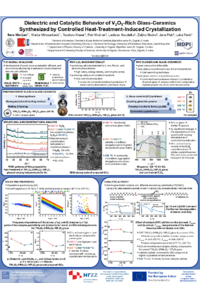
Sara_Marijan_ASEC2024_v2.pdf
Mitigating Environmental Risks: Efficient Removal of Metronidazole from Pharmaceutical Wastewater Using Functionalized Graphene Membrane
Chromatographic behaviour of arylidene 2-thiohydantoin derivatives in an acetonitrile and F5 column