Event submissions
Published
This submission belongs to the session S2. Nanosciences, Chemistry and Materials Science of the event The 5th International Electronic Conference on Applied Sciences
Published date
04 Dec, 2024
Academic Editor
'%3e%3cpath%20d='M12.6657%2010.9104C12.4185%2010.325%2012.0599%209.79327%2011.6097%209.34482C11.1609%208.89508%2010.6293%208.5365%2010.0442%208.28888C10.0389%208.28626%2010.0337%208.28495%2010.0285%208.28233C10.8446%207.69279%2011.3752%206.73249%2011.3752%205.64904C11.3752%203.8542%209.92103%202.39999%208.1262%202.39999C6.33136%202.39999%204.87715%203.8542%204.87715%205.64904C4.87715%206.73249%205.40774%207.69279%206.22393%208.28364C6.21869%208.28626%206.21345%208.28757%206.20821%208.29019C5.62129%208.5378%205.09463%208.89284%204.64265%209.34613C4.1929%209.79493%203.83432%2010.3266%203.58671%2010.9117C3.34345%2011.4845%203.21226%2012.0987%203.20023%2012.7209C3.19988%2012.7349%203.20233%2012.7488%203.20744%2012.7619C3.21255%2012.7749%203.22022%2012.7867%203.22998%2012.7968C3.23975%2012.8068%203.25142%2012.8147%203.26431%2012.8202C3.2772%2012.8256%203.29105%2012.8284%203.30504%2012.8284H4.09109C4.14874%2012.8284%204.19459%2012.7825%204.1959%2012.7262C4.2221%2011.7148%204.62823%2010.7676%205.34617%2010.0497C6.08899%209.30683%207.0755%208.89808%208.1262%208.89808C9.17689%208.89808%2010.1634%209.30683%2010.9062%2010.0497C11.6242%2010.7676%2012.0303%2011.7148%2012.0565%2012.7262C12.0578%2012.7838%2012.1037%2012.8284%2012.1613%2012.8284H12.9474C12.9613%2012.8284%2012.9752%2012.8256%2012.9881%2012.8202C13.001%2012.8147%2013.0126%2012.8068%2013.0224%2012.7968C13.0322%2012.7867%2013.0398%2012.7749%2013.0449%2012.7619C13.0501%2012.7488%2013.0525%2012.7349%2013.0522%2012.7209C13.0391%2012.0947%2012.9094%2011.4855%2012.6657%2010.9104ZM8.1262%207.9024C7.52486%207.9024%206.9589%207.6679%206.53312%207.24211C6.10733%206.81633%205.87283%206.25037%205.87283%205.64904C5.87283%205.0477%206.10733%204.48174%206.53312%204.05596C6.9589%203.63018%207.52486%203.39567%208.1262%203.39567C8.72753%203.39567%209.29349%203.63018%209.71927%204.05596C10.1451%204.48174%2010.3796%205.0477%2010.3796%205.64904C10.3796%206.25037%2010.1451%206.81633%209.71927%207.24211C9.29349%207.6679%208.72753%207.9024%208.1262%207.9024Z'%20fill='%235D1EE1'/%3e%3c/g%3e%3c/svg%3e) Luis Cerdán
Luis CerdánCitation
Maryam Isa, Fatimatalzahraa Naser, Zainab Jaffar, Zainab Saleh, Noor Ebrahim, Nidha begum, Dr.Roshan* Deen, Fatima* Alhannan, Biowaste-mediated green synthesis of well-defined silver nanoparticles and nanocomposites for biomedical and environmental applications: Waste-to-Wealth Approach., in Proceedings of The 5th International Electronic Conference on Applied Sciences, 4 December–6 December 2024, MDPI: Basel, Switzerland
Share
Email
Facebook
Twitter
LinkedIn
Biowaste-mediated green synthesis of well-defined silver nanoparticles and nanocomposites for biomedical and environmental applications: Waste-to-Wealth Approach.
'%3e%3cpath%20d='M12.6647%2010.9104C12.4176%2010.325%2012.0589%209.7933%2011.6088%209.34485C11.16%208.89511%2010.6283%208.53653%2010.0432%208.28891C10.038%208.28629%2010.0327%208.28498%2010.0275%208.28236C10.8437%207.69282%2011.3743%206.73252%2011.3743%205.64907C11.3743%203.85423%209.92005%202.40002%208.12522%202.40002C6.33038%202.40002%204.87618%203.85423%204.87618%205.64907C4.87618%206.73252%205.40677%207.69282%206.22296%208.28367C6.21772%208.28629%206.21248%208.2876%206.20724%208.29022C5.62031%208.53783%205.09365%208.89287%204.64167%209.34616C4.19192%209.79496%203.83334%2010.3266%203.58573%2010.9117C3.34247%2011.4846%203.21128%2012.0987%203.19925%2012.721C3.1989%2012.735%203.20135%2012.7489%203.20646%2012.7619C3.21157%2012.7749%203.21924%2012.7868%203.22901%2012.7968C3.23877%2012.8068%203.25045%2012.8148%203.26334%2012.8202C3.27623%2012.8256%203.29007%2012.8284%203.30406%2012.8284H4.09012C4.14776%2012.8284%204.19362%2012.7825%204.19493%2012.7262C4.22113%2011.7148%204.62726%2010.7676%205.34519%2010.0497C6.08802%209.30686%207.07452%208.89811%208.12522%208.89811C9.17592%208.89811%2010.1624%209.30686%2010.9052%2010.0497C11.6232%2010.7676%2012.0293%2011.7148%2012.0555%2012.7262C12.0568%2012.7839%2012.1027%2012.8284%2012.1603%2012.8284H12.9464C12.9604%2012.8284%2012.9742%2012.8256%2012.9871%2012.8202C13%2012.8148%2013.0117%2012.8068%2013.0214%2012.7968C13.0312%2012.7868%2013.0389%2012.7749%2013.044%2012.7619C13.0491%2012.7489%2013.0515%2012.735%2013.0512%2012.721C13.0381%2012.0947%2012.9084%2011.4856%2012.6647%2010.9104ZM8.12522%207.90243C7.52388%207.90243%206.95792%207.66793%206.53214%207.24215C6.10636%206.81636%205.87185%206.2504%205.87185%205.64907C5.87185%205.04773%206.10636%204.48177%206.53214%204.05599C6.95792%203.63021%207.52388%203.3957%208.12522%203.3957C8.72655%203.3957%209.29252%203.63021%209.7183%204.05599C10.1441%204.48177%2010.3786%205.04773%2010.3786%205.64907C10.3786%206.2504%2010.1441%206.81636%209.7183%207.24215C9.29252%207.66793%208.72655%207.90243%208.12522%207.90243Z'%20fill='%235D1EE1'/%3e%3c/g%3e%3c/svg%3e)
Maryam Isa 1
Fatimatalzahraa Naser 1
Zainab Jaffar 1
Zainab Saleh 1
Noor Ebrahim 1
Nidha begum 1

Dr.Roshan* Deen 1
Fatima* Alhannan 1
1. Materials for Medicine Research Group, School of Medicine, Royal College of Surgeons in Ireland-Medical University of Bahrain, Building No. 2441, Road 2835, Busaiteen Block 228, Kingdom of Bahrain
Abstract
Introduction
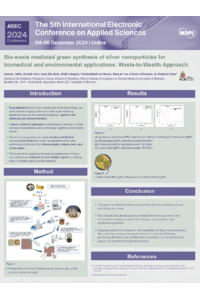
Utilizing organic biowaste to produce nanoparticles has become of great interest in the field of nanotechnology. Nanomaterials produced through this green route are non-toxic, and the process is environmentally friendly. In this project, we synthesized stable and well-defined silver nanoparticles and nanocomposite films using organic biowaste such as banana peels, chikoo peels, and lemon peels. The synthesis methodology and their application as antibacterial and catalytic agents were investigated.
Method
The formation of silver nanoparticles was achieved using biowaste extracts as reducing and stabilizing agents. Sodium alginate–polyvinyl alcohol–silver nanocomposites were prepared by crosslinking using glutaraldehyde. All the materials were characterized by UV-Vis spectroscopy and electron microscopy. Their antibacterial properties were assessed against Staphylococcus epidermidis, Staphylococcus aureus, and Eschericia coli.
Results
The color change to black with the addition of NaOH indicated the formation of silver nanoparticles. The nanoparticles exhibited a strong plasmon resonance (SPR) peak at around 400 nm, confirming their presence. The peak was sharp and narrow, indicating low polydispersity. The nanocomposite films were effective against the bacteria tested, especially Staphylococcus epidermidis.
Conclusion:
The green synthesis of silver nanoparticles using biowaste yielded promising results, such as the creation of flexible films. The re-use and application of the nanocomposite films in the proliferation of fibroblast cells are currently in progress.
Keywords
green synthesis
silver nanoparticles
antibacterial properties
films
Poster
Bio-waste mediated green synthesis of silver nanoparticles for biomedical and environmental applications Waste-to-Wealth Approach. (1).pdf
Effects of TiO₂ and ZnO nanoparticles on intestinal cells: An in vitro approach
Fabrication of polyvinyl alcohol-sodium alginate nanocomposite hydrogels reinforced with green synthesised silver nanoparticles for antimicrobial applications