Event submissions
Published
This submission belongs to the session S2. Nanosciences, Chemistry and Materials Science of the event The 5th International Electronic Conference on Applied Sciences
Published date
04 Dec, 2024
Academic Editor
'%3e%3cpath%20d='M12.6657%2010.9104C12.4185%2010.325%2012.0599%209.79327%2011.6097%209.34482C11.1609%208.89508%2010.6293%208.5365%2010.0442%208.28888C10.0389%208.28626%2010.0337%208.28495%2010.0285%208.28233C10.8446%207.69279%2011.3752%206.73249%2011.3752%205.64904C11.3752%203.8542%209.92103%202.39999%208.1262%202.39999C6.33136%202.39999%204.87715%203.8542%204.87715%205.64904C4.87715%206.73249%205.40774%207.69279%206.22393%208.28364C6.21869%208.28626%206.21345%208.28757%206.20821%208.29019C5.62129%208.5378%205.09463%208.89284%204.64265%209.34613C4.1929%209.79493%203.83432%2010.3266%203.58671%2010.9117C3.34345%2011.4845%203.21226%2012.0987%203.20023%2012.7209C3.19988%2012.7349%203.20233%2012.7488%203.20744%2012.7619C3.21255%2012.7749%203.22022%2012.7867%203.22998%2012.7968C3.23975%2012.8068%203.25142%2012.8147%203.26431%2012.8202C3.2772%2012.8256%203.29105%2012.8284%203.30504%2012.8284H4.09109C4.14874%2012.8284%204.19459%2012.7825%204.1959%2012.7262C4.2221%2011.7148%204.62823%2010.7676%205.34617%2010.0497C6.08899%209.30683%207.0755%208.89808%208.1262%208.89808C9.17689%208.89808%2010.1634%209.30683%2010.9062%2010.0497C11.6242%2010.7676%2012.0303%2011.7148%2012.0565%2012.7262C12.0578%2012.7838%2012.1037%2012.8284%2012.1613%2012.8284H12.9474C12.9613%2012.8284%2012.9752%2012.8256%2012.9881%2012.8202C13.001%2012.8147%2013.0126%2012.8068%2013.0224%2012.7968C13.0322%2012.7867%2013.0398%2012.7749%2013.0449%2012.7619C13.0501%2012.7488%2013.0525%2012.7349%2013.0522%2012.7209C13.0391%2012.0947%2012.9094%2011.4855%2012.6657%2010.9104ZM8.1262%207.9024C7.52486%207.9024%206.9589%207.6679%206.53312%207.24211C6.10733%206.81633%205.87283%206.25037%205.87283%205.64904C5.87283%205.0477%206.10733%204.48174%206.53312%204.05596C6.9589%203.63018%207.52486%203.39567%208.1262%203.39567C8.72753%203.39567%209.29349%203.63018%209.71927%204.05596C10.1451%204.48174%2010.3796%205.0477%2010.3796%205.64904C10.3796%206.25037%2010.1451%206.81633%209.71927%207.24211C9.29349%207.6679%208.72753%207.9024%208.1262%207.9024Z'%20fill='%235D1EE1'/%3e%3c/g%3e%3c/svg%3e) Luis Cerdán
Luis CerdánCitation
Ghadeer A.Ghaffar Almarzooq, Zain Jameel Salman, Amal Zakareya Alhaddad, Zainab Ahmed Ali, Tasneem Abdullah AL-Qatta, Fatema Abdulla, Fatima Al Hannan, G.Roshan Deen, Fabrication of polyvinyl alcohol-sodium alginate nanocomposite hydrogels reinforced with green synthesised silver nanoparticles for antimicrobial applications, in Proceedings of The 5th International Electronic Conference on Applied Sciences, 4 December–6 December 2024, MDPI: Basel, Switzerland
Share
Email
Facebook
Twitter
LinkedIn
Fabrication of polyvinyl alcohol-sodium alginate nanocomposite hydrogels reinforced with green synthesised silver nanoparticles for antimicrobial applications
'%3e%3cpath%20d='M12.6647%2010.9104C12.4176%2010.325%2012.0589%209.7933%2011.6088%209.34485C11.16%208.89511%2010.6283%208.53653%2010.0432%208.28891C10.038%208.28629%2010.0327%208.28498%2010.0275%208.28236C10.8437%207.69282%2011.3743%206.73252%2011.3743%205.64907C11.3743%203.85423%209.92005%202.40002%208.12522%202.40002C6.33038%202.40002%204.87618%203.85423%204.87618%205.64907C4.87618%206.73252%205.40677%207.69282%206.22296%208.28367C6.21772%208.28629%206.21248%208.2876%206.20724%208.29022C5.62031%208.53783%205.09365%208.89287%204.64167%209.34616C4.19192%209.79496%203.83334%2010.3266%203.58573%2010.9117C3.34247%2011.4846%203.21128%2012.0987%203.19925%2012.721C3.1989%2012.735%203.20135%2012.7489%203.20646%2012.7619C3.21157%2012.7749%203.21924%2012.7868%203.22901%2012.7968C3.23877%2012.8068%203.25045%2012.8148%203.26334%2012.8202C3.27623%2012.8256%203.29007%2012.8284%203.30406%2012.8284H4.09012C4.14776%2012.8284%204.19362%2012.7825%204.19493%2012.7262C4.22113%2011.7148%204.62726%2010.7676%205.34519%2010.0497C6.08802%209.30686%207.07452%208.89811%208.12522%208.89811C9.17592%208.89811%2010.1624%209.30686%2010.9052%2010.0497C11.6232%2010.7676%2012.0293%2011.7148%2012.0555%2012.7262C12.0568%2012.7839%2012.1027%2012.8284%2012.1603%2012.8284H12.9464C12.9604%2012.8284%2012.9742%2012.8256%2012.9871%2012.8202C13%2012.8148%2013.0117%2012.8068%2013.0214%2012.7968C13.0312%2012.7868%2013.0389%2012.7749%2013.044%2012.7619C13.0491%2012.7489%2013.0515%2012.735%2013.0512%2012.721C13.0381%2012.0947%2012.9084%2011.4856%2012.6647%2010.9104ZM8.12522%207.90243C7.52388%207.90243%206.95792%207.66793%206.53214%207.24215C6.10636%206.81636%205.87185%206.2504%205.87185%205.64907C5.87185%205.04773%206.10636%204.48177%206.53214%204.05599C6.95792%203.63021%207.52388%203.3957%208.12522%203.3957C8.72655%203.3957%209.29252%203.63021%209.7183%204.05599C10.1441%204.48177%2010.3786%205.04773%2010.3786%205.64907C10.3786%206.2504%2010.1441%206.81636%209.7183%207.24215C9.29252%207.66793%208.72655%207.90243%208.12522%207.90243Z'%20fill='%235D1EE1'/%3e%3c/g%3e%3c/svg%3e)
Ghadeer A.Ghaffar Almarzooq 1
Zain Jameel Salman 1
Amal Zakareya Alhaddad 2
Zainab Ahmed Ali 1
Tasneem Abdullah AL-Qatta 1
Fatema Abdulla 1
Fatima Al Hannan 1

G.Roshan Deen 1
1. Materials for Medicine Research Group, School of Medicine, Royal College of Surgeons in Ireland-Medical University of Bahrain, Building No. 2441, Road 2835, Busaiteen Block 228, Kingdom of Bahrain
2. Royal College of Surgeons in Ireland - Bahrain, Al Sayh Muharraq Governorate, RCSI Bahrain, 15503, Adliya, Bahrain
Abstract
Introduction
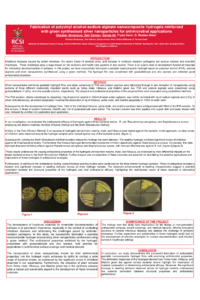
Infectious diseases caused by potent microbes, the recent Covid-19 medical crisis, and increase in antibiotic resistant pathogens are serious medical and scientific challenges. These challenges pose a huge impact on the economy and health care systems of any country. There is an urgent need to development functional materials for immediate decontamination of surfaces. In this project, we have successfully fabricated a peelable nanocomposite hydrogel based on polyvinyl alcohol (PVA), sodium alginate and silver nanoparticles (synthesized using a green method). The hydrogel film was crosslinked with glutaraldehyde and zinc acetate and exhibited good antibacterial properties.
Methods
Silver nanoparticles reinforced peelable hydrogel films and slabs comprising of PVA and sodium alginate were fabricated through in situ formation of nanoparticles using extracts of three different medicinally important plants such as Yerba mate, Hibiscus, and Matcha green tea. PVA and sodium alginate were crosslinked using glutaraldehyde (1 wt%), and zinc acetate solution, respectively. The physical and antibacterial properties of the prepared films were evaluated using established methods.
Results
The resulting hydrogels were tough, and the films were peelable and flexible. A strong surface plasmon resonance (SPR) peak around 400 nm confirmed the presence of silver nanoparticles in the hydrogel. The hydrogels exhibited considerable swelling capacity and the equilibrium water capacity was evaluated.
Conclusion and Work in-progress
A decontaminating hydrogel (in the form of slabs and films) composed of PVA and sodium alginate containing green synthesized silver nanoparticles were successfully prepared. The silver nanoparticles were prepared by ins situ chemical reduction using the extracts of medicinally important plant products. The presence of phytochemicals and silver nanoparticles had a synergistic effect on the antibacterial properties of the hydrogel. The mechanical properties of the films are currently being explored.
Keywords
Keywords: green synthesis
silver nanoparticles
nanocomposites
hydrogel
antibacterial
Poster
hydrogel poster.pdf
Biowaste-mediated green synthesis of well-defined silver nanoparticles and nanocomposites for biomedical and environmental applications: Waste-to-Wealth Approach.
Structural analysis of zinc oxide nanostructures and study of the influence of the hydrothermal method on nanowire preparation