Event submissions
Published
This submission belongs to the session S2. Nanosciences, Chemistry and Materials Science of the event The 5th International Electronic Conference on Applied Sciences
Published date
04 Dec, 2024
Academic Editor
'%3e%3cpath%20d='M12.6657%2010.9104C12.4185%2010.325%2012.0599%209.79327%2011.6097%209.34482C11.1609%208.89508%2010.6293%208.5365%2010.0442%208.28888C10.0389%208.28626%2010.0337%208.28495%2010.0285%208.28233C10.8446%207.69279%2011.3752%206.73249%2011.3752%205.64904C11.3752%203.8542%209.92103%202.39999%208.1262%202.39999C6.33136%202.39999%204.87715%203.8542%204.87715%205.64904C4.87715%206.73249%205.40774%207.69279%206.22393%208.28364C6.21869%208.28626%206.21345%208.28757%206.20821%208.29019C5.62129%208.5378%205.09463%208.89284%204.64265%209.34613C4.1929%209.79493%203.83432%2010.3266%203.58671%2010.9117C3.34345%2011.4845%203.21226%2012.0987%203.20023%2012.7209C3.19988%2012.7349%203.20233%2012.7488%203.20744%2012.7619C3.21255%2012.7749%203.22022%2012.7867%203.22998%2012.7968C3.23975%2012.8068%203.25142%2012.8147%203.26431%2012.8202C3.2772%2012.8256%203.29105%2012.8284%203.30504%2012.8284H4.09109C4.14874%2012.8284%204.19459%2012.7825%204.1959%2012.7262C4.2221%2011.7148%204.62823%2010.7676%205.34617%2010.0497C6.08899%209.30683%207.0755%208.89808%208.1262%208.89808C9.17689%208.89808%2010.1634%209.30683%2010.9062%2010.0497C11.6242%2010.7676%2012.0303%2011.7148%2012.0565%2012.7262C12.0578%2012.7838%2012.1037%2012.8284%2012.1613%2012.8284H12.9474C12.9613%2012.8284%2012.9752%2012.8256%2012.9881%2012.8202C13.001%2012.8147%2013.0126%2012.8068%2013.0224%2012.7968C13.0322%2012.7867%2013.0398%2012.7749%2013.0449%2012.7619C13.0501%2012.7488%2013.0525%2012.7349%2013.0522%2012.7209C13.0391%2012.0947%2012.9094%2011.4855%2012.6657%2010.9104ZM8.1262%207.9024C7.52486%207.9024%206.9589%207.6679%206.53312%207.24211C6.10733%206.81633%205.87283%206.25037%205.87283%205.64904C5.87283%205.0477%206.10733%204.48174%206.53312%204.05596C6.9589%203.63018%207.52486%203.39567%208.1262%203.39567C8.72753%203.39567%209.29349%203.63018%209.71927%204.05596C10.1451%204.48174%2010.3796%205.0477%2010.3796%205.64904C10.3796%206.25037%2010.1451%206.81633%209.71927%207.24211C9.29349%207.6679%208.72753%207.9024%208.1262%207.9024Z'%20fill='%235D1EE1'/%3e%3c/g%3e%3c/svg%3e) Luis Cerdán
Luis CerdánCitation
Fatimatalzahraa Naser, Zainab Saleh, Nidha begum, Zainab Jaffar, Noor Ebrahim, Maryam Isa, Roshan Deen, Fatima Alhannan, Green synthesis of protein-decorated selenium nanoparticles for enhanced antibacterial and degradation of organic dyes in water, in Proceedings of The 5th International Electronic Conference on Applied Sciences, 4 December–6 December 2024, MDPI: Basel, Switzerland
Share
Email
Facebook
Twitter
LinkedIn
Green synthesis of protein-decorated selenium nanoparticles for enhanced antibacterial and degradation of organic dyes in water
'%3e%3cpath%20d='M12.6647%2010.9104C12.4176%2010.325%2012.0589%209.7933%2011.6088%209.34485C11.16%208.89511%2010.6283%208.53653%2010.0432%208.28891C10.038%208.28629%2010.0327%208.28498%2010.0275%208.28236C10.8437%207.69282%2011.3743%206.73252%2011.3743%205.64907C11.3743%203.85423%209.92005%202.40002%208.12522%202.40002C6.33038%202.40002%204.87618%203.85423%204.87618%205.64907C4.87618%206.73252%205.40677%207.69282%206.22296%208.28367C6.21772%208.28629%206.21248%208.2876%206.20724%208.29022C5.62031%208.53783%205.09365%208.89287%204.64167%209.34616C4.19192%209.79496%203.83334%2010.3266%203.58573%2010.9117C3.34247%2011.4846%203.21128%2012.0987%203.19925%2012.721C3.1989%2012.735%203.20135%2012.7489%203.20646%2012.7619C3.21157%2012.7749%203.21924%2012.7868%203.22901%2012.7968C3.23877%2012.8068%203.25045%2012.8148%203.26334%2012.8202C3.27623%2012.8256%203.29007%2012.8284%203.30406%2012.8284H4.09012C4.14776%2012.8284%204.19362%2012.7825%204.19493%2012.7262C4.22113%2011.7148%204.62726%2010.7676%205.34519%2010.0497C6.08802%209.30686%207.07452%208.89811%208.12522%208.89811C9.17592%208.89811%2010.1624%209.30686%2010.9052%2010.0497C11.6232%2010.7676%2012.0293%2011.7148%2012.0555%2012.7262C12.0568%2012.7839%2012.1027%2012.8284%2012.1603%2012.8284H12.9464C12.9604%2012.8284%2012.9742%2012.8256%2012.9871%2012.8202C13%2012.8148%2013.0117%2012.8068%2013.0214%2012.7968C13.0312%2012.7868%2013.0389%2012.7749%2013.044%2012.7619C13.0491%2012.7489%2013.0515%2012.735%2013.0512%2012.721C13.0381%2012.0947%2012.9084%2011.4856%2012.6647%2010.9104ZM8.12522%207.90243C7.52388%207.90243%206.95792%207.66793%206.53214%207.24215C6.10636%206.81636%205.87185%206.2504%205.87185%205.64907C5.87185%205.04773%206.10636%204.48177%206.53214%204.05599C6.95792%203.63021%207.52388%203.3957%208.12522%203.3957C8.72655%203.3957%209.29252%203.63021%209.7183%204.05599C10.1441%204.48177%2010.3786%205.04773%2010.3786%205.64907C10.3786%206.2504%2010.1441%206.81636%209.7183%207.24215C9.29252%207.66793%208.72655%207.90243%208.12522%207.90243Z'%20fill='%235D1EE1'/%3e%3c/g%3e%3c/svg%3e)
Fatimatalzahraa Naser 1
Zainab Saleh 1
Nidha begum 1
Zainab Jaffar 1
Noor Ebrahim 1
Maryam Isa 1
Roshan Deen 1
Fatima Alhannan 1
1. Materials for Medicine Research Group, School of Medicine, Royal College of Surgeons in Ireland-Medical University of Bahrain, Building No. 2441, Road 2835, Busaiteen Block 228, Kingdom of Bahrain
Abstract
Introduction
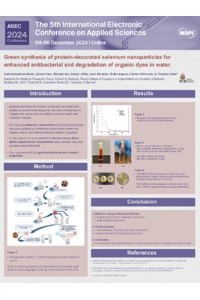
Bacteria and toxicants continue to threaten our health and pollute our environment. Eradicating those substances would lead to better health. Synthesizing selenium nanoparticles and incorporating them into solid supports is a milestone toward better health and hygiene due to their antimicrobial and catalytic properties. In this project, we have synthesized bovine serum album (BSA) capped silver nanoparticles using ascorbic acid, and polymer supported beads. The materials exhibited good antibacterial and catalytic properties.
Method
Selenium nanoparticles were synthesized by a reduction reaction using two core components, ascorbic acid (reductant) and sodium selenite, by two methods: First, the addition of ascorbic acid to sodium selenite drop-wise, then bovine serum albumin (BSA), a stabilizer to prevent sedimentation. It was tested by spectrometry. Secondly, beads were formed using sodium alginate and calcium chloride, which were added to the core components. In a UV-VIS spectrometer, the beads catalyzed the reaction with Congo red - a toxic dye - and NaBH4. Additionally, both methods were tested for their antibacterial properties on Staphylococcus epidermidis, Staphylococcus Aureus, and E.Coli.
Results
The formation of selenium nanoparticles was confirmed by UV-Vis spectroscopy. The particles were stable against aggregation due to the capping of BSA. The nanocomposite beads were spherical with porous morphology, and were effective in the degradation of a model dye Congo red. The beads are reusable with no appreciable decrease in degradation efficiency.
Conclusion
The nanoparticles and the nanocomposite beads were effective against bacteria. The beads were reusable and had enhanced catalytic activity against Congo red, showing promise for decontamination of water including hospital waste water.
Keywords
Selenium nanoparticles
antibacterial properties
catalytic properties
Selenium nanoparticle beads
Poster
Green synthesis of protein-decorated selenium nanoparticles for enhanced antibacterial and degradation of organic dyes in water..pdf
Cu Electrodeposited Catalysts for a Sustainable Electrochemical Reaction of Nitrate with Ammonia
OPTIMIZATION OF ANFIS PARAMETERS USING BOX–BEHNKEN DESIGN TO PREDICT CHROMIUM (VI) ADSORPTION