Event submissions
Published
This submission belongs to the session S2. Nanosciences, Chemistry and Materials Science of the event The 5th International Electronic Conference on Applied Sciences
Published date
04 Dec, 2024
Academic Editor
'%3e%3cpath%20d='M12.6657%2010.9104C12.4185%2010.325%2012.0599%209.79327%2011.6097%209.34482C11.1609%208.89508%2010.6293%208.5365%2010.0442%208.28888C10.0389%208.28626%2010.0337%208.28495%2010.0285%208.28233C10.8446%207.69279%2011.3752%206.73249%2011.3752%205.64904C11.3752%203.8542%209.92103%202.39999%208.1262%202.39999C6.33136%202.39999%204.87715%203.8542%204.87715%205.64904C4.87715%206.73249%205.40774%207.69279%206.22393%208.28364C6.21869%208.28626%206.21345%208.28757%206.20821%208.29019C5.62129%208.5378%205.09463%208.89284%204.64265%209.34613C4.1929%209.79493%203.83432%2010.3266%203.58671%2010.9117C3.34345%2011.4845%203.21226%2012.0987%203.20023%2012.7209C3.19988%2012.7349%203.20233%2012.7488%203.20744%2012.7619C3.21255%2012.7749%203.22022%2012.7867%203.22998%2012.7968C3.23975%2012.8068%203.25142%2012.8147%203.26431%2012.8202C3.2772%2012.8256%203.29105%2012.8284%203.30504%2012.8284H4.09109C4.14874%2012.8284%204.19459%2012.7825%204.1959%2012.7262C4.2221%2011.7148%204.62823%2010.7676%205.34617%2010.0497C6.08899%209.30683%207.0755%208.89808%208.1262%208.89808C9.17689%208.89808%2010.1634%209.30683%2010.9062%2010.0497C11.6242%2010.7676%2012.0303%2011.7148%2012.0565%2012.7262C12.0578%2012.7838%2012.1037%2012.8284%2012.1613%2012.8284H12.9474C12.9613%2012.8284%2012.9752%2012.8256%2012.9881%2012.8202C13.001%2012.8147%2013.0126%2012.8068%2013.0224%2012.7968C13.0322%2012.7867%2013.0398%2012.7749%2013.0449%2012.7619C13.0501%2012.7488%2013.0525%2012.7349%2013.0522%2012.7209C13.0391%2012.0947%2012.9094%2011.4855%2012.6657%2010.9104ZM8.1262%207.9024C7.52486%207.9024%206.9589%207.6679%206.53312%207.24211C6.10733%206.81633%205.87283%206.25037%205.87283%205.64904C5.87283%205.0477%206.10733%204.48174%206.53312%204.05596C6.9589%203.63018%207.52486%203.39567%208.1262%203.39567C8.72753%203.39567%209.29349%203.63018%209.71927%204.05596C10.1451%204.48174%2010.3796%205.0477%2010.3796%205.64904C10.3796%206.25037%2010.1451%206.81633%209.71927%207.24211C9.29349%207.6679%208.72753%207.9024%208.1262%207.9024Z'%20fill='%235D1EE1'/%3e%3c/g%3e%3c/svg%3e) Alberto Jiménez Suárez
Alberto Jiménez SuárezCitation
Luis Cerdán, Stefania Milanese, Maria Luisa De Giorgi, Maryna I. Bodnarchuk, Marco Anni, Rationalizing the Physical Mechanisms behind the Amplified Spontaneous Emission Signatures in CsPbBr₃ Nanocrystal Films, in Proceedings of The 5th International Electronic Conference on Applied Sciences, 4 December–6 December 2024, MDPI: Basel, Switzerland
Share
Email
Facebook
Twitter
LinkedIn
Rationalizing the Physical Mechanisms behind the Amplified Spontaneous Emission Signatures in CsPbBr₃ Nanocrystal Films
'%3e%3cpath%20d='M12.6647%2010.9104C12.4176%2010.325%2012.0589%209.7933%2011.6088%209.34485C11.16%208.89511%2010.6283%208.53653%2010.0432%208.28891C10.038%208.28629%2010.0327%208.28498%2010.0275%208.28236C10.8437%207.69282%2011.3743%206.73252%2011.3743%205.64907C11.3743%203.85423%209.92005%202.40002%208.12522%202.40002C6.33038%202.40002%204.87618%203.85423%204.87618%205.64907C4.87618%206.73252%205.40677%207.69282%206.22296%208.28367C6.21772%208.28629%206.21248%208.2876%206.20724%208.29022C5.62031%208.53783%205.09365%208.89287%204.64167%209.34616C4.19192%209.79496%203.83334%2010.3266%203.58573%2010.9117C3.34247%2011.4846%203.21128%2012.0987%203.19925%2012.721C3.1989%2012.735%203.20135%2012.7489%203.20646%2012.7619C3.21157%2012.7749%203.21924%2012.7868%203.22901%2012.7968C3.23877%2012.8068%203.25045%2012.8148%203.26334%2012.8202C3.27623%2012.8256%203.29007%2012.8284%203.30406%2012.8284H4.09012C4.14776%2012.8284%204.19362%2012.7825%204.19493%2012.7262C4.22113%2011.7148%204.62726%2010.7676%205.34519%2010.0497C6.08802%209.30686%207.07452%208.89811%208.12522%208.89811C9.17592%208.89811%2010.1624%209.30686%2010.9052%2010.0497C11.6232%2010.7676%2012.0293%2011.7148%2012.0555%2012.7262C12.0568%2012.7839%2012.1027%2012.8284%2012.1603%2012.8284H12.9464C12.9604%2012.8284%2012.9742%2012.8256%2012.9871%2012.8202C13%2012.8148%2013.0117%2012.8068%2013.0214%2012.7968C13.0312%2012.7868%2013.0389%2012.7749%2013.044%2012.7619C13.0491%2012.7489%2013.0515%2012.735%2013.0512%2012.721C13.0381%2012.0947%2012.9084%2011.4856%2012.6647%2010.9104ZM8.12522%207.90243C7.52388%207.90243%206.95792%207.66793%206.53214%207.24215C6.10636%206.81636%205.87185%206.2504%205.87185%205.64907C5.87185%205.04773%206.10636%204.48177%206.53214%204.05599C6.95792%203.63021%207.52388%203.3957%208.12522%203.3957C8.72655%203.3957%209.29252%203.63021%209.7183%204.05599C10.1441%204.48177%2010.3786%205.04773%2010.3786%205.64907C10.3786%206.2504%2010.1441%206.81636%209.7183%207.24215C9.29252%207.66793%208.72655%207.90243%208.12522%207.90243Z'%20fill='%235D1EE1'/%3e%3c/g%3e%3c/svg%3e)
Luis Cerdán 1
Stefania Milanese 2

Maria Luisa De Giorgi 2
Maryna I. Bodnarchuk 3,4

Marco Anni 2
1. Instituto de Química Física (IQF-CSIC)
2. Dipartimento di Matematica e Fisica “Ennio De Giorgi”, Università del Salento, Via per Arnesano, Lecce 73100, Italy
3. Institute of Inorganic Chemistry, Department of Chemistry and Applied Bioscience, ETH Zürich, Zürich CH-8093, Switzerland
4. Laboratory for Thin Films and Photovoltaics, Empa – Swiss Federal Laboratories for Materials Science and Technology, Dübendorf CH-8600, Switzerland
Abstract
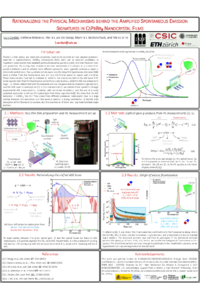
Thanks to their optical and electronic properties, lead halide perovskites have become prominent materials in optoelectronics. CsPbBr3 nanocrystals (NCs) stand out as excellent candidates for implementing lasers due to their excellent photoluminescence quantum yields and their facile and low-cost production. Elucidating their stimulated emission mechanisms is fundamental in addressing their possible limitations and to achieve more efficient perovskite lasers, specially continuous wave or electrically excited ones. Two questions remain open: why the Amplified Spontaneous Emission (ASE) band is shifted from the fluorescence one, and why the former seems to coexist with the latter. These characteristics have led to a debate about which is the mechanism behind the ASE band shift. Some reports claim that the fluorescence comes from single excitons, while the ASE has a biexcitonic origin. Others defend that both fluorescence and ASE are generated by localized single excitons, and the shift owes to reabsorption.
In this communication, we address these questions through experimental ASE measurements, combined with numerical simulations, and the use of a novel analytical expression to retrieve the optical gain from these experiments [1]. We show that the ASE behaviour in CsPbBr3 NCs thin films stems from four processes: reabsorption due to a large overlap between the absorption and fluorescence spectra, a strong contribution of excited state absorption at the fluorescence window, the excitation of differently polarized waveguide modes, and the coexistence of short- and long-lived localized single excitons. The results in this work establish guidelines with which to analyse the optical gain in perovskite samples, which can help in rationalizing the ASE signatures of both CsPbBr3 NCs and perovskites in general, and which provide insightful information on research avenues to increase the efficiency of perovskite light-emitting devices.
Reference:
[1] S. Milanese, M. L. De Giorgi, M. Anni, M. Bodnarchuk, and L. Cerdán, Adv. Opt. Mater., 2401078 (2024)
Keywords
amplified spontaneous emission
CsPbBr3
optical gain
perovskite nanocrystals
thin films
Poster
CerdanL_perovskites_1.pdf
Enhancing Vortex Tube Performance through Geometric Modifications
Structural, optical, and dielectric properties of lead-free double perovskite La2FeMnO6 for possible application in storage devices.