Event submissions
Published
This submission belongs to the session S2. Nanosciences, Chemistry and Materials Science of the event The 5th International Electronic Conference on Applied Sciences
Published date
04 Dec, 2024
Academic Editor
'%3e%3cpath%20d='M12.6657%2010.9104C12.4185%2010.325%2012.0599%209.79327%2011.6097%209.34482C11.1609%208.89508%2010.6293%208.5365%2010.0442%208.28888C10.0389%208.28626%2010.0337%208.28495%2010.0285%208.28233C10.8446%207.69279%2011.3752%206.73249%2011.3752%205.64904C11.3752%203.8542%209.92103%202.39999%208.1262%202.39999C6.33136%202.39999%204.87715%203.8542%204.87715%205.64904C4.87715%206.73249%205.40774%207.69279%206.22393%208.28364C6.21869%208.28626%206.21345%208.28757%206.20821%208.29019C5.62129%208.5378%205.09463%208.89284%204.64265%209.34613C4.1929%209.79493%203.83432%2010.3266%203.58671%2010.9117C3.34345%2011.4845%203.21226%2012.0987%203.20023%2012.7209C3.19988%2012.7349%203.20233%2012.7488%203.20744%2012.7619C3.21255%2012.7749%203.22022%2012.7867%203.22998%2012.7968C3.23975%2012.8068%203.25142%2012.8147%203.26431%2012.8202C3.2772%2012.8256%203.29105%2012.8284%203.30504%2012.8284H4.09109C4.14874%2012.8284%204.19459%2012.7825%204.1959%2012.7262C4.2221%2011.7148%204.62823%2010.7676%205.34617%2010.0497C6.08899%209.30683%207.0755%208.89808%208.1262%208.89808C9.17689%208.89808%2010.1634%209.30683%2010.9062%2010.0497C11.6242%2010.7676%2012.0303%2011.7148%2012.0565%2012.7262C12.0578%2012.7838%2012.1037%2012.8284%2012.1613%2012.8284H12.9474C12.9613%2012.8284%2012.9752%2012.8256%2012.9881%2012.8202C13.001%2012.8147%2013.0126%2012.8068%2013.0224%2012.7968C13.0322%2012.7867%2013.0398%2012.7749%2013.0449%2012.7619C13.0501%2012.7488%2013.0525%2012.7349%2013.0522%2012.7209C13.0391%2012.0947%2012.9094%2011.4855%2012.6657%2010.9104ZM8.1262%207.9024C7.52486%207.9024%206.9589%207.6679%206.53312%207.24211C6.10733%206.81633%205.87283%206.25037%205.87283%205.64904C5.87283%205.0477%206.10733%204.48174%206.53312%204.05596C6.9589%203.63018%207.52486%203.39567%208.1262%203.39567C8.72753%203.39567%209.29349%203.63018%209.71927%204.05596C10.1451%204.48174%2010.3796%205.0477%2010.3796%205.64904C10.3796%206.25037%2010.1451%206.81633%209.71927%207.24211C9.29349%207.6679%208.72753%207.9024%208.1262%207.9024Z'%20fill='%235D1EE1'/%3e%3c/g%3e%3c/svg%3e) Luis Cerdán
Luis CerdánCitation
Svetlana V. Ustiuzhanina, Maryia S. Baranava, Dzmitry Ch. Hvazdousk, Andrey A. Kistanov, Novel Zn₂(V, Nb, Ta)N₃ Monolayers for Application in Tandem Solar Cells, in Proceedings of The 5th International Electronic Conference on Applied Sciences, 4 December–6 December 2024, MDPI: Basel, Switzerland
Share
Email
Facebook
Twitter
LinkedIn
Novel Zn2(V, Nb, Ta)N3 Monolayers for Application in Tandem Solar Cells
'%3e%3cpath%20d='M12.6647%2010.9104C12.4176%2010.325%2012.0589%209.7933%2011.6088%209.34485C11.16%208.89511%2010.6283%208.53653%2010.0432%208.28891C10.038%208.28629%2010.0327%208.28498%2010.0275%208.28236C10.8437%207.69282%2011.3743%206.73252%2011.3743%205.64907C11.3743%203.85423%209.92005%202.40002%208.12522%202.40002C6.33038%202.40002%204.87618%203.85423%204.87618%205.64907C4.87618%206.73252%205.40677%207.69282%206.22296%208.28367C6.21772%208.28629%206.21248%208.2876%206.20724%208.29022C5.62031%208.53783%205.09365%208.89287%204.64167%209.34616C4.19192%209.79496%203.83334%2010.3266%203.58573%2010.9117C3.34247%2011.4846%203.21128%2012.0987%203.19925%2012.721C3.1989%2012.735%203.20135%2012.7489%203.20646%2012.7619C3.21157%2012.7749%203.21924%2012.7868%203.22901%2012.7968C3.23877%2012.8068%203.25045%2012.8148%203.26334%2012.8202C3.27623%2012.8256%203.29007%2012.8284%203.30406%2012.8284H4.09012C4.14776%2012.8284%204.19362%2012.7825%204.19493%2012.7262C4.22113%2011.7148%204.62726%2010.7676%205.34519%2010.0497C6.08802%209.30686%207.07452%208.89811%208.12522%208.89811C9.17592%208.89811%2010.1624%209.30686%2010.9052%2010.0497C11.6232%2010.7676%2012.0293%2011.7148%2012.0555%2012.7262C12.0568%2012.7839%2012.1027%2012.8284%2012.1603%2012.8284H12.9464C12.9604%2012.8284%2012.9742%2012.8256%2012.9871%2012.8202C13%2012.8148%2013.0117%2012.8068%2013.0214%2012.7968C13.0312%2012.7868%2013.0389%2012.7749%2013.044%2012.7619C13.0491%2012.7489%2013.0515%2012.735%2013.0512%2012.721C13.0381%2012.0947%2012.9084%2011.4856%2012.6647%2010.9104ZM8.12522%207.90243C7.52388%207.90243%206.95792%207.66793%206.53214%207.24215C6.10636%206.81636%205.87185%206.2504%205.87185%205.64907C5.87185%205.04773%206.10636%204.48177%206.53214%204.05599C6.95792%203.63021%207.52388%203.3957%208.12522%203.3957C8.72655%203.3957%209.29252%203.63021%209.7183%204.05599C10.1441%204.48177%2010.3786%205.04773%2010.3786%205.64907C10.3786%206.2504%2010.1441%206.81636%209.7183%207.24215C9.29252%207.66793%208.72655%207.90243%208.12522%207.90243Z'%20fill='%235D1EE1'/%3e%3c/g%3e%3c/svg%3e)
Svetlana V. Ustiuzhanina 1
Maryia S. Baranava 2
Dzmitry Ch. Hvazdousk 2

Andrey A. Kistanov 3
1. Institute for Metals Superplasticity Problems, Russian Academy of Sciences, Ufa 450001, Russia
2. Belarusian State University of Informatics and Radioelectronics, Minsk 220013, Belarus
3. Ufa University of Science and Technology, Ufa 450077, Russia
Abstract
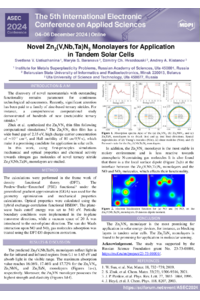
The discovery of novel nanomaterials with outstanding functionality remains paramount for continuous technological advancements. Recently, significant attention has been paid to a family of zinc-based ternary nitrides1. For instance, a comprehensive computational study demonstrated hundreds of new (meta)stable ternary nitrides2.
Using ab initio modeling simulations, novel ternary nitride Zn2(V, Nb, Ta)N3 monolayers are predicted. A mechanism for the formation of the Zn2(V, Nb, Ta)N3 monolayers is evaluated using ab initio molecular dynamics to facilitate their the chemical vapor deposition.
The predicted Zn2(V, Nb, Ta)N3 monolayers reflect light in the far-infrared and infrared regions from 0.1 to 1.65 eV and absorb light in the visible range. The maximum absorption values reach 16.06%, 17.46%, and 17.72% for the Zn2VN3, Zn2NbN3, and Zn2TaN3 monolayers, respectively. Moreover, the Zn2VN monolayer possesses the highest strength and elasticity. In addition, the Zn2VN3 monolayer is the most stable in moist environments and is less reactive towards atmospheric N-containing gas molecules. It is also found that there is a local surface dipole at the interface between the Zn2(V, Nb, Ta)N3 monolayers and the NH3, NO, and NO2 molecules, which affects their functionality.
In conclusion, the Zn2VN3 monolayer is the most promising for application in solar energy devices, such as for blocking layers in tandem solar cells. The discovered high sensitivity towards NH3, NO, and NO2 molecules and reversibility of the Zn2TaN3 monolayers make it promising for application in molecular sensing.
Acknowledgements. S.V.U. was supported by the State Assignment of the IMSP RAS. A.A.K. was supported by the Russian Science Foundation, grant No. 23-73-01001, https://rscf.ru/en/project/23-73-01001/.
References
- S. Zhuk, S. Siol, Appl. Surf. Sci. 601, 154172, 2022.
- W. Sun, et al. Nat. Mater. 18, 732−739, 2019.
Keywords
DFT
modeling
tandem solar cells
gas sensing
environmental stability
Poster
ASEC 2024_Kistanov.pdf
Ensuring Food Safety in Workers' Compounds: Addressing Challenges and Implementing Best Practices"
Polymeric Membranes in Water Treatment: Insights into Contaminant Removal Mechanisms and Advanced Processes