Event submissions
Published
This submission belongs to the session S2. Nanosciences, Chemistry and Materials Science of the event The 5th International Electronic Conference on Applied Sciences
Published date
04 Dec, 2024
Academic Editor
'%3e%3cpath%20d='M12.6657%2010.9104C12.4185%2010.325%2012.0599%209.79327%2011.6097%209.34482C11.1609%208.89508%2010.6293%208.5365%2010.0442%208.28888C10.0389%208.28626%2010.0337%208.28495%2010.0285%208.28233C10.8446%207.69279%2011.3752%206.73249%2011.3752%205.64904C11.3752%203.8542%209.92103%202.39999%208.1262%202.39999C6.33136%202.39999%204.87715%203.8542%204.87715%205.64904C4.87715%206.73249%205.40774%207.69279%206.22393%208.28364C6.21869%208.28626%206.21345%208.28757%206.20821%208.29019C5.62129%208.5378%205.09463%208.89284%204.64265%209.34613C4.1929%209.79493%203.83432%2010.3266%203.58671%2010.9117C3.34345%2011.4845%203.21226%2012.0987%203.20023%2012.7209C3.19988%2012.7349%203.20233%2012.7488%203.20744%2012.7619C3.21255%2012.7749%203.22022%2012.7867%203.22998%2012.7968C3.23975%2012.8068%203.25142%2012.8147%203.26431%2012.8202C3.2772%2012.8256%203.29105%2012.8284%203.30504%2012.8284H4.09109C4.14874%2012.8284%204.19459%2012.7825%204.1959%2012.7262C4.2221%2011.7148%204.62823%2010.7676%205.34617%2010.0497C6.08899%209.30683%207.0755%208.89808%208.1262%208.89808C9.17689%208.89808%2010.1634%209.30683%2010.9062%2010.0497C11.6242%2010.7676%2012.0303%2011.7148%2012.0565%2012.7262C12.0578%2012.7838%2012.1037%2012.8284%2012.1613%2012.8284H12.9474C12.9613%2012.8284%2012.9752%2012.8256%2012.9881%2012.8202C13.001%2012.8147%2013.0126%2012.8068%2013.0224%2012.7968C13.0322%2012.7867%2013.0398%2012.7749%2013.0449%2012.7619C13.0501%2012.7488%2013.0525%2012.7349%2013.0522%2012.7209C13.0391%2012.0947%2012.9094%2011.4855%2012.6657%2010.9104ZM8.1262%207.9024C7.52486%207.9024%206.9589%207.6679%206.53312%207.24211C6.10733%206.81633%205.87283%206.25037%205.87283%205.64904C5.87283%205.0477%206.10733%204.48174%206.53312%204.05596C6.9589%203.63018%207.52486%203.39567%208.1262%203.39567C8.72753%203.39567%209.29349%203.63018%209.71927%204.05596C10.1451%204.48174%2010.3796%205.0477%2010.3796%205.64904C10.3796%206.25037%2010.1451%206.81633%209.71927%207.24211C9.29349%207.6679%208.72753%207.9024%208.1262%207.9024Z'%20fill='%235D1EE1'/%3e%3c/g%3e%3c/svg%3e) Luis Cerdán
Luis CerdánCitation
Nataliia Tkachuk, Liubov Zelena, Yaroslav Novikov, Indicators of microbial corrosion of steel induced by sulfate-reducing bacteria under the influence heterotrophic bacteria with biocontrol properties, in Proceedings of The 5th International Electronic Conference on Applied Sciences, 4 December–6 December 2024, MDPI: Basel, Switzerland
Share
Email
Facebook
Twitter
LinkedIn
Indicators of microbial corrosion of steel induced by sulfate-reducing bacteria under the influence heterotrophic bacteria with biocontrol properties
'%3e%3cpath%20d='M12.6647%2010.9104C12.4176%2010.325%2012.0589%209.7933%2011.6088%209.34485C11.16%208.89511%2010.6283%208.53653%2010.0432%208.28891C10.038%208.28629%2010.0327%208.28498%2010.0275%208.28236C10.8437%207.69282%2011.3743%206.73252%2011.3743%205.64907C11.3743%203.85423%209.92005%202.40002%208.12522%202.40002C6.33038%202.40002%204.87618%203.85423%204.87618%205.64907C4.87618%206.73252%205.40677%207.69282%206.22296%208.28367C6.21772%208.28629%206.21248%208.2876%206.20724%208.29022C5.62031%208.53783%205.09365%208.89287%204.64167%209.34616C4.19192%209.79496%203.83334%2010.3266%203.58573%2010.9117C3.34247%2011.4846%203.21128%2012.0987%203.19925%2012.721C3.1989%2012.735%203.20135%2012.7489%203.20646%2012.7619C3.21157%2012.7749%203.21924%2012.7868%203.22901%2012.7968C3.23877%2012.8068%203.25045%2012.8148%203.26334%2012.8202C3.27623%2012.8256%203.29007%2012.8284%203.30406%2012.8284H4.09012C4.14776%2012.8284%204.19362%2012.7825%204.19493%2012.7262C4.22113%2011.7148%204.62726%2010.7676%205.34519%2010.0497C6.08802%209.30686%207.07452%208.89811%208.12522%208.89811C9.17592%208.89811%2010.1624%209.30686%2010.9052%2010.0497C11.6232%2010.7676%2012.0293%2011.7148%2012.0555%2012.7262C12.0568%2012.7839%2012.1027%2012.8284%2012.1603%2012.8284H12.9464C12.9604%2012.8284%2012.9742%2012.8256%2012.9871%2012.8202C13%2012.8148%2013.0117%2012.8068%2013.0214%2012.7968C13.0312%2012.7868%2013.0389%2012.7749%2013.044%2012.7619C13.0491%2012.7489%2013.0515%2012.735%2013.0512%2012.721C13.0381%2012.0947%2012.9084%2011.4856%2012.6647%2010.9104ZM8.12522%207.90243C7.52388%207.90243%206.95792%207.66793%206.53214%207.24215C6.10636%206.81636%205.87185%206.2504%205.87185%205.64907C5.87185%205.04773%206.10636%204.48177%206.53214%204.05599C6.95792%203.63021%207.52388%203.3957%208.12522%203.3957C8.72655%203.3957%209.29252%203.63021%209.7183%204.05599C10.1441%204.48177%2010.3786%205.04773%2010.3786%205.64907C10.3786%206.2504%2010.1441%206.81636%209.7183%207.24215C9.29252%207.66793%208.72655%207.90243%208.12522%207.90243Z'%20fill='%235D1EE1'/%3e%3c/g%3e%3c/svg%3e)
Nataliia Tkachuk 1
Liubov Zelena 2
Yaroslav Novikov 3
1. Department of Biology, Faculty of Mathematics and Natural Sciences, T.H. Shevchenko National University “Chernihiv Colehium”, 14013 Chernihiv, Ukraine
2. Department of Virus Reproduction, Danylo Zabolotny Institute Microbiology and Virology NAS of Ukraine, Kyiv, Ukraine
3. Department of Biology, T.H. Shevchenko National University “Chernihiv Colehium”
Abstract
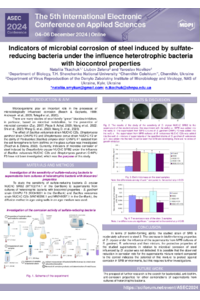
Microorganisms take an active part in the processes of microbiologically influenced corrosion, for protection against which bactericides with inhibitory properties are used, which are often toxic compounds. There are many studies of eco-friendly “green” biocides-inhibitors, in particular, based on microbial metabolites. Previously, sulfate-reducing bacteria were isolated from the sulfidogenic microbial community of the soil ferrosphere and identified as Desulfovibrio oryzae NUChC SRB1 and NUChC SRB2. The properties of the mentioned strains of D. oryzae to form biofilms on the surfaces of artificial polymers (polypropylene, polyethyleneterephthalate), in particular, under the influence of Bacillus velezensis NUChC C1 and NUChC C2b, were investigated. The effect of the strains B. velezensis, Streptomyces gardneri strain ChNPU F3 and Streptomyces canus NUChC F3 on the ability of the Peribacillus simplex ChNPU F1 strain isolated from the soil ferrosphere to form biofilms on the glass surface was also investigated. So far, indicators of the processes of microbial corrosion of steel 3 induced by sulfate-reducing bacteria D. oryzae NUChC SRB2 under the influence of B. velezensis NUChC C2b and S. gardneri ChNPU F3 strains have not been investigated, which was the aim of this study. Methods: The agar well diffusion method (for antibacterial properties of the supernatants) was used, along with the crystal violet (for the biomass of the biofilm on the steel) and gravimetric methods (for the corrosion rate). Moderate adhesiveness to steel 3 was established for the D. oryzae by biofilm-forming ability. The presence of a supernatant from cultures of S. gardneri, B. velezensis and their mixture (2:1) did not reduce the biofilm-forming properties of D. oryzae. Compared to the control, a decrease in the corrosion rate was recorded for the variant of the mixture of the studied supernatants of bacterial cultures. This indicates the potential of this mixture for corrosion protection in environments with sulfate-reducing bacteria, which requires further research.
Keywords
microbiologically influenced corrosion
“green” biocides-inhibitors
Desulfovibrio oryzae
Bacillus velezensis
Streptomyces gardneri
Poster
sciforum-095958.pdf
Quest for piezoresistive strain sensors based on polymer nanocomposites for human motion monitoring
Simulation of ultrasonic transducer for plastic welding system using finite element method