Event submissions
Published
This submission belongs to the session S7. Food Science and Technology of the event The 5th International Electronic Conference on Applied Sciences
Published date
04 Dec, 2024
Academic Editor
'%3e%3cpath%20d='M12.6657%2010.9104C12.4185%2010.325%2012.0599%209.79327%2011.6097%209.34482C11.1609%208.89508%2010.6293%208.5365%2010.0442%208.28888C10.0389%208.28626%2010.0337%208.28495%2010.0285%208.28233C10.8446%207.69279%2011.3752%206.73249%2011.3752%205.64904C11.3752%203.8542%209.92103%202.39999%208.1262%202.39999C6.33136%202.39999%204.87715%203.8542%204.87715%205.64904C4.87715%206.73249%205.40774%207.69279%206.22393%208.28364C6.21869%208.28626%206.21345%208.28757%206.20821%208.29019C5.62129%208.5378%205.09463%208.89284%204.64265%209.34613C4.1929%209.79493%203.83432%2010.3266%203.58671%2010.9117C3.34345%2011.4845%203.21226%2012.0987%203.20023%2012.7209C3.19988%2012.7349%203.20233%2012.7488%203.20744%2012.7619C3.21255%2012.7749%203.22022%2012.7867%203.22998%2012.7968C3.23975%2012.8068%203.25142%2012.8147%203.26431%2012.8202C3.2772%2012.8256%203.29105%2012.8284%203.30504%2012.8284H4.09109C4.14874%2012.8284%204.19459%2012.7825%204.1959%2012.7262C4.2221%2011.7148%204.62823%2010.7676%205.34617%2010.0497C6.08899%209.30683%207.0755%208.89808%208.1262%208.89808C9.17689%208.89808%2010.1634%209.30683%2010.9062%2010.0497C11.6242%2010.7676%2012.0303%2011.7148%2012.0565%2012.7262C12.0578%2012.7838%2012.1037%2012.8284%2012.1613%2012.8284H12.9474C12.9613%2012.8284%2012.9752%2012.8256%2012.9881%2012.8202C13.001%2012.8147%2013.0126%2012.8068%2013.0224%2012.7968C13.0322%2012.7867%2013.0398%2012.7749%2013.0449%2012.7619C13.0501%2012.7488%2013.0525%2012.7349%2013.0522%2012.7209C13.0391%2012.0947%2012.9094%2011.4855%2012.6657%2010.9104ZM8.1262%207.9024C7.52486%207.9024%206.9589%207.6679%206.53312%207.24211C6.10733%206.81633%205.87283%206.25037%205.87283%205.64904C5.87283%205.0477%206.10733%204.48174%206.53312%204.05596C6.9589%203.63018%207.52486%203.39567%208.1262%203.39567C8.72753%203.39567%209.29349%203.63018%209.71927%204.05596C10.1451%204.48174%2010.3796%205.0477%2010.3796%205.64904C10.3796%206.25037%2010.1451%206.81633%209.71927%207.24211C9.29349%207.6679%208.72753%207.9024%208.1262%207.9024Z'%20fill='%235D1EE1'/%3e%3c/g%3e%3c/svg%3e) Antonios Koutelidakis
Antonios KoutelidakisCitation
Oksana Sema, Elena Aksonova, Anastasiia Sachko, Sergey Gubsky, Development of technology for candy caramel with barberry powder and sugar substitute isomaltitol, in Proceedings of The 5th International Electronic Conference on Applied Sciences, 4 December–6 December 2024, MDPI: Basel, Switzerland
Share
Email
Facebook
Twitter
LinkedIn
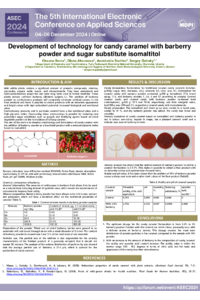
Development of technology for candy caramel with barberry powder and sugar substitute isomaltitol
'%3e%3cpath%20d='M12.6647%2010.9104C12.4176%2010.325%2012.0589%209.7933%2011.6088%209.34485C11.16%208.89511%2010.6283%208.53653%2010.0432%208.28891C10.038%208.28629%2010.0327%208.28498%2010.0275%208.28236C10.8437%207.69282%2011.3743%206.73252%2011.3743%205.64907C11.3743%203.85423%209.92005%202.40002%208.12522%202.40002C6.33038%202.40002%204.87618%203.85423%204.87618%205.64907C4.87618%206.73252%205.40677%207.69282%206.22296%208.28367C6.21772%208.28629%206.21248%208.2876%206.20724%208.29022C5.62031%208.53783%205.09365%208.89287%204.64167%209.34616C4.19192%209.79496%203.83334%2010.3266%203.58573%2010.9117C3.34247%2011.4846%203.21128%2012.0987%203.19925%2012.721C3.1989%2012.735%203.20135%2012.7489%203.20646%2012.7619C3.21157%2012.7749%203.21924%2012.7868%203.22901%2012.7968C3.23877%2012.8068%203.25045%2012.8148%203.26334%2012.8202C3.27623%2012.8256%203.29007%2012.8284%203.30406%2012.8284H4.09012C4.14776%2012.8284%204.19362%2012.7825%204.19493%2012.7262C4.22113%2011.7148%204.62726%2010.7676%205.34519%2010.0497C6.08802%209.30686%207.07452%208.89811%208.12522%208.89811C9.17592%208.89811%2010.1624%209.30686%2010.9052%2010.0497C11.6232%2010.7676%2012.0293%2011.7148%2012.0555%2012.7262C12.0568%2012.7839%2012.1027%2012.8284%2012.1603%2012.8284H12.9464C12.9604%2012.8284%2012.9742%2012.8256%2012.9871%2012.8202C13%2012.8148%2013.0117%2012.8068%2013.0214%2012.7968C13.0312%2012.7868%2013.0389%2012.7749%2013.044%2012.7619C13.0491%2012.7489%2013.0515%2012.735%2013.0512%2012.721C13.0381%2012.0947%2012.9084%2011.4856%2012.6647%2010.9104ZM8.12522%207.90243C7.52388%207.90243%206.95792%207.66793%206.53214%207.24215C6.10636%206.81636%205.87185%206.2504%205.87185%205.64907C5.87185%205.04773%206.10636%204.48177%206.53214%204.05599C6.95792%203.63021%207.52388%203.3957%208.12522%203.3957C8.72655%203.3957%209.29252%203.63021%209.7183%204.05599C10.1441%204.48177%2010.3786%205.04773%2010.3786%205.64907C10.3786%206.2504%2010.1441%206.81636%209.7183%207.24215C9.29252%207.66793%208.72655%207.90243%208.12522%207.90243Z'%20fill='%235D1EE1'/%3e%3c/g%3e%3c/svg%3e)
Oksana Sema 1
Elena Aksonova 2
Anastasiia Sachko 1

Sergey Gubsky 3
1. Department of Chemistry and Food Analysis, Yuriy Fedkovych Chernivtsi National University, Chernivtsi, Ukraine
2. Kharkiv State University of Food Technology and Trade, Ukraine
3. Department of Chemistry, Biochemistry, Microbiology and Hygiene of Nutrition, State Biotechnological University, Kharkiv, Ukraine
Abstract
Background: Confectionery products and, in particular, caramel have a low nutritional value and a high glycemic index. Overcoming these shortcomings is possible by including new-generation sugar substitutes such as polyols and fortifying agents based on dried plant powders in the formulation of candy caramel.
Object: The purpose of this study was to develop the technology of candy caramel as a functional product with a lower glycemic index. The index reduction was achieved by including sugar substitute such as isomaltitol in the caramel formulation. As a fortifying agent with a significant amount of bioactive compounds and at the same time a natural colorant, the dried powder of the wild plant Berberis vulgaris L. was used in an amount of 1, 2.5, 5 and 10% (w/w).
Methods: The microstructural characteristics of the powder were determined by laser diffraction. The elemental composition was confirmed by atomic adsorption spectroscopy. Physicochemical methods and sensory analysis were used to evaluate candy caramel samples.
Results: The technology for the production of candy caramel using isomaltitol, invert syrup and barberry powder was developed. Dry barberry powder was used to prepare the samples, characterized by an optimal average particle size of 37.4 μm and a width of the SPAN particle distribution curve of 2.94 μm. The addition of barberry powder in quantity made it possible to enrich candies with trace elements such as sodium, potassium, iron, manganese and zinc. When the amount of barberry in the caramel recipe is increased, the acidity significantly increases from 1.02 to 10.2 mg/100 g of the sample in the equivalent of citric acid and changes the pH from 3.45 to 3.12. Sensory analysis allowed us to establish that the optimal amount of barberry powder inclusion in caramel formulations is 2.5-5%.
Conclusion: The result was a candy caramel with a potential as a functional food.
Keywords
Candy caramel
isomaltitol
Berberis vulgaris L.
functional food
plant powder
Poster
sciforum-107851 poster.pdf
Antioxidant properties and release of phenolic compounds from hydrogels as wound dressings
LEVERAGING TECHNOLOGY TO OPTIMISE TERTIARY
EDUCATION TRUST FUND BUILDING PROJECTS FOR PUBLIC UNIVERSITIES IN
DELTA STATE NIGERIA
EDUCATION TRUST FUND BUILDING PROJECTS FOR PUBLIC UNIVERSITIES IN
DELTA STATE NIGERIA