Event submissions
Published
This submission belongs to the session S2. Nanosciences, Chemistry and Materials Science of the event The 5th International Electronic Conference on Applied Sciences
Published date
04 Dec, 2024
Academic Editor
'%3e%3cpath%20d='M12.6657%2010.9104C12.4185%2010.325%2012.0599%209.79327%2011.6097%209.34482C11.1609%208.89508%2010.6293%208.5365%2010.0442%208.28888C10.0389%208.28626%2010.0337%208.28495%2010.0285%208.28233C10.8446%207.69279%2011.3752%206.73249%2011.3752%205.64904C11.3752%203.8542%209.92103%202.39999%208.1262%202.39999C6.33136%202.39999%204.87715%203.8542%204.87715%205.64904C4.87715%206.73249%205.40774%207.69279%206.22393%208.28364C6.21869%208.28626%206.21345%208.28757%206.20821%208.29019C5.62129%208.5378%205.09463%208.89284%204.64265%209.34613C4.1929%209.79493%203.83432%2010.3266%203.58671%2010.9117C3.34345%2011.4845%203.21226%2012.0987%203.20023%2012.7209C3.19988%2012.7349%203.20233%2012.7488%203.20744%2012.7619C3.21255%2012.7749%203.22022%2012.7867%203.22998%2012.7968C3.23975%2012.8068%203.25142%2012.8147%203.26431%2012.8202C3.2772%2012.8256%203.29105%2012.8284%203.30504%2012.8284H4.09109C4.14874%2012.8284%204.19459%2012.7825%204.1959%2012.7262C4.2221%2011.7148%204.62823%2010.7676%205.34617%2010.0497C6.08899%209.30683%207.0755%208.89808%208.1262%208.89808C9.17689%208.89808%2010.1634%209.30683%2010.9062%2010.0497C11.6242%2010.7676%2012.0303%2011.7148%2012.0565%2012.7262C12.0578%2012.7838%2012.1037%2012.8284%2012.1613%2012.8284H12.9474C12.9613%2012.8284%2012.9752%2012.8256%2012.9881%2012.8202C13.001%2012.8147%2013.0126%2012.8068%2013.0224%2012.7968C13.0322%2012.7867%2013.0398%2012.7749%2013.0449%2012.7619C13.0501%2012.7488%2013.0525%2012.7349%2013.0522%2012.7209C13.0391%2012.0947%2012.9094%2011.4855%2012.6657%2010.9104ZM8.1262%207.9024C7.52486%207.9024%206.9589%207.6679%206.53312%207.24211C6.10733%206.81633%205.87283%206.25037%205.87283%205.64904C5.87283%205.0477%206.10733%204.48174%206.53312%204.05596C6.9589%203.63018%207.52486%203.39567%208.1262%203.39567C8.72753%203.39567%209.29349%203.63018%209.71927%204.05596C10.1451%204.48174%2010.3796%205.0477%2010.3796%205.64904C10.3796%206.25037%2010.1451%206.81633%209.71927%207.24211C9.29349%207.6679%208.72753%207.9024%208.1262%207.9024Z'%20fill='%235D1EE1'/%3e%3c/g%3e%3c/svg%3e) Luis Cerdán
Luis CerdánCitation
Josipa Sarjanović, Marta Razum, Luka Pavić, Jana Pisk, Structural Insights into Molybdenum Schiff Base Complexes: Impedance Spectroscopy and Coordination Behavior, in Proceedings of The 5th International Electronic Conference on Applied Sciences, 4 December–6 December 2024, MDPI: Basel, Switzerland
Share
Email
Facebook
Twitter
LinkedIn
Structural Insights into Molybdenum Schiff Base Complexes: Impedance Spectroscopy and Coordination Behavior
'%3e%3cpath%20d='M12.6647%2010.9104C12.4176%2010.325%2012.0589%209.7933%2011.6088%209.34485C11.16%208.89511%2010.6283%208.53653%2010.0432%208.28891C10.038%208.28629%2010.0327%208.28498%2010.0275%208.28236C10.8437%207.69282%2011.3743%206.73252%2011.3743%205.64907C11.3743%203.85423%209.92005%202.40002%208.12522%202.40002C6.33038%202.40002%204.87618%203.85423%204.87618%205.64907C4.87618%206.73252%205.40677%207.69282%206.22296%208.28367C6.21772%208.28629%206.21248%208.2876%206.20724%208.29022C5.62031%208.53783%205.09365%208.89287%204.64167%209.34616C4.19192%209.79496%203.83334%2010.3266%203.58573%2010.9117C3.34247%2011.4846%203.21128%2012.0987%203.19925%2012.721C3.1989%2012.735%203.20135%2012.7489%203.20646%2012.7619C3.21157%2012.7749%203.21924%2012.7868%203.22901%2012.7968C3.23877%2012.8068%203.25045%2012.8148%203.26334%2012.8202C3.27623%2012.8256%203.29007%2012.8284%203.30406%2012.8284H4.09012C4.14776%2012.8284%204.19362%2012.7825%204.19493%2012.7262C4.22113%2011.7148%204.62726%2010.7676%205.34519%2010.0497C6.08802%209.30686%207.07452%208.89811%208.12522%208.89811C9.17592%208.89811%2010.1624%209.30686%2010.9052%2010.0497C11.6232%2010.7676%2012.0293%2011.7148%2012.0555%2012.7262C12.0568%2012.7839%2012.1027%2012.8284%2012.1603%2012.8284H12.9464C12.9604%2012.8284%2012.9742%2012.8256%2012.9871%2012.8202C13%2012.8148%2013.0117%2012.8068%2013.0214%2012.7968C13.0312%2012.7868%2013.0389%2012.7749%2013.044%2012.7619C13.0491%2012.7489%2013.0515%2012.735%2013.0512%2012.721C13.0381%2012.0947%2012.9084%2011.4856%2012.6647%2010.9104ZM8.12522%207.90243C7.52388%207.90243%206.95792%207.66793%206.53214%207.24215C6.10636%206.81636%205.87185%206.2504%205.87185%205.64907C5.87185%205.04773%206.10636%204.48177%206.53214%204.05599C6.95792%203.63021%207.52388%203.3957%208.12522%203.3957C8.72655%203.3957%209.29252%203.63021%209.7183%204.05599C10.1441%204.48177%2010.3786%205.04773%2010.3786%205.64907C10.3786%206.2504%2010.1441%206.81636%209.7183%207.24215C9.29252%207.66793%208.72655%207.90243%208.12522%207.90243Z'%20fill='%235D1EE1'/%3e%3c/g%3e%3c/svg%3e)
Josipa Sarjanović 1
Marta Razum 2

Luka Pavić 2

Jana Pisk 1
1. Department of Chemistry, Faculty of Science, University of Zagreb, Horvatovac 102a, Zagreb, Croatia
2. Ruđer Bošković Institute, Bijenička cesta 54, Zagreb, Croatia
Abstract
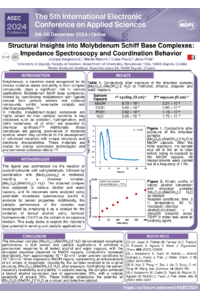
Molybdenum, a transition metal, is well regarded for its diverse applications due to its ability to adopt multiple oxidation states and form various complexes. Molybdenum Schiff base complexes, which are created by coordinating molybdenum with Schiff base ligands, resulting from the condensation of primary amines and carbonyl compounds, demonstrate unique and valuable properties [1]. These complexes are extensively documented for their significant roles across various fields. Biologically, molybdenum is crucial as a component of several key enzymes [2]. Industrially, these complexes are essential in processes like petroleum refining and chemical manufacturing. They are especially notable for their catalytic activity in oxidation, hydrogenation, and olefin metathesis reactions, contributing to various chemical synthesis processes [1]. In material science, they are instrumental in developing advanced materials with distinctive electronic and structural properties, which are beneficial for enhancing energy conversion and environmental remediation [3,4].
In the current study, a Schiff base ligand was synthesized via the condensation of salicylaldehyde and oxalyldihydrazide and then coordinated to the [MoO2]2+ core. This synthesis, performed in methanol, resulted in the formation of the complex [Mo2O4(L)(MeOH)2]·2 H2O. The complex was exposed to vapors of water, methanol, ethanol, and propanol, leading to the desolvatatation and decoordination of solvent molecules and the coordination of vapor molecules. Characterization was conducted using IR-ATR spectroscopy and thermogravimetric analysis (TG), with molecular and crystal structures determined through X-ray diffraction. Impedance spectroscopy (IS) confirmed structural changes. Additionally, these complexes were tested as catalysts for the oxidation of benzyl alcohol, demonstrating their potential in catalytic applications.
[1] A. Bafti, M. Razum, E. Topić, D. Agustin, J. Pisk, V. Vrdoljak, Mol. Catal. 512 (2021) 111764.
[2] R. Hille, J. Hall, P. Basu, Chem. Rev. 114 (2014) 3963-4038.
[3] J. Sarjanović, M. Stojić, M. Rubčić, L. Pavić, J. Pisk, J. Materials 16 (2023) 1064.
[4] J. Pisk, M. Šušković, E. Topić, D. Agustin, N. Judaš, L. Pavić, Int. J. Mol. Sci. 25 (2024) 4859.
Keywords
molybdenum complexes
semiconductors
Poster
Poster_Josipa_Sarjanovic.pdf
Phase-Field Modeling of Crack Propagation for brittle materials by finite elements method (FEM)
Bioactive Potential of Castanea sativa Hedgehog Extracts for Sustainable Packaging Solutions