Event submissions
Published
This submission belongs to the session S2. Nanosciences, Chemistry and Materials Science of the event The 5th International Electronic Conference on Applied Sciences
Published date
04 Dec, 2024
Academic Editor
'%3e%3cpath%20d='M12.6657%2010.9104C12.4185%2010.325%2012.0599%209.79327%2011.6097%209.34482C11.1609%208.89508%2010.6293%208.5365%2010.0442%208.28888C10.0389%208.28626%2010.0337%208.28495%2010.0285%208.28233C10.8446%207.69279%2011.3752%206.73249%2011.3752%205.64904C11.3752%203.8542%209.92103%202.39999%208.1262%202.39999C6.33136%202.39999%204.87715%203.8542%204.87715%205.64904C4.87715%206.73249%205.40774%207.69279%206.22393%208.28364C6.21869%208.28626%206.21345%208.28757%206.20821%208.29019C5.62129%208.5378%205.09463%208.89284%204.64265%209.34613C4.1929%209.79493%203.83432%2010.3266%203.58671%2010.9117C3.34345%2011.4845%203.21226%2012.0987%203.20023%2012.7209C3.19988%2012.7349%203.20233%2012.7488%203.20744%2012.7619C3.21255%2012.7749%203.22022%2012.7867%203.22998%2012.7968C3.23975%2012.8068%203.25142%2012.8147%203.26431%2012.8202C3.2772%2012.8256%203.29105%2012.8284%203.30504%2012.8284H4.09109C4.14874%2012.8284%204.19459%2012.7825%204.1959%2012.7262C4.2221%2011.7148%204.62823%2010.7676%205.34617%2010.0497C6.08899%209.30683%207.0755%208.89808%208.1262%208.89808C9.17689%208.89808%2010.1634%209.30683%2010.9062%2010.0497C11.6242%2010.7676%2012.0303%2011.7148%2012.0565%2012.7262C12.0578%2012.7838%2012.1037%2012.8284%2012.1613%2012.8284H12.9474C12.9613%2012.8284%2012.9752%2012.8256%2012.9881%2012.8202C13.001%2012.8147%2013.0126%2012.8068%2013.0224%2012.7968C13.0322%2012.7867%2013.0398%2012.7749%2013.0449%2012.7619C13.0501%2012.7488%2013.0525%2012.7349%2013.0522%2012.7209C13.0391%2012.0947%2012.9094%2011.4855%2012.6657%2010.9104ZM8.1262%207.9024C7.52486%207.9024%206.9589%207.6679%206.53312%207.24211C6.10733%206.81633%205.87283%206.25037%205.87283%205.64904C5.87283%205.0477%206.10733%204.48174%206.53312%204.05596C6.9589%203.63018%207.52486%203.39567%208.1262%203.39567C8.72753%203.39567%209.29349%203.63018%209.71927%204.05596C10.1451%204.48174%2010.3796%205.0477%2010.3796%205.64904C10.3796%206.25037%2010.1451%206.81633%209.71927%207.24211C9.29349%207.6679%208.72753%207.9024%208.1262%207.9024Z'%20fill='%235D1EE1'/%3e%3c/g%3e%3c/svg%3e) Luis Cerdán
Luis CerdánCitation
Indhumathi R, Sathiya Priya A, Samyuktha B. S., Analyzing the Thermal Behavior and Phase Transitions of ZnSnO₃ Prepared via Chemical Precipitation, in Proceedings of The 5th International Electronic Conference on Applied Sciences, 4 December–6 December 2024, MDPI: Basel, Switzerland
Share
Email
Facebook
Twitter
LinkedIn
Analyzing the Thermal Behavior and Phase Transitions of ZnSnO₃ Prepared via Chemical Precipitation
'%3e%3cpath%20d='M12.6647%2010.9104C12.4176%2010.325%2012.0589%209.7933%2011.6088%209.34485C11.16%208.89511%2010.6283%208.53653%2010.0432%208.28891C10.038%208.28629%2010.0327%208.28498%2010.0275%208.28236C10.8437%207.69282%2011.3743%206.73252%2011.3743%205.64907C11.3743%203.85423%209.92005%202.40002%208.12522%202.40002C6.33038%202.40002%204.87618%203.85423%204.87618%205.64907C4.87618%206.73252%205.40677%207.69282%206.22296%208.28367C6.21772%208.28629%206.21248%208.2876%206.20724%208.29022C5.62031%208.53783%205.09365%208.89287%204.64167%209.34616C4.19192%209.79496%203.83334%2010.3266%203.58573%2010.9117C3.34247%2011.4846%203.21128%2012.0987%203.19925%2012.721C3.1989%2012.735%203.20135%2012.7489%203.20646%2012.7619C3.21157%2012.7749%203.21924%2012.7868%203.22901%2012.7968C3.23877%2012.8068%203.25045%2012.8148%203.26334%2012.8202C3.27623%2012.8256%203.29007%2012.8284%203.30406%2012.8284H4.09012C4.14776%2012.8284%204.19362%2012.7825%204.19493%2012.7262C4.22113%2011.7148%204.62726%2010.7676%205.34519%2010.0497C6.08802%209.30686%207.07452%208.89811%208.12522%208.89811C9.17592%208.89811%2010.1624%209.30686%2010.9052%2010.0497C11.6232%2010.7676%2012.0293%2011.7148%2012.0555%2012.7262C12.0568%2012.7839%2012.1027%2012.8284%2012.1603%2012.8284H12.9464C12.9604%2012.8284%2012.9742%2012.8256%2012.9871%2012.8202C13%2012.8148%2013.0117%2012.8068%2013.0214%2012.7968C13.0312%2012.7868%2013.0389%2012.7749%2013.044%2012.7619C13.0491%2012.7489%2013.0515%2012.735%2013.0512%2012.721C13.0381%2012.0947%2012.9084%2011.4856%2012.6647%2010.9104ZM8.12522%207.90243C7.52388%207.90243%206.95792%207.66793%206.53214%207.24215C6.10636%206.81636%205.87185%206.2504%205.87185%205.64907C5.87185%205.04773%206.10636%204.48177%206.53214%204.05599C6.95792%203.63021%207.52388%203.3957%208.12522%203.3957C8.72655%203.3957%209.29252%203.63021%209.7183%204.05599C10.1441%204.48177%2010.3786%205.04773%2010.3786%205.64907C10.3786%206.2504%2010.1441%206.81636%209.7183%207.24215C9.29252%207.66793%208.72655%207.90243%208.12522%207.90243Z'%20fill='%235D1EE1'/%3e%3c/g%3e%3c/svg%3e)
Indhumathi R 1
Sathiya Priya A 1
Samyuktha B. S. 1
1. Department of Physics, Sri Sairam Engineering College, Chennai, Tamil Nadu, India
Abstract
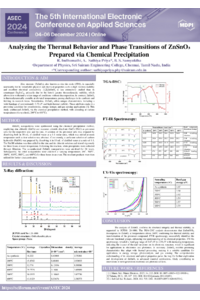
This study investigates the synthesis and phase transition behavior of ZnSnO₃ nanoparticles prepared via chemical precipitation. To understand their properties, the nanoparticles were characterized using several techniques: thermogravimetric analysis (TGA), X-ray diffraction (XRD), UV-visible spectroscopy, and Fourier transform infrared spectroscopy (FTIR). TGA measured the weight changes of the nanoparticles as they were heated from 200°C to 600°C, revealing their thermal stability and decomposition patterns. Initially, at 200°C, the nanoparticles showed minimal weight loss, indicating they were stable. As the temperature increased to 300°C, a noticeable weight reduction occurred, likely due to the removal of residual organic materials and the onset of structural transformations. Between 400°C and 500°C, significant weight loss was observed, corresponding to major phase transitions and the release of volatile components. By 600°C, the nanoparticles exhibited enhanced thermal stability with only minor additional weight loss, suggesting the formation of a stable Zn₂SnO₄ phase. XRD analysis confirmed the evolution of the crystalline structure, showing a transition from cubic ZnSnO₃ to orthorhombic Zn₂SnO₄ as the temperature increased. UV-visible spectroscopy revealed changes in the bandgap energy associated with these phase transitions, which is important for understanding the material's optical and electronic properties. FTIR spectra confirmed the presence of specific functional groups, providing insights into the chemical bonds within the nanoparticles. These findings offer critical insights into the thermal behavior and phase transitions of ZnSnO₃ nanoparticles. Understanding these properties is essential for tailoring the material for various applications, including advanced materials, catalysis, and electronic devices. Moreover, the study provides valuable guidance for optimizing synthesis conditions to achieve the desired material properties, enhancing their performance in technological applications. By elucidating the phase transitions and thermal stability of ZnSnO₃ nanoparticles, this research contributes to the development of materials with specific and enhanced properties for diverse scientific and industrial uses.
Keywords
ZnSnO₃ nanoparticles
Chemical precipitation
Phase transition
TGA
XRD
UV-Vis
FTIR
Poster
ASEC2024 .pdf
Development of method for determination of sucralfate in suspension by High-performance liquid chromatography
The Synthesis of Silver Nanoparticles by Marine Brown Algae Padina commersonii: The Characterization and Evaluation of their Antimicrobial Potential.