Event submissions
Published
This submission belongs to the session S2. Nanosciences, Chemistry and Materials Science of the event The 5th International Electronic Conference on Applied Sciences
Published date
04 Dec, 2024
Academic Editor
'%3e%3cpath%20d='M12.6657%2010.9104C12.4185%2010.325%2012.0599%209.79327%2011.6097%209.34482C11.1609%208.89508%2010.6293%208.5365%2010.0442%208.28888C10.0389%208.28626%2010.0337%208.28495%2010.0285%208.28233C10.8446%207.69279%2011.3752%206.73249%2011.3752%205.64904C11.3752%203.8542%209.92103%202.39999%208.1262%202.39999C6.33136%202.39999%204.87715%203.8542%204.87715%205.64904C4.87715%206.73249%205.40774%207.69279%206.22393%208.28364C6.21869%208.28626%206.21345%208.28757%206.20821%208.29019C5.62129%208.5378%205.09463%208.89284%204.64265%209.34613C4.1929%209.79493%203.83432%2010.3266%203.58671%2010.9117C3.34345%2011.4845%203.21226%2012.0987%203.20023%2012.7209C3.19988%2012.7349%203.20233%2012.7488%203.20744%2012.7619C3.21255%2012.7749%203.22022%2012.7867%203.22998%2012.7968C3.23975%2012.8068%203.25142%2012.8147%203.26431%2012.8202C3.2772%2012.8256%203.29105%2012.8284%203.30504%2012.8284H4.09109C4.14874%2012.8284%204.19459%2012.7825%204.1959%2012.7262C4.2221%2011.7148%204.62823%2010.7676%205.34617%2010.0497C6.08899%209.30683%207.0755%208.89808%208.1262%208.89808C9.17689%208.89808%2010.1634%209.30683%2010.9062%2010.0497C11.6242%2010.7676%2012.0303%2011.7148%2012.0565%2012.7262C12.0578%2012.7838%2012.1037%2012.8284%2012.1613%2012.8284H12.9474C12.9613%2012.8284%2012.9752%2012.8256%2012.9881%2012.8202C13.001%2012.8147%2013.0126%2012.8068%2013.0224%2012.7968C13.0322%2012.7867%2013.0398%2012.7749%2013.0449%2012.7619C13.0501%2012.7488%2013.0525%2012.7349%2013.0522%2012.7209C13.0391%2012.0947%2012.9094%2011.4855%2012.6657%2010.9104ZM8.1262%207.9024C7.52486%207.9024%206.9589%207.6679%206.53312%207.24211C6.10733%206.81633%205.87283%206.25037%205.87283%205.64904C5.87283%205.0477%206.10733%204.48174%206.53312%204.05596C6.9589%203.63018%207.52486%203.39567%208.1262%203.39567C8.72753%203.39567%209.29349%203.63018%209.71927%204.05596C10.1451%204.48174%2010.3796%205.0477%2010.3796%205.64904C10.3796%206.25037%2010.1451%206.81633%209.71927%207.24211C9.29349%207.6679%208.72753%207.9024%208.1262%207.9024Z'%20fill='%235D1EE1'/%3e%3c/g%3e%3c/svg%3e) Luis Cerdán
Luis CerdánCitation
Ragavi Ratnaranjan, Dinithi Peiris, The Synthesis of Silver Nanoparticles by Marine Brown Algae Padina commersonii: The Characterization and Evaluation of their Antimicrobial Potential., in Proceedings of The 5th International Electronic Conference on Applied Sciences, 4 December–6 December 2024, MDPI: Basel, Switzerland
Share
Email
Facebook
Twitter
LinkedIn
The Synthesis of Silver Nanoparticles by Marine Brown Algae Padina commersonii: The Characterization and Evaluation of their Antimicrobial Potential.
'%3e%3cpath%20d='M12.6647%2010.9104C12.4176%2010.325%2012.0589%209.7933%2011.6088%209.34485C11.16%208.89511%2010.6283%208.53653%2010.0432%208.28891C10.038%208.28629%2010.0327%208.28498%2010.0275%208.28236C10.8437%207.69282%2011.3743%206.73252%2011.3743%205.64907C11.3743%203.85423%209.92005%202.40002%208.12522%202.40002C6.33038%202.40002%204.87618%203.85423%204.87618%205.64907C4.87618%206.73252%205.40677%207.69282%206.22296%208.28367C6.21772%208.28629%206.21248%208.2876%206.20724%208.29022C5.62031%208.53783%205.09365%208.89287%204.64167%209.34616C4.19192%209.79496%203.83334%2010.3266%203.58573%2010.9117C3.34247%2011.4846%203.21128%2012.0987%203.19925%2012.721C3.1989%2012.735%203.20135%2012.7489%203.20646%2012.7619C3.21157%2012.7749%203.21924%2012.7868%203.22901%2012.7968C3.23877%2012.8068%203.25045%2012.8148%203.26334%2012.8202C3.27623%2012.8256%203.29007%2012.8284%203.30406%2012.8284H4.09012C4.14776%2012.8284%204.19362%2012.7825%204.19493%2012.7262C4.22113%2011.7148%204.62726%2010.7676%205.34519%2010.0497C6.08802%209.30686%207.07452%208.89811%208.12522%208.89811C9.17592%208.89811%2010.1624%209.30686%2010.9052%2010.0497C11.6232%2010.7676%2012.0293%2011.7148%2012.0555%2012.7262C12.0568%2012.7839%2012.1027%2012.8284%2012.1603%2012.8284H12.9464C12.9604%2012.8284%2012.9742%2012.8256%2012.9871%2012.8202C13%2012.8148%2013.0117%2012.8068%2013.0214%2012.7968C13.0312%2012.7868%2013.0389%2012.7749%2013.044%2012.7619C13.0491%2012.7489%2013.0515%2012.735%2013.0512%2012.721C13.0381%2012.0947%2012.9084%2011.4856%2012.6647%2010.9104ZM8.12522%207.90243C7.52388%207.90243%206.95792%207.66793%206.53214%207.24215C6.10636%206.81636%205.87185%206.2504%205.87185%205.64907C5.87185%205.04773%206.10636%204.48177%206.53214%204.05599C6.95792%203.63021%207.52388%203.3957%208.12522%203.3957C8.72655%203.3957%209.29252%203.63021%209.7183%204.05599C10.1441%204.48177%2010.3786%205.04773%2010.3786%205.64907C10.3786%206.2504%2010.1441%206.81636%209.7183%207.24215C9.29252%207.66793%208.72655%207.90243%208.12522%207.90243Z'%20fill='%235D1EE1'/%3e%3c/g%3e%3c/svg%3e)
Ragavi Ratnaranjan 1
Dinithi Peiris 1
1. Department of Zoology, University of Sri Jayewardenepura, Sri Lanka
Abstract
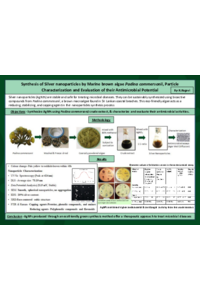
Drug-loaded nanoparticles serve as carriers for targeted therapies, with silver nanoparticles being particularly noted for their conductivity, stability, and safety in treating diseases. Padina commersonii, an edible brown macroalgae found along Sri Lanka's coastal beaches, is eco-friendly . The bioactive compounds in Padina commersonii can reduce metal ions to form nanoparticles, acting as stabilizers and capping agents. This research aims to green-synthesize silver nanoparticles using Padina commersonii, characterize the nanoparticles, and evaluate their in vitro antioxidant efficacy. Silver nanoparticles were synthesized by mixing crude methanol extract of Padina commersonii with silver nitrate. Characterization of the synthesized nanoparticles was conducted using UV-Vis spectroscopy, Dynamic Light Scattering (DLS), Zeta potential analysis, Scanning Electron Microscopy (SEM), Energy Dispersive X-ray (EDX) analysis, X-ray Diffraction (XRD), FTIR spectroscopy, and Raman spectroscopy. Antimicrobial activities were evaluated against bacterial and fungal strains via the Agar well diffusion method. A colour change from pale yellow to reddish-brown within 48 hours indicated nanoparticle formation. UV-Vis spectrophotometry revealed a surface plasmon resonance peak at 424 nm, confirming silver nanoparticles. DLS analysis showed an average size of 79.34 nm, with zeta potential at -21.5 mV indicating stability. SEM images depicted spherical nanoparticles with smooth surfaces and no aggregation. EDX analysis confirmed 19.5% silver content by weight, and XRD analysis showed a face-centered cubic structure. FTIR and Raman spectroscopy identified proteins, phenolic compounds, and amines as capping agents, with polyphenolic compounds and flavonoids as reducing agents. The antimicrobial potential of silver nanoparticles synthesized using Padina commersonii against bacterial strains Staphylococcus aureus (12.77 ± 0.58 mm), Escherichia coli (15.27 ± 0.58 mm), and fungal strains Aspergillus niger (18.10 ± 0.15 mm) and Candida albicans (17.43 ± 0.57 mm) was greater than that of the crude extract of Padina sp. (S. aureus = 11.17 ± 0.29 mm, E. coli = 10.50 ± 0.50mm, A. niger = 12.66 ± 0.10mm, C. albicans = 15.66 ± 0.10mm). These findings highlight the potential of eco-friendly synthesized silver nanoparticles as a therapeutic approach for treating microbial infections
Keywords
Green synthesis
Characterization
Silver nanoparticles
Padina commersonii
Antimicrobial
Poster
R.Ragavi -sciforum-102703- ASEC 2024- Poster.pdf
Analyzing the Thermal Behavior and Phase Transitions of ZnSnO₃ Prepared via Chemical Precipitation
A Systematic Review of Biomass-Derived Potassium Extraction for Potassium-Ion Batteries: Techniques, Challenges, and Sustainable Energy Solutions