Event submissions
Published
This submission belongs to the session S7. Food Science and Technology of the event The 5th International Electronic Conference on Applied Sciences
Published date
04 Dec, 2024
Academic Editor
'%3e%3cpath%20d='M12.6657%2010.9104C12.4185%2010.325%2012.0599%209.79327%2011.6097%209.34482C11.1609%208.89508%2010.6293%208.5365%2010.0442%208.28888C10.0389%208.28626%2010.0337%208.28495%2010.0285%208.28233C10.8446%207.69279%2011.3752%206.73249%2011.3752%205.64904C11.3752%203.8542%209.92103%202.39999%208.1262%202.39999C6.33136%202.39999%204.87715%203.8542%204.87715%205.64904C4.87715%206.73249%205.40774%207.69279%206.22393%208.28364C6.21869%208.28626%206.21345%208.28757%206.20821%208.29019C5.62129%208.5378%205.09463%208.89284%204.64265%209.34613C4.1929%209.79493%203.83432%2010.3266%203.58671%2010.9117C3.34345%2011.4845%203.21226%2012.0987%203.20023%2012.7209C3.19988%2012.7349%203.20233%2012.7488%203.20744%2012.7619C3.21255%2012.7749%203.22022%2012.7867%203.22998%2012.7968C3.23975%2012.8068%203.25142%2012.8147%203.26431%2012.8202C3.2772%2012.8256%203.29105%2012.8284%203.30504%2012.8284H4.09109C4.14874%2012.8284%204.19459%2012.7825%204.1959%2012.7262C4.2221%2011.7148%204.62823%2010.7676%205.34617%2010.0497C6.08899%209.30683%207.0755%208.89808%208.1262%208.89808C9.17689%208.89808%2010.1634%209.30683%2010.9062%2010.0497C11.6242%2010.7676%2012.0303%2011.7148%2012.0565%2012.7262C12.0578%2012.7838%2012.1037%2012.8284%2012.1613%2012.8284H12.9474C12.9613%2012.8284%2012.9752%2012.8256%2012.9881%2012.8202C13.001%2012.8147%2013.0126%2012.8068%2013.0224%2012.7968C13.0322%2012.7867%2013.0398%2012.7749%2013.0449%2012.7619C13.0501%2012.7488%2013.0525%2012.7349%2013.0522%2012.7209C13.0391%2012.0947%2012.9094%2011.4855%2012.6657%2010.9104ZM8.1262%207.9024C7.52486%207.9024%206.9589%207.6679%206.53312%207.24211C6.10733%206.81633%205.87283%206.25037%205.87283%205.64904C5.87283%205.0477%206.10733%204.48174%206.53312%204.05596C6.9589%203.63018%207.52486%203.39567%208.1262%203.39567C8.72753%203.39567%209.29349%203.63018%209.71927%204.05596C10.1451%204.48174%2010.3796%205.0477%2010.3796%205.64904C10.3796%206.25037%2010.1451%206.81633%209.71927%207.24211C9.29349%207.6679%208.72753%207.9024%208.1262%207.9024Z'%20fill='%235D1EE1'/%3e%3c/g%3e%3c/svg%3e) Nunzio Cennamo
Nunzio CennamoCitation
Elsa Marisa Vieira, Tomás Amaral, Cristina Delerue Matos, Innovative Use of Spent Brewer's Yeast for Tannin Adsorption from Treatment Solution, in Proceedings of The 5th International Electronic Conference on Applied Sciences, 4 December–6 December 2024, MDPI: Basel, Switzerland
Share
Email
Facebook
Twitter
LinkedIn
Innovative Use of Spent Brewer's Yeast for Tannin Adsorption from Treatment Solution

Elsa Marisa Vieira 1
'%3e%3cpath%20d='M12.6647%2010.9104C12.4176%2010.325%2012.0589%209.7933%2011.6088%209.34485C11.16%208.89511%2010.6283%208.53653%2010.0432%208.28891C10.038%208.28629%2010.0327%208.28498%2010.0275%208.28236C10.8437%207.69282%2011.3743%206.73252%2011.3743%205.64907C11.3743%203.85423%209.92005%202.40002%208.12522%202.40002C6.33038%202.40002%204.87618%203.85423%204.87618%205.64907C4.87618%206.73252%205.40677%207.69282%206.22296%208.28367C6.21772%208.28629%206.21248%208.2876%206.20724%208.29022C5.62031%208.53783%205.09365%208.89287%204.64167%209.34616C4.19192%209.79496%203.83334%2010.3266%203.58573%2010.9117C3.34247%2011.4846%203.21128%2012.0987%203.19925%2012.721C3.1989%2012.735%203.20135%2012.7489%203.20646%2012.7619C3.21157%2012.7749%203.21924%2012.7868%203.22901%2012.7968C3.23877%2012.8068%203.25045%2012.8148%203.26334%2012.8202C3.27623%2012.8256%203.29007%2012.8284%203.30406%2012.8284H4.09012C4.14776%2012.8284%204.19362%2012.7825%204.19493%2012.7262C4.22113%2011.7148%204.62726%2010.7676%205.34519%2010.0497C6.08802%209.30686%207.07452%208.89811%208.12522%208.89811C9.17592%208.89811%2010.1624%209.30686%2010.9052%2010.0497C11.6232%2010.7676%2012.0293%2011.7148%2012.0555%2012.7262C12.0568%2012.7839%2012.1027%2012.8284%2012.1603%2012.8284H12.9464C12.9604%2012.8284%2012.9742%2012.8256%2012.9871%2012.8202C13%2012.8148%2013.0117%2012.8068%2013.0214%2012.7968C13.0312%2012.7868%2013.0389%2012.7749%2013.044%2012.7619C13.0491%2012.7489%2013.0515%2012.735%2013.0512%2012.721C13.0381%2012.0947%2012.9084%2011.4856%2012.6647%2010.9104ZM8.12522%207.90243C7.52388%207.90243%206.95792%207.66793%206.53214%207.24215C6.10636%206.81636%205.87185%206.2504%205.87185%205.64907C5.87185%205.04773%206.10636%204.48177%206.53214%204.05599C6.95792%203.63021%207.52388%203.3957%208.12522%203.3957C8.72655%203.3957%209.29252%203.63021%209.7183%204.05599C10.1441%204.48177%2010.3786%205.04773%2010.3786%205.64907C10.3786%206.2504%2010.1441%206.81636%209.7183%207.24215C9.29252%207.66793%208.72655%207.90243%208.12522%207.90243Z'%20fill='%235D1EE1'/%3e%3c/g%3e%3c/svg%3e)
Tomás Amaral 2

Cristina Delerue Matos 3
1. Instituto Superior de Engenharia, IPP, Portugal
2. School of Health, Polytechnic of Porto (ESS/IPP), Porto, Portugal
3. REQUIMTE/LAQV, Polytechnic of Porto - School of Engineering (ISEP/IPP), Porto, Portugal
Abstract
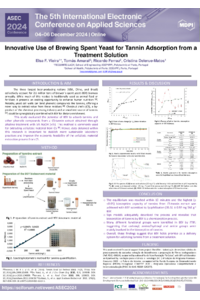
This study aimed to evaluate the capacity of spent brewer's yeast (BSY) to adsorb tannins and other phenolic compounds from an alkaline-extracted chestnut shell tannin solution (CS tannin extract). The alkaline extraction process used 5% NaOH (v/v), a method commonly employed to extract cellulosic material from chestnut shells (CSs). The findings of this research contribute to the development of more sustainable laboratory practices and enhance the economic viability of cellulosic material extraction from CS.
Various treatments—lyophilization, immobilization in calcium alginate beads, and both alkaline and acid treatments—were applied to BSY to determine which method resulted in the highest tannin adsorption capacity from the CS tannin extract. Kinetic and equilibrium adsorption studies were performed to identify the best adsorption approach. The tannin content was analyzed using the Folin–Ciocalteau method, with results expressed as milligrams of tannic acid equivalents (TAEs) per milliliter of extract solution. The adsorbent material was characterized before and after the experiments; the characterization methods included the determination of the point of zero charge (pHPZC), Fourier Transform Infrared (FT-IR) Spectroscopy, and Scanning Electron Microscopy with Energy Dispersive Spectroscopy (SEM/EDS).
Equilibrium was reached within 10 minutes, with the highest (p<0.05) biosorption capacity of tannins from the CS tannin extract observed in lyophilized BSY (35.51 ± 0.97 mg TAE per gram of BSY). The Sips models provided an adequate description of the adsorption process, indicating that tannin biosorption by BSY is driven by chemisorption. FTIR analysis identified various functional groups in BSY, with carboxyl, amino/hydroxyl, and amide groups playing a significant role in the biosorption process.
Overall, these findings suggest that BSY has potential as a delivery system for the valorization of tannins from treatment solutions.
Keywords
Brewer's Spent Yeast (BSY)
Chestnut shells tannin extract
Lyophilization
Alginate Immobilization
Acid treatment
Alkaline treatment
Equilibrium Assay
Kinetics Assay
FTIR
Poster
Sciforum-104432_Elsa F. Vieira.pdf
Nanocomposites of chitosan–lignin doped with ZnO, TiO2 and Zn2SnO4 for food packaging with UV-blocking, antimicrobial and antioxidant properties
Vanillin-crosslinked chitosan/PVA membranes loaded with dexpanthenol for skin tissue regeneration