Event submissions
Published
This submission belongs to the session S6. Energy, Environmental and Earth Science of the event The 5th International Electronic Conference on Applied Sciences
Published date
04 Dec, 2024
Academic Editor
'%3e%3cpath%20d='M12.6657%2010.9104C12.4185%2010.325%2012.0599%209.79327%2011.6097%209.34482C11.1609%208.89508%2010.6293%208.5365%2010.0442%208.28888C10.0389%208.28626%2010.0337%208.28495%2010.0285%208.28233C10.8446%207.69279%2011.3752%206.73249%2011.3752%205.64904C11.3752%203.8542%209.92103%202.39999%208.1262%202.39999C6.33136%202.39999%204.87715%203.8542%204.87715%205.64904C4.87715%206.73249%205.40774%207.69279%206.22393%208.28364C6.21869%208.28626%206.21345%208.28757%206.20821%208.29019C5.62129%208.5378%205.09463%208.89284%204.64265%209.34613C4.1929%209.79493%203.83432%2010.3266%203.58671%2010.9117C3.34345%2011.4845%203.21226%2012.0987%203.20023%2012.7209C3.19988%2012.7349%203.20233%2012.7488%203.20744%2012.7619C3.21255%2012.7749%203.22022%2012.7867%203.22998%2012.7968C3.23975%2012.8068%203.25142%2012.8147%203.26431%2012.8202C3.2772%2012.8256%203.29105%2012.8284%203.30504%2012.8284H4.09109C4.14874%2012.8284%204.19459%2012.7825%204.1959%2012.7262C4.2221%2011.7148%204.62823%2010.7676%205.34617%2010.0497C6.08899%209.30683%207.0755%208.89808%208.1262%208.89808C9.17689%208.89808%2010.1634%209.30683%2010.9062%2010.0497C11.6242%2010.7676%2012.0303%2011.7148%2012.0565%2012.7262C12.0578%2012.7838%2012.1037%2012.8284%2012.1613%2012.8284H12.9474C12.9613%2012.8284%2012.9752%2012.8256%2012.9881%2012.8202C13.001%2012.8147%2013.0126%2012.8068%2013.0224%2012.7968C13.0322%2012.7867%2013.0398%2012.7749%2013.0449%2012.7619C13.0501%2012.7488%2013.0525%2012.7349%2013.0522%2012.7209C13.0391%2012.0947%2012.9094%2011.4855%2012.6657%2010.9104ZM8.1262%207.9024C7.52486%207.9024%206.9589%207.6679%206.53312%207.24211C6.10733%206.81633%205.87283%206.25037%205.87283%205.64904C5.87283%205.0477%206.10733%204.48174%206.53312%204.05596C6.9589%203.63018%207.52486%203.39567%208.1262%203.39567C8.72753%203.39567%209.29349%203.63018%209.71927%204.05596C10.1451%204.48174%2010.3796%205.0477%2010.3796%205.64904C10.3796%206.25037%2010.1451%206.81633%209.71927%207.24211C9.29349%207.6679%208.72753%207.9024%208.1262%207.9024Z'%20fill='%235D1EE1'/%3e%3c/g%3e%3c/svg%3e) Francesco Arcadio
Francesco ArcadioCitation
Olha Biedunkova, Pavlo Kuznietsov, Yuliia Trach, Assessment of the anthropogenic load levels of heavy metals: a case study on the example of the Styr River, in Proceedings of The 5th International Electronic Conference on Applied Sciences, 4 December–6 December 2024, MDPI: Basel, Switzerland
Share
Email
Facebook
Twitter
LinkedIn
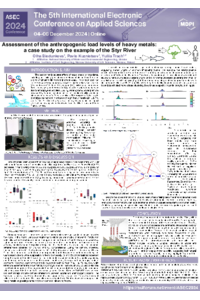
Assessment of the anthropogenic load levels of heavy metals: a case study on the example of the Styr River

Olha Biedunkova 1
'%3e%3cpath%20d='M12.6647%2010.9104C12.4176%2010.325%2012.0589%209.7933%2011.6088%209.34485C11.16%208.89511%2010.6283%208.53653%2010.0432%208.28891C10.038%208.28629%2010.0327%208.28498%2010.0275%208.28236C10.8437%207.69282%2011.3743%206.73252%2011.3743%205.64907C11.3743%203.85423%209.92005%202.40002%208.12522%202.40002C6.33038%202.40002%204.87618%203.85423%204.87618%205.64907C4.87618%206.73252%205.40677%207.69282%206.22296%208.28367C6.21772%208.28629%206.21248%208.2876%206.20724%208.29022C5.62031%208.53783%205.09365%208.89287%204.64167%209.34616C4.19192%209.79496%203.83334%2010.3266%203.58573%2010.9117C3.34247%2011.4846%203.21128%2012.0987%203.19925%2012.721C3.1989%2012.735%203.20135%2012.7489%203.20646%2012.7619C3.21157%2012.7749%203.21924%2012.7868%203.22901%2012.7968C3.23877%2012.8068%203.25045%2012.8148%203.26334%2012.8202C3.27623%2012.8256%203.29007%2012.8284%203.30406%2012.8284H4.09012C4.14776%2012.8284%204.19362%2012.7825%204.19493%2012.7262C4.22113%2011.7148%204.62726%2010.7676%205.34519%2010.0497C6.08802%209.30686%207.07452%208.89811%208.12522%208.89811C9.17592%208.89811%2010.1624%209.30686%2010.9052%2010.0497C11.6232%2010.7676%2012.0293%2011.7148%2012.0555%2012.7262C12.0568%2012.7839%2012.1027%2012.8284%2012.1603%2012.8284H12.9464C12.9604%2012.8284%2012.9742%2012.8256%2012.9871%2012.8202C13%2012.8148%2013.0117%2012.8068%2013.0214%2012.7968C13.0312%2012.7868%2013.0389%2012.7749%2013.044%2012.7619C13.0491%2012.7489%2013.0515%2012.735%2013.0512%2012.721C13.0381%2012.0947%2012.9084%2011.4856%2012.6647%2010.9104ZM8.12522%207.90243C7.52388%207.90243%206.95792%207.66793%206.53214%207.24215C6.10636%206.81636%205.87185%206.2504%205.87185%205.64907C5.87185%205.04773%206.10636%204.48177%206.53214%204.05599C6.95792%203.63021%207.52388%203.3957%208.12522%203.3957C8.72655%203.3957%209.29252%203.63021%209.7183%204.05599C10.1441%204.48177%2010.3786%205.04773%2010.3786%205.64907C10.3786%206.2504%2010.1441%206.81636%209.7183%207.24215C9.29252%207.66793%208.72655%207.90243%208.12522%207.90243Z'%20fill='%235D1EE1'/%3e%3c/g%3e%3c/svg%3e)
Pavlo Kuznietsov 2

Yuliia Trach 1,3
1. National University of Water and Environmental Engineering, Ukraine
2. National University of Water and Environmental Engineering, 33028 Rivne, Ukraine
3. Institute of Civil Engineering, Poland
Abstract
Introduction: The increasing levels of heavy metals in natural waters pose significant environmental and health risks. This study focuses on the Styr River, particularly in the area affected by cooling water discharge from the Rivne Nuclear Power Plant in Ukraine. The primary aim is to analyze the distribution and sources of eight heavy metals: Zn, Cd, Pb, Cu, Ni, Mn, As, and Cr.
Methods: Monthly water samples were collected from 2018 to 2022 and analyzed using an inductively coupled plasma mass spectrometer (ICAP 7400 Duo). The analytical lines used were Zn (213.857 nm), Cd (226.502 nm), Pb (220.353 nm), Cu (324.754 nm), Ni (231.604 nm), Mn (257.610 nm), As (193.696 nm), and Cr (267.716 nm). Calibration was performed with standard solutions, and results were checked against internal quality standards. Statistical analyses included Pearson correlation and cluster analysis to identify relationships and potential sources of heavy metals.
Results: The average concentrations of heavy metals in the Styr River water followed the sequence: Cu > As > Zn > Mn > Ni > Cr > Pb > Cd. Seasonal and annual variations were observed, with notable decreases in Zn, Cu, and Mn in 2021, likely due to reduced anthropogenic activities. Pearson correlation and cluster analysis revealed distinct patterns, suggesting both natural and anthropogenic sources. Heavy metals like Pb, Cr, and Ni were associated with industrial emissions and urban pollution, while Cd and As showed more isolated sources. Despite the presence of these metals, their concentrations did not exceed the allowable limits set by the Council Directive 98/83/EC for drinking water.
Conclusions: This study provides a comprehensive assessment of heavy metal pollution in the Styr River. The findings indicate that the water quality remains within safe limits for human consumption, although continuous monitoring is essential. The results highlight the complex interplay of natural and anthropogenic factors influencing heavy metal levels, emphasizing the need for sustainable environmental management practices.
Keywords
heavy metals
water pollution
inductively coupled plasma mass spectrometer
environmental monitoring
anthropogenic activities
Poster
Biedunkova_Kuznietsov_Trach.pdf
Semi-supervised facial beauty prediction using contrastive pretraining with SimCLR
Electrochemical techniques for monitoring analytes dissolved in acidic solutions for the food industry