Event submissions
Published
This submission belongs to the session S7. Food Science and Technology of the event The 5th International Electronic Conference on Applied Sciences
Published date
04 Dec, 2024
Academic Editor
'%3e%3cpath%20d='M12.6657%2010.9104C12.4185%2010.325%2012.0599%209.79327%2011.6097%209.34482C11.1609%208.89508%2010.6293%208.5365%2010.0442%208.28888C10.0389%208.28626%2010.0337%208.28495%2010.0285%208.28233C10.8446%207.69279%2011.3752%206.73249%2011.3752%205.64904C11.3752%203.8542%209.92103%202.39999%208.1262%202.39999C6.33136%202.39999%204.87715%203.8542%204.87715%205.64904C4.87715%206.73249%205.40774%207.69279%206.22393%208.28364C6.21869%208.28626%206.21345%208.28757%206.20821%208.29019C5.62129%208.5378%205.09463%208.89284%204.64265%209.34613C4.1929%209.79493%203.83432%2010.3266%203.58671%2010.9117C3.34345%2011.4845%203.21226%2012.0987%203.20023%2012.7209C3.19988%2012.7349%203.20233%2012.7488%203.20744%2012.7619C3.21255%2012.7749%203.22022%2012.7867%203.22998%2012.7968C3.23975%2012.8068%203.25142%2012.8147%203.26431%2012.8202C3.2772%2012.8256%203.29105%2012.8284%203.30504%2012.8284H4.09109C4.14874%2012.8284%204.19459%2012.7825%204.1959%2012.7262C4.2221%2011.7148%204.62823%2010.7676%205.34617%2010.0497C6.08899%209.30683%207.0755%208.89808%208.1262%208.89808C9.17689%208.89808%2010.1634%209.30683%2010.9062%2010.0497C11.6242%2010.7676%2012.0303%2011.7148%2012.0565%2012.7262C12.0578%2012.7838%2012.1037%2012.8284%2012.1613%2012.8284H12.9474C12.9613%2012.8284%2012.9752%2012.8256%2012.9881%2012.8202C13.001%2012.8147%2013.0126%2012.8068%2013.0224%2012.7968C13.0322%2012.7867%2013.0398%2012.7749%2013.0449%2012.7619C13.0501%2012.7488%2013.0525%2012.7349%2013.0522%2012.7209C13.0391%2012.0947%2012.9094%2011.4855%2012.6657%2010.9104ZM8.1262%207.9024C7.52486%207.9024%206.9589%207.6679%206.53312%207.24211C6.10733%206.81633%205.87283%206.25037%205.87283%205.64904C5.87283%205.0477%206.10733%204.48174%206.53312%204.05596C6.9589%203.63018%207.52486%203.39567%208.1262%203.39567C8.72753%203.39567%209.29349%203.63018%209.71927%204.05596C10.1451%204.48174%2010.3796%205.0477%2010.3796%205.64904C10.3796%206.25037%2010.1451%206.81633%209.71927%207.24211C9.29349%207.6679%208.72753%207.9024%208.1262%207.9024Z'%20fill='%235D1EE1'/%3e%3c/g%3e%3c/svg%3e) Antonios Koutelidakis
Antonios KoutelidakisCitation
Guilherme Cruto Ala da Costa, Daniel Duarte, Cláudia Ribeiro, João Tomé, Guilherme Martins, Luiz Pereira, Lúcia Bilro, Rogério Nogueira, Electrochemical techniques for monitoring analytes dissolved in acidic solutions for the food industry, in Proceedings of The 5th International Electronic Conference on Applied Sciences, 4 December–6 December 2024, MDPI: Basel, Switzerland
Share
Email
Facebook
Twitter
LinkedIn
Electrochemical techniques for monitoring analytes dissolved in acidic solutions for the food industry
'%3e%3cpath%20d='M12.6647%2010.9104C12.4176%2010.325%2012.0589%209.7933%2011.6088%209.34485C11.16%208.89511%2010.6283%208.53653%2010.0432%208.28891C10.038%208.28629%2010.0327%208.28498%2010.0275%208.28236C10.8437%207.69282%2011.3743%206.73252%2011.3743%205.64907C11.3743%203.85423%209.92005%202.40002%208.12522%202.40002C6.33038%202.40002%204.87618%203.85423%204.87618%205.64907C4.87618%206.73252%205.40677%207.69282%206.22296%208.28367C6.21772%208.28629%206.21248%208.2876%206.20724%208.29022C5.62031%208.53783%205.09365%208.89287%204.64167%209.34616C4.19192%209.79496%203.83334%2010.3266%203.58573%2010.9117C3.34247%2011.4846%203.21128%2012.0987%203.19925%2012.721C3.1989%2012.735%203.20135%2012.7489%203.20646%2012.7619C3.21157%2012.7749%203.21924%2012.7868%203.22901%2012.7968C3.23877%2012.8068%203.25045%2012.8148%203.26334%2012.8202C3.27623%2012.8256%203.29007%2012.8284%203.30406%2012.8284H4.09012C4.14776%2012.8284%204.19362%2012.7825%204.19493%2012.7262C4.22113%2011.7148%204.62726%2010.7676%205.34519%2010.0497C6.08802%209.30686%207.07452%208.89811%208.12522%208.89811C9.17592%208.89811%2010.1624%209.30686%2010.9052%2010.0497C11.6232%2010.7676%2012.0293%2011.7148%2012.0555%2012.7262C12.0568%2012.7839%2012.1027%2012.8284%2012.1603%2012.8284H12.9464C12.9604%2012.8284%2012.9742%2012.8256%2012.9871%2012.8202C13%2012.8148%2013.0117%2012.8068%2013.0214%2012.7968C13.0312%2012.7868%2013.0389%2012.7749%2013.044%2012.7619C13.0491%2012.7489%2013.0515%2012.735%2013.0512%2012.721C13.0381%2012.0947%2012.9084%2011.4856%2012.6647%2010.9104ZM8.12522%207.90243C7.52388%207.90243%206.95792%207.66793%206.53214%207.24215C6.10636%206.81636%205.87185%206.2504%205.87185%205.64907C5.87185%205.04773%206.10636%204.48177%206.53214%204.05599C6.95792%203.63021%207.52388%203.3957%208.12522%203.3957C8.72655%203.3957%209.29252%203.63021%209.7183%204.05599C10.1441%204.48177%2010.3786%205.04773%2010.3786%205.64907C10.3786%206.2504%2010.1441%206.81636%209.7183%207.24215C9.29252%207.66793%208.72655%207.90243%208.12522%207.90243Z'%20fill='%235D1EE1'/%3e%3c/g%3e%3c/svg%3e)
Guilherme Cruto Ala da Costa 1
Daniel Duarte 2
Cláudia Ribeiro 3

João Tomé 3
Guilherme Martins 4,5
Luiz Pereira 6,7
Lúcia Bilro 8
Rogério Nogueira 8,9
1. Universidade de Aveiro, Aveiro, Portugal.
2. Watgrid, Aveiro, Portugal.
3. CQE & IMS, Departamento de Engenharia Química, Instituto Superior Técnico, Universidade de Lisboa, Lisboa, Portugal
4. Université de Bordeaux, INRAE, Bordeaux INP, UMR Œnologie EA 4577, USC 1366, ISVV, 33140 Villenave d’Ornon, France
5. Bordeaux Sciences Agro, 1 cours du Général de Gaulle, 33170 Gradignan, France
6. Universidade de Aveiro
7. Institute of Nanostructures, Nanomodelling, and Nanofabrication (i3N)
8. Watgrid
9. Instituto de Telecomunicações, Aveiro
Abstract
Introduction:
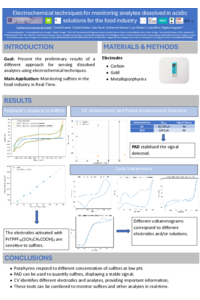
Real-time monitoring of liquid solutions has several critical applications in the food industry, where detecting and quantifying several analytes is essential for preventing health hazards, guarantying quality control and reducing production costs. The wine industry is presenting an increasing interest in monitoring different analytes, like sulfites, leading to studies regarding different materials and monitoring techniques. Electrochemical solutions present significant advantages for industrial applications due to their straightforward instrumentation. Nevertheless, when dealing with complex chemical solutions, like wine, one must find methods that allow for simple calibration curves and reutilization and can effectively account for many interfering molecules.
Methods:
In this work, we applied different electrochemical techniques for monitoring sulfites in acidic solutions. Electrodes made from different materials were used to perform the techniques of amperometry and cyclic voltammetry for sulfite detection. DC potential and pulsed amperometry techniques were compared. Cyclic voltammetry was used for detecting sulfites and identifying different solutions.
Results:
The results show that amperometry can be used to monitor different concentrations of sulfites, using pulsed potential waveforms (PAD) to prevent signal decay, and provide a more stable response. Cyclic voltammetry can also monitor sulfites but one great application is in identifying different solutions, analytes and electrodes, thus adding layers of information with features present in the respective voltammograms.
Conclusions:
The information gathered from these electrochemical techniques can be fed into different models that allow for the separation of interfering molecules from our desired target analyte. This suggests the potential of using amperometry and CV together as applicable methods for real-time analyte monitoring in the food industry.
Acknowledgments: I would like to express my gratitude to CQE (UIDB/00100/2020 and UIDP/00100/2020), IMS (LA/P/0056/2020) and Watgrid for providing the materials to conduct this study.
Keywords
Sulfites
Electrochemistry
Pulsed Amperometry
Cyclic Voltammetry
Acidic solutions
Poster
sciforum-107822.pdf
Assessment of the anthropogenic load levels of heavy metals: a case study on the example of the Styr River
Evaluating the quality of generative artificial intelligence in healthcare: a systematic review