Event submissions
Published
This submission belongs to the session S6. Energy, Environmental and Earth Science of the event The 5th International Electronic Conference on Applied Sciences
Published date
04 Dec, 2024
Academic Editor
'%3e%3cpath%20d='M12.6657%2010.9104C12.4185%2010.325%2012.0599%209.79327%2011.6097%209.34482C11.1609%208.89508%2010.6293%208.5365%2010.0442%208.28888C10.0389%208.28626%2010.0337%208.28495%2010.0285%208.28233C10.8446%207.69279%2011.3752%206.73249%2011.3752%205.64904C11.3752%203.8542%209.92103%202.39999%208.1262%202.39999C6.33136%202.39999%204.87715%203.8542%204.87715%205.64904C4.87715%206.73249%205.40774%207.69279%206.22393%208.28364C6.21869%208.28626%206.21345%208.28757%206.20821%208.29019C5.62129%208.5378%205.09463%208.89284%204.64265%209.34613C4.1929%209.79493%203.83432%2010.3266%203.58671%2010.9117C3.34345%2011.4845%203.21226%2012.0987%203.20023%2012.7209C3.19988%2012.7349%203.20233%2012.7488%203.20744%2012.7619C3.21255%2012.7749%203.22022%2012.7867%203.22998%2012.7968C3.23975%2012.8068%203.25142%2012.8147%203.26431%2012.8202C3.2772%2012.8256%203.29105%2012.8284%203.30504%2012.8284H4.09109C4.14874%2012.8284%204.19459%2012.7825%204.1959%2012.7262C4.2221%2011.7148%204.62823%2010.7676%205.34617%2010.0497C6.08899%209.30683%207.0755%208.89808%208.1262%208.89808C9.17689%208.89808%2010.1634%209.30683%2010.9062%2010.0497C11.6242%2010.7676%2012.0303%2011.7148%2012.0565%2012.7262C12.0578%2012.7838%2012.1037%2012.8284%2012.1613%2012.8284H12.9474C12.9613%2012.8284%2012.9752%2012.8256%2012.9881%2012.8202C13.001%2012.8147%2013.0126%2012.8068%2013.0224%2012.7968C13.0322%2012.7867%2013.0398%2012.7749%2013.0449%2012.7619C13.0501%2012.7488%2013.0525%2012.7349%2013.0522%2012.7209C13.0391%2012.0947%2012.9094%2011.4855%2012.6657%2010.9104ZM8.1262%207.9024C7.52486%207.9024%206.9589%207.6679%206.53312%207.24211C6.10733%206.81633%205.87283%206.25037%205.87283%205.64904C5.87283%205.0477%206.10733%204.48174%206.53312%204.05596C6.9589%203.63018%207.52486%203.39567%208.1262%203.39567C8.72753%203.39567%209.29349%203.63018%209.71927%204.05596C10.1451%204.48174%2010.3796%205.0477%2010.3796%205.64904C10.3796%206.25037%2010.1451%206.81633%209.71927%207.24211C9.29349%207.6679%208.72753%207.9024%208.1262%207.9024Z'%20fill='%235D1EE1'/%3e%3c/g%3e%3c/svg%3e) Nunzio Cennamo
Nunzio CennamoCitation
Elissavet Emmanouilidou, Alexandros Psalidas, Anastasia Lazaridou, Sophia Mitkidou, Nikolaos C. Kokkinos, Green upgrading of biodiesel derived from biomass wastes, in Proceedings of The 5th International Electronic Conference on Applied Sciences, 4 December–6 December 2024, MDPI: Basel, Switzerland
Share
Email
Facebook
Twitter
LinkedIn
Green upgrading of biodiesel derived from biomass wastes

Elissavet Emmanouilidou 1,2

Alexandros Psalidas 1
'%3e%3cpath%20d='M12.6647%2010.9104C12.4176%2010.325%2012.0589%209.7933%2011.6088%209.34485C11.16%208.89511%2010.6283%208.53653%2010.0432%208.28891C10.038%208.28629%2010.0327%208.28498%2010.0275%208.28236C10.8437%207.69282%2011.3743%206.73252%2011.3743%205.64907C11.3743%203.85423%209.92005%202.40002%208.12522%202.40002C6.33038%202.40002%204.87618%203.85423%204.87618%205.64907C4.87618%206.73252%205.40677%207.69282%206.22296%208.28367C6.21772%208.28629%206.21248%208.2876%206.20724%208.29022C5.62031%208.53783%205.09365%208.89287%204.64167%209.34616C4.19192%209.79496%203.83334%2010.3266%203.58573%2010.9117C3.34247%2011.4846%203.21128%2012.0987%203.19925%2012.721C3.1989%2012.735%203.20135%2012.7489%203.20646%2012.7619C3.21157%2012.7749%203.21924%2012.7868%203.22901%2012.7968C3.23877%2012.8068%203.25045%2012.8148%203.26334%2012.8202C3.27623%2012.8256%203.29007%2012.8284%203.30406%2012.8284H4.09012C4.14776%2012.8284%204.19362%2012.7825%204.19493%2012.7262C4.22113%2011.7148%204.62726%2010.7676%205.34519%2010.0497C6.08802%209.30686%207.07452%208.89811%208.12522%208.89811C9.17592%208.89811%2010.1624%209.30686%2010.9052%2010.0497C11.6232%2010.7676%2012.0293%2011.7148%2012.0555%2012.7262C12.0568%2012.7839%2012.1027%2012.8284%2012.1603%2012.8284H12.9464C12.9604%2012.8284%2012.9742%2012.8256%2012.9871%2012.8202C13%2012.8148%2013.0117%2012.8068%2013.0214%2012.7968C13.0312%2012.7868%2013.0389%2012.7749%2013.044%2012.7619C13.0491%2012.7489%2013.0515%2012.735%2013.0512%2012.721C13.0381%2012.0947%2012.9084%2011.4856%2012.6647%2010.9104ZM8.12522%207.90243C7.52388%207.90243%206.95792%207.66793%206.53214%207.24215C6.10636%206.81636%205.87185%206.2504%205.87185%205.64907C5.87185%205.04773%206.10636%204.48177%206.53214%204.05599C6.95792%203.63021%207.52388%203.3957%208.12522%203.3957C8.72655%203.3957%209.29252%203.63021%209.7183%204.05599C10.1441%204.48177%2010.3786%205.04773%2010.3786%205.64907C10.3786%206.2504%2010.1441%206.81636%209.7183%207.24215C9.29252%207.66793%208.72655%207.90243%208.12522%207.90243Z'%20fill='%235D1EE1'/%3e%3c/g%3e%3c/svg%3e)
Anastasia Lazaridou 1,2
Sophia Mitkidou 1,2

Nikolaos C. Kokkinos 1,2,3
1. School of Chemistry, Faculty of Science, Democritus University of Thrace, Ag. Loukas, 654 04 Kavala, Greece
2. Petroleum Institute, Democritus University of Thrace, Ag. Loukas, 654 04 Kavala, Greece
3. Hephaestus Laboratory, Faculty of Science, Democritus University of Thrace, Ag. Loukas, 654 04 Kavala, Greece
Abstract
With the increasing demand for edible oils for food and fuel purposes, non-edible oils have become more attractive for biodiesel production. Nevertheless, biodiesel has significant drawbacks that hinder its broader utilization, necessitating its blending with conventional diesel for current applications. These drawbacks include low oxidative stability (OS) and inadequate cold flow properties. These fuel properties are influenced by the composition of fatty acid methyl esters (FAMEs), with a particular emphasis on their degree of unsaturation. Compression ignition (CI) engines can effortlessly handle blends of up to 30% biodiesel mixed with diesel fuel without necessitating any modifications. However, surpassing this threshold and utilizing biodiesel to a greater extent demands engine upgrade. Partial hydrogenation in aqueous/organic biphasic catalytic systems of polyunsaturated FAMEs aims for maximum selectivity towards cis-monounsaturated FAMEs. This approach optimizes oxidative stability while preserving satisfactory cold flow properties to the greatest extent possible.
The method used in this work includes the characterization of biodiesel samples using EN ISO standard methods and gas chromatography–mass spectrometry (GC-MS) for qualitative and quantitative analysis. Based on the composition of biodiesel samples in polyunsaturated FAMEs, partial hydrogenation in aqueous/organic biphasic catalytic systems using transition metal complexes aims at improving the properties of produced biodiesel to meet specific standards while acting as a purification step, effectively eliminating impurities.
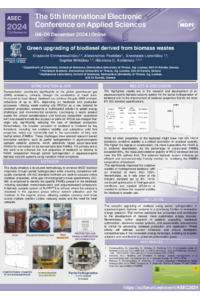
The highlighted results are (i) the research and development of an aqueous/organic biphasic catalytic system for the partial hydrogenation of biodiesel, and (ii) the improvement of biodiesel properties that do not meet EN ISO standard specifications.
Given the ongoing research and development in this field, the catalytic upgrading of biodiesel through partial hydrogenation in aqueous/organic biphasic catalytic systems seems promising. Further exploration of innovative catalysts and techniques holds potential for advancing biodiesel production and its application.
Keywords
biodiesel
upgrade
biphasic catalysis
biomass
waste cooking oil
Poster
sciforum-103665.pdf
Evaluating the quality of generative artificial intelligence in healthcare: a systematic review
Feature Engineering for Lung Cancer Classification Using Next-Generation Sequencing Data