Event submissions
Published
This submission belongs to the session C. Human Genomics and Genetic Diseases of the event The 2nd International Electronic Conference on Genes
Published date
09 Dec, 2024
Academic Editor
'%3e%3cpath%20d='M12.6657%2010.9104C12.4185%2010.325%2012.0599%209.79327%2011.6097%209.34482C11.1609%208.89508%2010.6293%208.5365%2010.0442%208.28888C10.0389%208.28626%2010.0337%208.28495%2010.0285%208.28233C10.8446%207.69279%2011.3752%206.73249%2011.3752%205.64904C11.3752%203.8542%209.92103%202.39999%208.1262%202.39999C6.33136%202.39999%204.87715%203.8542%204.87715%205.64904C4.87715%206.73249%205.40774%207.69279%206.22393%208.28364C6.21869%208.28626%206.21345%208.28757%206.20821%208.29019C5.62129%208.5378%205.09463%208.89284%204.64265%209.34613C4.1929%209.79493%203.83432%2010.3266%203.58671%2010.9117C3.34345%2011.4845%203.21226%2012.0987%203.20023%2012.7209C3.19988%2012.7349%203.20233%2012.7488%203.20744%2012.7619C3.21255%2012.7749%203.22022%2012.7867%203.22998%2012.7968C3.23975%2012.8068%203.25142%2012.8147%203.26431%2012.8202C3.2772%2012.8256%203.29105%2012.8284%203.30504%2012.8284H4.09109C4.14874%2012.8284%204.19459%2012.7825%204.1959%2012.7262C4.2221%2011.7148%204.62823%2010.7676%205.34617%2010.0497C6.08899%209.30683%207.0755%208.89808%208.1262%208.89808C9.17689%208.89808%2010.1634%209.30683%2010.9062%2010.0497C11.6242%2010.7676%2012.0303%2011.7148%2012.0565%2012.7262C12.0578%2012.7838%2012.1037%2012.8284%2012.1613%2012.8284H12.9474C12.9613%2012.8284%2012.9752%2012.8256%2012.9881%2012.8202C13.001%2012.8147%2013.0126%2012.8068%2013.0224%2012.7968C13.0322%2012.7867%2013.0398%2012.7749%2013.0449%2012.7619C13.0501%2012.7488%2013.0525%2012.7349%2013.0522%2012.7209C13.0391%2012.0947%2012.9094%2011.4855%2012.6657%2010.9104ZM8.1262%207.9024C7.52486%207.9024%206.9589%207.6679%206.53312%207.24211C6.10733%206.81633%205.87283%206.25037%205.87283%205.64904C5.87283%205.0477%206.10733%204.48174%206.53312%204.05596C6.9589%203.63018%207.52486%203.39567%208.1262%203.39567C8.72753%203.39567%209.29349%203.63018%209.71927%204.05596C10.1451%204.48174%2010.3796%205.0477%2010.3796%205.64904C10.3796%206.25037%2010.1451%206.81633%209.71927%207.24211C9.29349%207.6679%208.72753%207.9024%208.1262%207.9024Z'%20fill='%235D1EE1'/%3e%3c/g%3e%3c/svg%3e) Dror Sharon
Dror SharonCitation
Surbhi Malhotra, Manik Kaushal, Gauri Awasthi, Relevance of Pharmacogenomics, CYP450 genes and their genetic variations in drug metabolism and toxicity , in Proceedings of The 2nd International Electronic Conference on Genes, 11 December–13 December 2024, MDPI: Basel, Switzerland
Share
Email
Facebook
Twitter
LinkedIn
Relevance of Pharmacogenomics, CYP450 genes and their genetic variations in drug metabolism and toxicity
'%3e%3cpath%20d='M12.6647%2010.9104C12.4176%2010.325%2012.0589%209.7933%2011.6088%209.34485C11.16%208.89511%2010.6283%208.53653%2010.0432%208.28891C10.038%208.28629%2010.0327%208.28498%2010.0275%208.28236C10.8437%207.69282%2011.3743%206.73252%2011.3743%205.64907C11.3743%203.85423%209.92005%202.40002%208.12522%202.40002C6.33038%202.40002%204.87618%203.85423%204.87618%205.64907C4.87618%206.73252%205.40677%207.69282%206.22296%208.28367C6.21772%208.28629%206.21248%208.2876%206.20724%208.29022C5.62031%208.53783%205.09365%208.89287%204.64167%209.34616C4.19192%209.79496%203.83334%2010.3266%203.58573%2010.9117C3.34247%2011.4846%203.21128%2012.0987%203.19925%2012.721C3.1989%2012.735%203.20135%2012.7489%203.20646%2012.7619C3.21157%2012.7749%203.21924%2012.7868%203.22901%2012.7968C3.23877%2012.8068%203.25045%2012.8148%203.26334%2012.8202C3.27623%2012.8256%203.29007%2012.8284%203.30406%2012.8284H4.09012C4.14776%2012.8284%204.19362%2012.7825%204.19493%2012.7262C4.22113%2011.7148%204.62726%2010.7676%205.34519%2010.0497C6.08802%209.30686%207.07452%208.89811%208.12522%208.89811C9.17592%208.89811%2010.1624%209.30686%2010.9052%2010.0497C11.6232%2010.7676%2012.0293%2011.7148%2012.0555%2012.7262C12.0568%2012.7839%2012.1027%2012.8284%2012.1603%2012.8284H12.9464C12.9604%2012.8284%2012.9742%2012.8256%2012.9871%2012.8202C13%2012.8148%2013.0117%2012.8068%2013.0214%2012.7968C13.0312%2012.7868%2013.0389%2012.7749%2013.044%2012.7619C13.0491%2012.7489%2013.0515%2012.735%2013.0512%2012.721C13.0381%2012.0947%2012.9084%2011.4856%2012.6647%2010.9104ZM8.12522%207.90243C7.52388%207.90243%206.95792%207.66793%206.53214%207.24215C6.10636%206.81636%205.87185%206.2504%205.87185%205.64907C5.87185%205.04773%206.10636%204.48177%206.53214%204.05599C6.95792%203.63021%207.52388%203.3957%208.12522%203.3957C8.72655%203.3957%209.29252%203.63021%209.7183%204.05599C10.1441%204.48177%2010.3786%205.04773%2010.3786%205.64907C10.3786%206.2504%2010.1441%206.81636%209.7183%207.24215C9.29252%207.66793%208.72655%207.90243%208.12522%207.90243Z'%20fill='%235D1EE1'/%3e%3c/g%3e%3c/svg%3e)
Surbhi Malhotra 1
Manik Kaushal 1
Gauri Awasthi 1
1. Genomics and Personalized Medicine, Tata Consultancy Services
Abstract
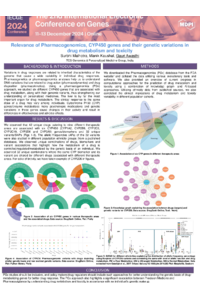
Background: Variations in drug responses are related to inherited characteristics of the genome that cause a wide variability in individual responses to drugs. Pharmacogenetics or pharmacogenomics analyses help us to understand DNA variations that are related to drug action (pharmacodynamics) and drug disposition (pharmacokinetics). Using a pharmacogenomics (PGx) approach, we studied different CYP450 genes that are associated with drug metabolism, along with their genomic variants, thus strengthening our understanding of personalized medicines.
Methods: We downloaded the PGx database from the FDA website and collated the data utilizing various evolutionary tools and software. We also provided an overview of current progress in computational approaches for the prediction of drug metabolism and toxicity using a combination of knowledge graph- and AI-based approaches. Utilizing ethnicity data from published sources, we also correlated the clinical implications of drug metabolism and toxicity variability in different population cohorts.
Results: We observed that 42 unique drugs catering to nine different therapeutic areas are associated with six CYP450 (CYP1A2, CYP2B6, CYP2C9, CYP2C19, CYP2D6 and CYP3A5) genes/biomarkers and 32 unique variants/SNPs. The allelic frequencies (AFs) of the 32 variants were also studied in different population ethnicity groups (from a published database). We observed unique combinations of drugs, biomarkers and variant associations that highlight how the metabolism of a drug is controlled/regulated/metabolized by the genetic basis of an individual. We observed 32 unique combinations where the same CYP biomarker and its variant are shared by different drugs associated with different therapeutic areas.
Conclusions: PGx studies should be inclusive, and policy makers/drug regulators should include such approaches for better understanding the genetic basis of drug-metabolizing genes for better drug response. The PGx approach also highlights a significant association between Precision Medicine and Pharmacovigilance by understanding drug metabolism and toxicity in accordance with an individual’s genetic makeup.
Keywords
Pharmacogenomics
Drug Metabolism
Drug toxicity
Human CYP450 genes
Therapeutic areas
Genomic variants,
Poster
Gauri Awasthi poster.pdf
The CXCR4/CXCL12 axis contributes to cerebrolysin-induced neuroprotection against staurosporine-treated cortical neurons at 7 days in vitro and prevents inflammation in a N2a cell line exposed to LPS
Study of SUM159 Cell Lines Untreated and Treated with drug Mebendazole and its effect on Transcriptome Level (Rna-Seq Analysis)