Event submissions
Published
This submission belongs to the session B. Genetic Diagnosis and Targeted Therapy in Cancer of the event The 2nd International Electronic Conference on Genes
Published date
09 Dec, 2024
Academic Editor
'%3e%3cpath%20d='M12.6657%2010.9104C12.4185%2010.325%2012.0599%209.79327%2011.6097%209.34482C11.1609%208.89508%2010.6293%208.5365%2010.0442%208.28888C10.0389%208.28626%2010.0337%208.28495%2010.0285%208.28233C10.8446%207.69279%2011.3752%206.73249%2011.3752%205.64904C11.3752%203.8542%209.92103%202.39999%208.1262%202.39999C6.33136%202.39999%204.87715%203.8542%204.87715%205.64904C4.87715%206.73249%205.40774%207.69279%206.22393%208.28364C6.21869%208.28626%206.21345%208.28757%206.20821%208.29019C5.62129%208.5378%205.09463%208.89284%204.64265%209.34613C4.1929%209.79493%203.83432%2010.3266%203.58671%2010.9117C3.34345%2011.4845%203.21226%2012.0987%203.20023%2012.7209C3.19988%2012.7349%203.20233%2012.7488%203.20744%2012.7619C3.21255%2012.7749%203.22022%2012.7867%203.22998%2012.7968C3.23975%2012.8068%203.25142%2012.8147%203.26431%2012.8202C3.2772%2012.8256%203.29105%2012.8284%203.30504%2012.8284H4.09109C4.14874%2012.8284%204.19459%2012.7825%204.1959%2012.7262C4.2221%2011.7148%204.62823%2010.7676%205.34617%2010.0497C6.08899%209.30683%207.0755%208.89808%208.1262%208.89808C9.17689%208.89808%2010.1634%209.30683%2010.9062%2010.0497C11.6242%2010.7676%2012.0303%2011.7148%2012.0565%2012.7262C12.0578%2012.7838%2012.1037%2012.8284%2012.1613%2012.8284H12.9474C12.9613%2012.8284%2012.9752%2012.8256%2012.9881%2012.8202C13.001%2012.8147%2013.0126%2012.8068%2013.0224%2012.7968C13.0322%2012.7867%2013.0398%2012.7749%2013.0449%2012.7619C13.0501%2012.7488%2013.0525%2012.7349%2013.0522%2012.7209C13.0391%2012.0947%2012.9094%2011.4855%2012.6657%2010.9104ZM8.1262%207.9024C7.52486%207.9024%206.9589%207.6679%206.53312%207.24211C6.10733%206.81633%205.87283%206.25037%205.87283%205.64904C5.87283%205.0477%206.10733%204.48174%206.53312%204.05596C6.9589%203.63018%207.52486%203.39567%208.1262%203.39567C8.72753%203.39567%209.29349%203.63018%209.71927%204.05596C10.1451%204.48174%2010.3796%205.0477%2010.3796%205.64904C10.3796%206.25037%2010.1451%206.81633%209.71927%207.24211C9.29349%207.6679%208.72753%207.9024%208.1262%207.9024Z'%20fill='%235D1EE1'/%3e%3c/g%3e%3c/svg%3e) Dror Sharon
Dror SharonCitation
Pramodkumar P Gupta, Mala M Parab, Janhavi Tripathi, Mayur Sonkusare, Hridhya Yogesh Nair, Mrunal Gokhale, Amit Kumar Shrivastava, Prerona Boruah, Debjani Dasgupta, Study of SUM159 Cell Lines Untreated and Treated with drug Mebendazole and its effect on Transcriptome Level (Rna-Seq Analysis), in Proceedings of The 2nd International Electronic Conference on Genes, 11 December–13 December 2024, MDPI: Basel, Switzerland
Share
Email
Facebook
Twitter
LinkedIn
Study of SUM159 Cell Lines Untreated and Treated with drug Mebendazole and its effect on Transcriptome Level (Rna-Seq Analysis)

Pramodkumar P Gupta 1

Mala M Parab 1
'%3e%3cpath%20d='M12.6647%2010.9104C12.4176%2010.325%2012.0589%209.7933%2011.6088%209.34485C11.16%208.89511%2010.6283%208.53653%2010.0432%208.28891C10.038%208.28629%2010.0327%208.28498%2010.0275%208.28236C10.8437%207.69282%2011.3743%206.73252%2011.3743%205.64907C11.3743%203.85423%209.92005%202.40002%208.12522%202.40002C6.33038%202.40002%204.87618%203.85423%204.87618%205.64907C4.87618%206.73252%205.40677%207.69282%206.22296%208.28367C6.21772%208.28629%206.21248%208.2876%206.20724%208.29022C5.62031%208.53783%205.09365%208.89287%204.64167%209.34616C4.19192%209.79496%203.83334%2010.3266%203.58573%2010.9117C3.34247%2011.4846%203.21128%2012.0987%203.19925%2012.721C3.1989%2012.735%203.20135%2012.7489%203.20646%2012.7619C3.21157%2012.7749%203.21924%2012.7868%203.22901%2012.7968C3.23877%2012.8068%203.25045%2012.8148%203.26334%2012.8202C3.27623%2012.8256%203.29007%2012.8284%203.30406%2012.8284H4.09012C4.14776%2012.8284%204.19362%2012.7825%204.19493%2012.7262C4.22113%2011.7148%204.62726%2010.7676%205.34519%2010.0497C6.08802%209.30686%207.07452%208.89811%208.12522%208.89811C9.17592%208.89811%2010.1624%209.30686%2010.9052%2010.0497C11.6232%2010.7676%2012.0293%2011.7148%2012.0555%2012.7262C12.0568%2012.7839%2012.1027%2012.8284%2012.1603%2012.8284H12.9464C12.9604%2012.8284%2012.9742%2012.8256%2012.9871%2012.8202C13%2012.8148%2013.0117%2012.8068%2013.0214%2012.7968C13.0312%2012.7868%2013.0389%2012.7749%2013.044%2012.7619C13.0491%2012.7489%2013.0515%2012.735%2013.0512%2012.721C13.0381%2012.0947%2012.9084%2011.4856%2012.6647%2010.9104ZM8.12522%207.90243C7.52388%207.90243%206.95792%207.66793%206.53214%207.24215C6.10636%206.81636%205.87185%206.2504%205.87185%205.64907C5.87185%205.04773%206.10636%204.48177%206.53214%204.05599C6.95792%203.63021%207.52388%203.3957%208.12522%203.3957C8.72655%203.3957%209.29252%203.63021%209.7183%204.05599C10.1441%204.48177%2010.3786%205.04773%2010.3786%205.64907C10.3786%206.2504%2010.1441%206.81636%209.7183%207.24215C9.29252%207.66793%208.72655%207.90243%208.12522%207.90243Z'%20fill='%235D1EE1'/%3e%3c/g%3e%3c/svg%3e)
Janhavi Tripathi 1
Mayur Sonkusare 1
Hridhya Yogesh Nair 1
Mrunal Gokhale 1
Amit Kumar Shrivastava 2
Prerona Boruah 1
Debjani Dasgupta 1
1. School of Biotechnology and Bioinformatics, D Y Patil Deemed to be University, Navi Mumbai, Maharashtra, India
2. Department of Pharmacology, Universal College of Medical Sciences, Bhairahawa, Rupandehi, Nepal.
Abstract
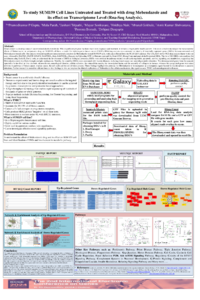
Breast cancer is a leading cause of cancer-related deaths worldwide. While significant progress has been made in its diagnosis and treatment, it remains a major public health concern. This study aimed to investigate the transcriptomic effects of Mebendazole, an antiparasitic drug, on SUM159 cell lines, a model for triple-negative breast cancer (TNBC). RNA-Seq analysis was conducted to identify differentially expressed genes (DEGs) between untreated and Mebendazole-treated cells. Our analysis revealed significant transcriptional alterations in Mebendazole-treated SUM159 cells, with data collected from the NCBI GEO database. The GALAXY server NGS data analysis frame work was used, followed by FASTQC, FASTP, HISAT2, SAMTOOL_Sort, SAMTOOLs_Dataset, the Uploading GTF for Humans standard file from UCSC, Hiseq-Count and analysis in R-reported DEGs. The list of 820 DEGs were analysed for enrichment using EnrichR, David tools, to understand the involvement of DEGs in biological processes. DEGs were enriched in pathways related to cell cycle regulation, apoptosis, survival signaling, and metabolism, suggesting that Mebendazole exerts its effects through multiple mechanisms. Notably, the identified DEGs were associated with various diseases, including breast cancer and neurodegenerative disorders. The downregulated genes from the analysis reported to be involved in liver cirrhosis, atherosclerosis, neurological disorder, cellular adhesion, the extracellular matrix, the transcription factor, and the assembly of collagens in humans, whereas the upregulated genes were more involved in pathways of breast cancer, ovarian cancer, the cell cycle and the cell division process. These findings highlight the potential for Mebendazole to be repurposed as a therapeutic agent beyond its traditional use in parasitic infections. Further research is needed to validate these in vitro findings in vivo and explore the clinical implications of Mebendazole for cellular mechanisms, the signal cascade, TNBC and neurodegenerative diseases.
Keywords
RNA Seq
GEO
Breast cancer
Data Analysis
TNBC
Poster
sciforum-106255.pdf
Relevance of Pharmacogenomics, CYP450 genes and their genetic variations in drug metabolism and toxicity
RUNX1 Mutations in Stomach Adenocarcinoma: Unveiling a New Player in Solid Tumors and Its Immune Microenvironment Impact