Event submissions
Published
This submission belongs to the session A. Non-coding RNAs in Health and Diseases of the event The 2nd International Electronic Conference on Genes
Published date
09 Dec, 2024
Academic Editor
'%3e%3cpath%20d='M12.6657%2010.9104C12.4185%2010.325%2012.0599%209.79327%2011.6097%209.34482C11.1609%208.89508%2010.6293%208.5365%2010.0442%208.28888C10.0389%208.28626%2010.0337%208.28495%2010.0285%208.28233C10.8446%207.69279%2011.3752%206.73249%2011.3752%205.64904C11.3752%203.8542%209.92103%202.39999%208.1262%202.39999C6.33136%202.39999%204.87715%203.8542%204.87715%205.64904C4.87715%206.73249%205.40774%207.69279%206.22393%208.28364C6.21869%208.28626%206.21345%208.28757%206.20821%208.29019C5.62129%208.5378%205.09463%208.89284%204.64265%209.34613C4.1929%209.79493%203.83432%2010.3266%203.58671%2010.9117C3.34345%2011.4845%203.21226%2012.0987%203.20023%2012.7209C3.19988%2012.7349%203.20233%2012.7488%203.20744%2012.7619C3.21255%2012.7749%203.22022%2012.7867%203.22998%2012.7968C3.23975%2012.8068%203.25142%2012.8147%203.26431%2012.8202C3.2772%2012.8256%203.29105%2012.8284%203.30504%2012.8284H4.09109C4.14874%2012.8284%204.19459%2012.7825%204.1959%2012.7262C4.2221%2011.7148%204.62823%2010.7676%205.34617%2010.0497C6.08899%209.30683%207.0755%208.89808%208.1262%208.89808C9.17689%208.89808%2010.1634%209.30683%2010.9062%2010.0497C11.6242%2010.7676%2012.0303%2011.7148%2012.0565%2012.7262C12.0578%2012.7838%2012.1037%2012.8284%2012.1613%2012.8284H12.9474C12.9613%2012.8284%2012.9752%2012.8256%2012.9881%2012.8202C13.001%2012.8147%2013.0126%2012.8068%2013.0224%2012.7968C13.0322%2012.7867%2013.0398%2012.7749%2013.0449%2012.7619C13.0501%2012.7488%2013.0525%2012.7349%2013.0522%2012.7209C13.0391%2012.0947%2012.9094%2011.4855%2012.6657%2010.9104ZM8.1262%207.9024C7.52486%207.9024%206.9589%207.6679%206.53312%207.24211C6.10733%206.81633%205.87283%206.25037%205.87283%205.64904C5.87283%205.0477%206.10733%204.48174%206.53312%204.05596C6.9589%203.63018%207.52486%203.39567%208.1262%203.39567C8.72753%203.39567%209.29349%203.63018%209.71927%204.05596C10.1451%204.48174%2010.3796%205.0477%2010.3796%205.64904C10.3796%206.25037%2010.1451%206.81633%209.71927%207.24211C9.29349%207.6679%208.72753%207.9024%208.1262%207.9024Z'%20fill='%235D1EE1'/%3e%3c/g%3e%3c/svg%3e) Selvarangan Ponnazhagan
Selvarangan PonnazhaganCitation
Navya Raj, Shidhi P R, Deepthi Varughese, Achuthsankar S Nair, Pawan Dhar, Predicting Mimotopes of Amyloid beta (Aβ₄₂) from Non-Coding DNA as candidates for Synthetic Peptide Vaccine Design against Alzheimer’s Disease, in Proceedings of The 2nd International Electronic Conference on Genes, 11 December–13 December 2024, MDPI: Basel, Switzerland
Share
Email
Facebook
Twitter
LinkedIn
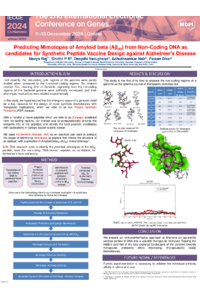
Predicting Mimotopes of Amyloid beta (Aβ42) from Non-Coding DNA as candidates for Synthetic Peptide Vaccine Design against Alzheimer’s Disease

Navya Raj 1
'%3e%3cpath%20d='M12.6647%2010.9104C12.4176%2010.325%2012.0589%209.7933%2011.6088%209.34485C11.16%208.89511%2010.6283%208.53653%2010.0432%208.28891C10.038%208.28629%2010.0327%208.28498%2010.0275%208.28236C10.8437%207.69282%2011.3743%206.73252%2011.3743%205.64907C11.3743%203.85423%209.92005%202.40002%208.12522%202.40002C6.33038%202.40002%204.87618%203.85423%204.87618%205.64907C4.87618%206.73252%205.40677%207.69282%206.22296%208.28367C6.21772%208.28629%206.21248%208.2876%206.20724%208.29022C5.62031%208.53783%205.09365%208.89287%204.64167%209.34616C4.19192%209.79496%203.83334%2010.3266%203.58573%2010.9117C3.34247%2011.4846%203.21128%2012.0987%203.19925%2012.721C3.1989%2012.735%203.20135%2012.7489%203.20646%2012.7619C3.21157%2012.7749%203.21924%2012.7868%203.22901%2012.7968C3.23877%2012.8068%203.25045%2012.8148%203.26334%2012.8202C3.27623%2012.8256%203.29007%2012.8284%203.30406%2012.8284H4.09012C4.14776%2012.8284%204.19362%2012.7825%204.19493%2012.7262C4.22113%2011.7148%204.62726%2010.7676%205.34519%2010.0497C6.08802%209.30686%207.07452%208.89811%208.12522%208.89811C9.17592%208.89811%2010.1624%209.30686%2010.9052%2010.0497C11.6232%2010.7676%2012.0293%2011.7148%2012.0555%2012.7262C12.0568%2012.7839%2012.1027%2012.8284%2012.1603%2012.8284H12.9464C12.9604%2012.8284%2012.9742%2012.8256%2012.9871%2012.8202C13%2012.8148%2013.0117%2012.8068%2013.0214%2012.7968C13.0312%2012.7868%2013.0389%2012.7749%2013.044%2012.7619C13.0491%2012.7489%2013.0515%2012.735%2013.0512%2012.721C13.0381%2012.0947%2012.9084%2011.4856%2012.6647%2010.9104ZM8.12522%207.90243C7.52388%207.90243%206.95792%207.66793%206.53214%207.24215C6.10636%206.81636%205.87185%206.2504%205.87185%205.64907C5.87185%205.04773%206.10636%204.48177%206.53214%204.05599C6.95792%203.63021%207.52388%203.3957%208.12522%203.3957C8.72655%203.3957%209.29252%203.63021%209.7183%204.05599C10.1441%204.48177%2010.3786%205.04773%2010.3786%205.64907C10.3786%206.2504%2010.1441%206.81636%209.7183%207.24215C9.29252%207.66793%208.72655%207.90243%208.12522%207.90243Z'%20fill='%235D1EE1'/%3e%3c/g%3e%3c/svg%3e)
Shidhi P R 2
Deepthi Varughese 3
Achuthsankar S Nair 4
Pawan Dhar 5
1. Department of Health Informatics, College of Health Sciences, Saudi Electronic University, Dammam, Saudi Arabia
2. Department of Zoology, University of Kerala, Thiruvananthapuram, Kerala, India
3. Centre for Development and Aging Research, Inter University Centre for Biomedical Research & Super Speciality Hospital, Mahatma Gandhi University Campus at Thalappady, Kerala, India
4. Department of Computational Biology and Bioinformatics, University of Kerala, India
5. School of Biotechnology, Jawaharlal Nehru University, New Delhi, India.
Abstract
Introduction: What could be an ideal raw material for developing a drug or a vaccine? In line with the research on different biomolecules like DNA, RNA, protein, and peptide, we explore the potential use of non-coding DNA in designing lifesaving vaccines and drugs.
Methods: Using computational approaches, a multi-parametric virtual library of novel peptides from the intergenic regions of the Escherichia coli genome was generated, and their therapeutic potential was studied. The potential antigens from the peptides were analyzed for their B cell epitopes and MHC binding T cell epitopes, which find application in epitope-based vaccine design. Alzheimer's disease (AD) immunotherapy was selected as an example to demonstrate the possible application of the non-coding DNA-derived peptides as promising candidates for Synthetic Peptide Vaccine Design.
Results: Sequence and structure comparison studies between toxic amyloid beta (Aβ42) peptides and the non-coding DNA-derived peptides revealed promising matches. The structural mimics of Aβ42 with potential mimotopes were further studied through mimotope-antibody docking and molecular dynamic simulation for their affinity towards the antibody's antigen-binding fragment (Fab).
Conclusion: Our study put forward a novel method to identify therapeutic peptides from non-coding DNA, which offers a non-obvious source of potential mimotope candidates for designing novel synthetic vaccines against Alzheimer’s Disease.
Keywords
Noncoding DNA
Mimotopes
Peptide-Antibody Docking
Alzheimer's disease (AD)
Epitope-based Vaccine Design.
Poster
sciforum-107515-Poster-Navya.pdf
Genetic Insights and Therapeutic Approaches for Epidermolysis Bullosa in the Saudi Arabian Population
Regional Variability of Spotted Fever Group Rickettsia Genospecies: Insights from Eight Regions in Russia