Event submissions
Published
This submission belongs to the session E. Microbial Genetics and Genomics of the event The 2nd International Electronic Conference on Genes
Published date
09 Dec, 2024
Academic Editor
'%3e%3cpath%20d='M12.6657%2010.9104C12.4185%2010.325%2012.0599%209.79327%2011.6097%209.34482C11.1609%208.89508%2010.6293%208.5365%2010.0442%208.28888C10.0389%208.28626%2010.0337%208.28495%2010.0285%208.28233C10.8446%207.69279%2011.3752%206.73249%2011.3752%205.64904C11.3752%203.8542%209.92103%202.39999%208.1262%202.39999C6.33136%202.39999%204.87715%203.8542%204.87715%205.64904C4.87715%206.73249%205.40774%207.69279%206.22393%208.28364C6.21869%208.28626%206.21345%208.28757%206.20821%208.29019C5.62129%208.5378%205.09463%208.89284%204.64265%209.34613C4.1929%209.79493%203.83432%2010.3266%203.58671%2010.9117C3.34345%2011.4845%203.21226%2012.0987%203.20023%2012.7209C3.19988%2012.7349%203.20233%2012.7488%203.20744%2012.7619C3.21255%2012.7749%203.22022%2012.7867%203.22998%2012.7968C3.23975%2012.8068%203.25142%2012.8147%203.26431%2012.8202C3.2772%2012.8256%203.29105%2012.8284%203.30504%2012.8284H4.09109C4.14874%2012.8284%204.19459%2012.7825%204.1959%2012.7262C4.2221%2011.7148%204.62823%2010.7676%205.34617%2010.0497C6.08899%209.30683%207.0755%208.89808%208.1262%208.89808C9.17689%208.89808%2010.1634%209.30683%2010.9062%2010.0497C11.6242%2010.7676%2012.0303%2011.7148%2012.0565%2012.7262C12.0578%2012.7838%2012.1037%2012.8284%2012.1613%2012.8284H12.9474C12.9613%2012.8284%2012.9752%2012.8256%2012.9881%2012.8202C13.001%2012.8147%2013.0126%2012.8068%2013.0224%2012.7968C13.0322%2012.7867%2013.0398%2012.7749%2013.0449%2012.7619C13.0501%2012.7488%2013.0525%2012.7349%2013.0522%2012.7209C13.0391%2012.0947%2012.9094%2011.4855%2012.6657%2010.9104ZM8.1262%207.9024C7.52486%207.9024%206.9589%207.6679%206.53312%207.24211C6.10733%206.81633%205.87283%206.25037%205.87283%205.64904C5.87283%205.0477%206.10733%204.48174%206.53312%204.05596C6.9589%203.63018%207.52486%203.39567%208.1262%203.39567C8.72753%203.39567%209.29349%203.63018%209.71927%204.05596C10.1451%204.48174%2010.3796%205.0477%2010.3796%205.64904C10.3796%206.25037%2010.1451%206.81633%209.71927%207.24211C9.29349%207.6679%208.72753%207.9024%208.1262%207.9024Z'%20fill='%235D1EE1'/%3e%3c/g%3e%3c/svg%3e) Silvia Turroni
Silvia TurroniCitation
Marcos Jessé Abrahão Silva, Sebastião Kauã de Sousa Bispo, Rebecca Lobato Marinho, Eliete Costa da Cruz, Keitty Anne Silva Neves, Luiza Raquel Tapajós Figueira, Diana da Costa Lobato, Lilian Cristina Santos Sinfrônio da Silva, Marcelo Cleyton da Silva Vieira, Everaldina Cordeiro dos Santos, Karla Valéria Batista Lima, Luana Nepomuceno Gondim Costa Lima, Functional and Structural Characterization of Exonic SNPs associated with Leprosy Risk: an In Silico Analysis, in Proceedings of The 2nd International Electronic Conference on Genes, 11 December–13 December 2024, MDPI: Basel, Switzerland
Share
Email
Facebook
Twitter
LinkedIn
Functional and Structural Characterization of Exonic SNPs associated with Leprosy Risk: an In Silico Analysis

Marcos Jessé Abrahão Silva 1
'%3e%3cpath%20d='M12.6647%2010.9104C12.4176%2010.325%2012.0589%209.7933%2011.6088%209.34485C11.16%208.89511%2010.6283%208.53653%2010.0432%208.28891C10.038%208.28629%2010.0327%208.28498%2010.0275%208.28236C10.8437%207.69282%2011.3743%206.73252%2011.3743%205.64907C11.3743%203.85423%209.92005%202.40002%208.12522%202.40002C6.33038%202.40002%204.87618%203.85423%204.87618%205.64907C4.87618%206.73252%205.40677%207.69282%206.22296%208.28367C6.21772%208.28629%206.21248%208.2876%206.20724%208.29022C5.62031%208.53783%205.09365%208.89287%204.64167%209.34616C4.19192%209.79496%203.83334%2010.3266%203.58573%2010.9117C3.34247%2011.4846%203.21128%2012.0987%203.19925%2012.721C3.1989%2012.735%203.20135%2012.7489%203.20646%2012.7619C3.21157%2012.7749%203.21924%2012.7868%203.22901%2012.7968C3.23877%2012.8068%203.25045%2012.8148%203.26334%2012.8202C3.27623%2012.8256%203.29007%2012.8284%203.30406%2012.8284H4.09012C4.14776%2012.8284%204.19362%2012.7825%204.19493%2012.7262C4.22113%2011.7148%204.62726%2010.7676%205.34519%2010.0497C6.08802%209.30686%207.07452%208.89811%208.12522%208.89811C9.17592%208.89811%2010.1624%209.30686%2010.9052%2010.0497C11.6232%2010.7676%2012.0293%2011.7148%2012.0555%2012.7262C12.0568%2012.7839%2012.1027%2012.8284%2012.1603%2012.8284H12.9464C12.9604%2012.8284%2012.9742%2012.8256%2012.9871%2012.8202C13%2012.8148%2013.0117%2012.8068%2013.0214%2012.7968C13.0312%2012.7868%2013.0389%2012.7749%2013.044%2012.7619C13.0491%2012.7489%2013.0515%2012.735%2013.0512%2012.721C13.0381%2012.0947%2012.9084%2011.4856%2012.6647%2010.9104ZM8.12522%207.90243C7.52388%207.90243%206.95792%207.66793%206.53214%207.24215C6.10636%206.81636%205.87185%206.2504%205.87185%205.64907C5.87185%205.04773%206.10636%204.48177%206.53214%204.05599C6.95792%203.63021%207.52388%203.3957%208.12522%203.3957C8.72655%203.3957%209.29252%203.63021%209.7183%204.05599C10.1441%204.48177%2010.3786%205.04773%2010.3786%205.64907C10.3786%206.2504%2010.1441%206.81636%209.7183%207.24215C9.29252%207.66793%208.72655%207.90243%208.12522%207.90243Z'%20fill='%235D1EE1'/%3e%3c/g%3e%3c/svg%3e)
Sebastião Kauã de Sousa Bispo 1
Rebecca Lobato Marinho 2
Eliete Costa da Cruz 3
Keitty Anne Silva Neves 2

Luiza Raquel Tapajós Figueira 2

Diana da Costa Lobato 2
Lilian Cristina Santos Sinfrônio da Silva 4
Marcelo Cleyton da Silva Vieira 2
Everaldina Cordeiro dos Santos 4
Karla Valéria Batista Lima 1
Luana Nepomuceno Gondim Costa Lima 1
1. Bacteriology and Mycology Section of the Evandro Chagas Institute (IEC), Brazil
2. University of Pará State (UEPA), Brazil
3. Federal University of Pará (UFPA), Brazil
4. Evandro Chagas Institute (IEC), Brazil
Abstract
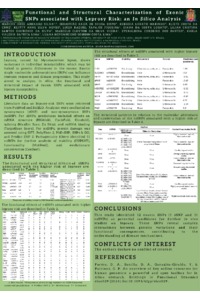
Introduction: Leprosy, caused by Mycobacterium leprae, shows variations in individual susceptibility, which may be linked to genetic differences in the exome. Exonic single-nucleotide polymorphisms (SNPs) can influence immune response and disease progression. This study aimed to analyze, in silico, the functional and structural impact of exonic SNPs associated with leprosy susceptibility. Methods: Data from the literature on leprosy-risk SNPs were retrieved from PubMed and SciELO. Analyses were conducted on synonymous (sSNP) and non-synonymous SNPs (nsSNP). For sSNPs, predictions included effects on mRNA structure (RNAfold, CycleFold, Kinefold), splicing (MaxEnt Scan, Ex Skip), and miRNA binding (TargetScan Score). For nsSNPs, protein damage was assessed using SIFT, PolyPhen 2, PhD-SNP, SNPs and GO, and Predict SNP 2. Pathogenicity filters identified 11 nsSNPs for further analysis of stability (CUPSAT), functionality (MutPred), and evolutionary conservation (ConSurf). Results: A total of 35 exonic SNPs were analyzed (6 sSNPs, 29 nsSNPs). The sSNP rs2230365 (NFKBIL1) showed the highest potential for impacting miRNA regulation and mRNA structure, while no significant changes were observed in splicing. The nsSNP rs5743708 (TLR2) was predicted as deleterious by all tools used. SNP rs145562243 (NCKIPSD) was shown to be destabilizing with an unfavorable ΔΔG (-5.53 kcal/mol). The molecular, structural and evolutionary impacts of each SNP were reported. Highly conserved and exposed SNPs like rs5743708 suggest that they are critical for protein function. Conclusion: This study identified 12 exonic SNPs (1 sSNP and 11 nsSNPs) as potential candidates for further in vivo studies on leprosy. These SNPs reveal complex interactions between genetic variations and their functional consequences, contributing to the understanding of disease mechanisms.
Keywords
Leprosy
Single Nucleotide Polymorphism
Computational Biology
Genomics
Poster
Dark Blue and Orange Simple Poster (1).pdf
Resistance gene profiles of multidrug-resistant Klebsiella spp. from poultry samples
A leaky deep intronic splice variant in CLRN1 is associated
with non-syndromic retinitis pigmentosa
with non-syndromic retinitis pigmentosa