Event submissions
Published
This submission belongs to the session C. Human Genomics and Genetic Diseases of the event The 2nd International Electronic Conference on Genes
Published date
09 Dec, 2024
Academic Editor
'%3e%3cpath%20d='M12.6657%2010.9104C12.4185%2010.325%2012.0599%209.79327%2011.6097%209.34482C11.1609%208.89508%2010.6293%208.5365%2010.0442%208.28888C10.0389%208.28626%2010.0337%208.28495%2010.0285%208.28233C10.8446%207.69279%2011.3752%206.73249%2011.3752%205.64904C11.3752%203.8542%209.92103%202.39999%208.1262%202.39999C6.33136%202.39999%204.87715%203.8542%204.87715%205.64904C4.87715%206.73249%205.40774%207.69279%206.22393%208.28364C6.21869%208.28626%206.21345%208.28757%206.20821%208.29019C5.62129%208.5378%205.09463%208.89284%204.64265%209.34613C4.1929%209.79493%203.83432%2010.3266%203.58671%2010.9117C3.34345%2011.4845%203.21226%2012.0987%203.20023%2012.7209C3.19988%2012.7349%203.20233%2012.7488%203.20744%2012.7619C3.21255%2012.7749%203.22022%2012.7867%203.22998%2012.7968C3.23975%2012.8068%203.25142%2012.8147%203.26431%2012.8202C3.2772%2012.8256%203.29105%2012.8284%203.30504%2012.8284H4.09109C4.14874%2012.8284%204.19459%2012.7825%204.1959%2012.7262C4.2221%2011.7148%204.62823%2010.7676%205.34617%2010.0497C6.08899%209.30683%207.0755%208.89808%208.1262%208.89808C9.17689%208.89808%2010.1634%209.30683%2010.9062%2010.0497C11.6242%2010.7676%2012.0303%2011.7148%2012.0565%2012.7262C12.0578%2012.7838%2012.1037%2012.8284%2012.1613%2012.8284H12.9474C12.9613%2012.8284%2012.9752%2012.8256%2012.9881%2012.8202C13.001%2012.8147%2013.0126%2012.8068%2013.0224%2012.7968C13.0322%2012.7867%2013.0398%2012.7749%2013.0449%2012.7619C13.0501%2012.7488%2013.0525%2012.7349%2013.0522%2012.7209C13.0391%2012.0947%2012.9094%2011.4855%2012.6657%2010.9104ZM8.1262%207.9024C7.52486%207.9024%206.9589%207.6679%206.53312%207.24211C6.10733%206.81633%205.87283%206.25037%205.87283%205.64904C5.87283%205.0477%206.10733%204.48174%206.53312%204.05596C6.9589%203.63018%207.52486%203.39567%208.1262%203.39567C8.72753%203.39567%209.29349%203.63018%209.71927%204.05596C10.1451%204.48174%2010.3796%205.0477%2010.3796%205.64904C10.3796%206.25037%2010.1451%206.81633%209.71927%207.24211C9.29349%207.6679%208.72753%207.9024%208.1262%207.9024Z'%20fill='%235D1EE1'/%3e%3c/g%3e%3c/svg%3e) Dror Sharon
Dror SharonCitation
Shadab Ahamad, Prachi Kukshal, Ajay Kumar, Subramanian Chellappan, Yogesh Sathe, Prabhatha Rashmi Murthy, ACE Insertion/Deletion Polymorphism as a Potential Risk Factor for Congenital Heart Disease among North Indians: Insights from a Tertiary Pediatric Cardiac Care Centre Study, in Proceedings of The 2nd International Electronic Conference on Genes, 11 December–13 December 2024, MDPI: Basel, Switzerland
Share
Email
Facebook
Twitter
LinkedIn
ACE Insertion/Deletion Polymorphism as a Potential Risk Factor for Congenital Heart Disease among North Indians: Insights from a Tertiary Pediatric Cardiac Care Centre Study
'%3e%3cpath%20d='M12.6647%2010.9104C12.4176%2010.325%2012.0589%209.7933%2011.6088%209.34485C11.16%208.89511%2010.6283%208.53653%2010.0432%208.28891C10.038%208.28629%2010.0327%208.28498%2010.0275%208.28236C10.8437%207.69282%2011.3743%206.73252%2011.3743%205.64907C11.3743%203.85423%209.92005%202.40002%208.12522%202.40002C6.33038%202.40002%204.87618%203.85423%204.87618%205.64907C4.87618%206.73252%205.40677%207.69282%206.22296%208.28367C6.21772%208.28629%206.21248%208.2876%206.20724%208.29022C5.62031%208.53783%205.09365%208.89287%204.64167%209.34616C4.19192%209.79496%203.83334%2010.3266%203.58573%2010.9117C3.34247%2011.4846%203.21128%2012.0987%203.19925%2012.721C3.1989%2012.735%203.20135%2012.7489%203.20646%2012.7619C3.21157%2012.7749%203.21924%2012.7868%203.22901%2012.7968C3.23877%2012.8068%203.25045%2012.8148%203.26334%2012.8202C3.27623%2012.8256%203.29007%2012.8284%203.30406%2012.8284H4.09012C4.14776%2012.8284%204.19362%2012.7825%204.19493%2012.7262C4.22113%2011.7148%204.62726%2010.7676%205.34519%2010.0497C6.08802%209.30686%207.07452%208.89811%208.12522%208.89811C9.17592%208.89811%2010.1624%209.30686%2010.9052%2010.0497C11.6232%2010.7676%2012.0293%2011.7148%2012.0555%2012.7262C12.0568%2012.7839%2012.1027%2012.8284%2012.1603%2012.8284H12.9464C12.9604%2012.8284%2012.9742%2012.8256%2012.9871%2012.8202C13%2012.8148%2013.0117%2012.8068%2013.0214%2012.7968C13.0312%2012.7868%2013.0389%2012.7749%2013.044%2012.7619C13.0491%2012.7489%2013.0515%2012.735%2013.0512%2012.721C13.0381%2012.0947%2012.9084%2011.4856%2012.6647%2010.9104ZM8.12522%207.90243C7.52388%207.90243%206.95792%207.66793%206.53214%207.24215C6.10636%206.81636%205.87185%206.2504%205.87185%205.64907C5.87185%205.04773%206.10636%204.48177%206.53214%204.05599C6.95792%203.63021%207.52388%203.3957%208.12522%203.3957C8.72655%203.3957%209.29252%203.63021%209.7183%204.05599C10.1441%204.48177%2010.3786%205.04773%2010.3786%205.64907C10.3786%206.2504%2010.1441%206.81636%209.7183%207.24215C9.29252%207.66793%208.72655%207.90243%208.12522%207.90243Z'%20fill='%235D1EE1'/%3e%3c/g%3e%3c/svg%3e)
Shadab Ahamad 1
Prachi Kukshal 1
Ajay Kumar 1
Subramanian Chellappan 2
Yogesh Sathe 2
Prabhatha Rashmi Murthy 3
1. Sri Sathya Sai Sanjeevani Research Foundation, Palwal, Haryana, India-121102
2. Sri Sathya Sai Sanjeevani International Centre for Child Heart Care & Research, Palwal, Haryana, India-121102
3. Sri Sathya Sai Sanjeevani Centre for Child Heart Care & Training in Paediatric Cardiac Skills, Navi Mumbai, Maharashtra, India-410210
Abstract
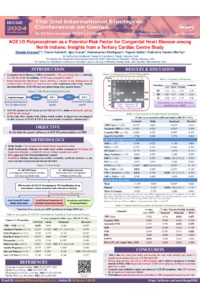
Background: Congenital heart disease (CHD) is a global health concern, particularly in low- to middle-income countries like India. The renin–angiotensin–aldosterone system (RAAS) plays a crucial role in the development of cardiovascular disorders and hypertension, with the angiotensin-converting enzyme insertion/deletion (ACE I/D) polymorphism being a key genetic factor. Our study aims to elucidate the genetic influence of ACE I/D polymorphism on CHD in a north Indian cohort.
Methods: A total of 667 CHD cases, including 433 individuals with parental data and 104 controls, were enrolled and genotyped by polymerase chain reaction. Case–control association, parental transmission tests, and the association of patients' and parents' clinical parameters with ACE I/D were explored.
Results: The frequencies of the DD, ID, and II genotypes were 0.23, 0.47, and 0.30, respectively. Our findings highlight significant associations, notably the increased CHD risk conferred by the DD genotype in females (p = 0.036; OR = 1.68), its correlation with abnormal hemoglobin (p = 0.049; OR = 1.68), and its impact on primigravida (p = 0.05). Conversely, the II genotype was found to significantly elevate the risk of CHD in the offspring of tobacco-consuming fathers by 2.5-fold (p = 0.029). Notably, cyanotic cases exhibited a heightened prevalence of ACE I/D mutations (p = 0.059), with the Tetralogy of Fallot showing the strongest association (p = 0.024). Additionally, the DD genotype's involvement in conditions such as stenosis (p = 0.026) and pulmonary artery hypertension (p = 0.05) underscores its clinical relevance. The parent-of-origin test showed maternal transmission of the D allele in combined (p = 0.037) and acyanotic cases (p = 0.039) and paternal transmission in ventricular septal defect (p = 0.021).
Conclusion: This is the first study from India and possibly the only study globally that reports a significant association between ACE I/D and CHD, highlighting the importance of genetic factors in CHD susceptibility.
Keywords
ACE I/D
Congenital Heart Disease
Association
Parental Transmission
North India
Poster
Sciforum-106139_Shadab Ahamad.pdf
Uremic toxin levels are associated with miR-223 in Chronic Kidney Disease-associated anemia
Non-coding single-nucleotide and structural variants affecting the EYS putative promoter cause autosomal recessive retinitis pigmentosa