Event submissions
Published
This submission belongs to the session E. Microbial Genetics and Genomics of the event The 2nd International Electronic Conference on Genes
Published date
09 Dec, 2024
Academic Editor
'%3e%3cpath%20d='M12.6657%2010.9104C12.4185%2010.325%2012.0599%209.79327%2011.6097%209.34482C11.1609%208.89508%2010.6293%208.5365%2010.0442%208.28888C10.0389%208.28626%2010.0337%208.28495%2010.0285%208.28233C10.8446%207.69279%2011.3752%206.73249%2011.3752%205.64904C11.3752%203.8542%209.92103%202.39999%208.1262%202.39999C6.33136%202.39999%204.87715%203.8542%204.87715%205.64904C4.87715%206.73249%205.40774%207.69279%206.22393%208.28364C6.21869%208.28626%206.21345%208.28757%206.20821%208.29019C5.62129%208.5378%205.09463%208.89284%204.64265%209.34613C4.1929%209.79493%203.83432%2010.3266%203.58671%2010.9117C3.34345%2011.4845%203.21226%2012.0987%203.20023%2012.7209C3.19988%2012.7349%203.20233%2012.7488%203.20744%2012.7619C3.21255%2012.7749%203.22022%2012.7867%203.22998%2012.7968C3.23975%2012.8068%203.25142%2012.8147%203.26431%2012.8202C3.2772%2012.8256%203.29105%2012.8284%203.30504%2012.8284H4.09109C4.14874%2012.8284%204.19459%2012.7825%204.1959%2012.7262C4.2221%2011.7148%204.62823%2010.7676%205.34617%2010.0497C6.08899%209.30683%207.0755%208.89808%208.1262%208.89808C9.17689%208.89808%2010.1634%209.30683%2010.9062%2010.0497C11.6242%2010.7676%2012.0303%2011.7148%2012.0565%2012.7262C12.0578%2012.7838%2012.1037%2012.8284%2012.1613%2012.8284H12.9474C12.9613%2012.8284%2012.9752%2012.8256%2012.9881%2012.8202C13.001%2012.8147%2013.0126%2012.8068%2013.0224%2012.7968C13.0322%2012.7867%2013.0398%2012.7749%2013.0449%2012.7619C13.0501%2012.7488%2013.0525%2012.7349%2013.0522%2012.7209C13.0391%2012.0947%2012.9094%2011.4855%2012.6657%2010.9104ZM8.1262%207.9024C7.52486%207.9024%206.9589%207.6679%206.53312%207.24211C6.10733%206.81633%205.87283%206.25037%205.87283%205.64904C5.87283%205.0477%206.10733%204.48174%206.53312%204.05596C6.9589%203.63018%207.52486%203.39567%208.1262%203.39567C8.72753%203.39567%209.29349%203.63018%209.71927%204.05596C10.1451%204.48174%2010.3796%205.0477%2010.3796%205.64904C10.3796%206.25037%2010.1451%206.81633%209.71927%207.24211C9.29349%207.6679%208.72753%207.9024%208.1262%207.9024Z'%20fill='%235D1EE1'/%3e%3c/g%3e%3c/svg%3e) Silvia Turroni
Silvia TurroniCitation
Zhengjie Hou, Chunyang Cao, Gengrong Gao, Mingzhu Ding, Qiuman Xu, Jingsheng Cheng, Enhanced iturin A synthesis in Bacillus amyloliquefaciens Through Genetic Modification Targeting Rap Phosphatase Inactivation, in Proceedings of The 2nd International Electronic Conference on Genes, 11 December–13 December 2024, MDPI: Basel, Switzerland
Share
Email
Facebook
Twitter
LinkedIn
Enhanced iturin A synthesis in Bacillus amyloliquefaciens Through Genetic Modification Targeting Rap Phosphatase Inactivation
'%3e%3cpath%20d='M12.6647%2010.9104C12.4176%2010.325%2012.0589%209.7933%2011.6088%209.34485C11.16%208.89511%2010.6283%208.53653%2010.0432%208.28891C10.038%208.28629%2010.0327%208.28498%2010.0275%208.28236C10.8437%207.69282%2011.3743%206.73252%2011.3743%205.64907C11.3743%203.85423%209.92005%202.40002%208.12522%202.40002C6.33038%202.40002%204.87618%203.85423%204.87618%205.64907C4.87618%206.73252%205.40677%207.69282%206.22296%208.28367C6.21772%208.28629%206.21248%208.2876%206.20724%208.29022C5.62031%208.53783%205.09365%208.89287%204.64167%209.34616C4.19192%209.79496%203.83334%2010.3266%203.58573%2010.9117C3.34247%2011.4846%203.21128%2012.0987%203.19925%2012.721C3.1989%2012.735%203.20135%2012.7489%203.20646%2012.7619C3.21157%2012.7749%203.21924%2012.7868%203.22901%2012.7968C3.23877%2012.8068%203.25045%2012.8148%203.26334%2012.8202C3.27623%2012.8256%203.29007%2012.8284%203.30406%2012.8284H4.09012C4.14776%2012.8284%204.19362%2012.7825%204.19493%2012.7262C4.22113%2011.7148%204.62726%2010.7676%205.34519%2010.0497C6.08802%209.30686%207.07452%208.89811%208.12522%208.89811C9.17592%208.89811%2010.1624%209.30686%2010.9052%2010.0497C11.6232%2010.7676%2012.0293%2011.7148%2012.0555%2012.7262C12.0568%2012.7839%2012.1027%2012.8284%2012.1603%2012.8284H12.9464C12.9604%2012.8284%2012.9742%2012.8256%2012.9871%2012.8202C13%2012.8148%2013.0117%2012.8068%2013.0214%2012.7968C13.0312%2012.7868%2013.0389%2012.7749%2013.044%2012.7619C13.0491%2012.7489%2013.0515%2012.735%2013.0512%2012.721C13.0381%2012.0947%2012.9084%2011.4856%2012.6647%2010.9104ZM8.12522%207.90243C7.52388%207.90243%206.95792%207.66793%206.53214%207.24215C6.10636%206.81636%205.87185%206.2504%205.87185%205.64907C5.87185%205.04773%206.10636%204.48177%206.53214%204.05599C6.95792%203.63021%207.52388%203.3957%208.12522%203.3957C8.72655%203.3957%209.29252%203.63021%209.7183%204.05599C10.1441%204.48177%2010.3786%205.04773%2010.3786%205.64907C10.3786%206.2504%2010.1441%206.81636%209.7183%207.24215C9.29252%207.66793%208.72655%207.90243%208.12522%207.90243Z'%20fill='%235D1EE1'/%3e%3c/g%3e%3c/svg%3e)
Zhengjie Hou 1
Chunyang Cao 1
Gengrong Gao 1
Mingzhu Ding 1
Qiuman Xu 2
Jingsheng Cheng 1
1. Department of Pharmaceutical Engineering, School of Chemical Engineering and Technology, Tianjin University, Yaguan Road 135, Jinnan District, Tianjin, 300350, People’s Republic of China.
2. Tianjin Key Laboratory of Animal and Plant Resistance, College of Life Science, Tianjin Normal University, Binshuixi Road 393, Xiqing District, Tianjin 300387, People’s Republic of China.
Abstract
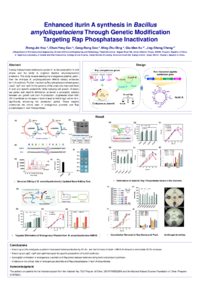
The biosynthesis of Iturin A, a compound with potent antimicrobial properties, has attracted considerable interest. However, challenges persist in achieving high yields from wild-type strains and optimizing Bacillus amyloliquefaciens for industrial-scale production. This study investigates the genetic foundations of Iturin A biosynthesis, emphasizing the roles of endogenous plasmids and Rap phosphatases. By optimizing and updating CRISPR/Cas9-based gene-editing tools, the modifications were successfully applied to the genetic manipulation of Bacillus amyloliquefaciens. The deletion of the endogenous plasmid plas1 from B. amyloliquefaciens HM618 significantly enhances Iturin A production, likely due to the removal of the Rap phosphatase gene located on plas1. Additionally, the targeted inactivation of the rapC, rapF, and rapH genes within the chromosomal DNA further increases Iturin A yield and specific productivity, although this is accompanied by reduced cell growth. By strategically combining plasmid deletion with targeted gene inactivation, a balance between cellular growth and Iturin A production is established. The engineered strain subsequently produced 849.9 mg/L of Iturin A within 48 hours, demonstrating a significant improvement in production efficiency. These findings underscore the crucial role of microbial genetics in optimizing Iturin A biosynthesis and offer a novel approach for enhancing the industrial production of this valuable antimicrobial compound in B. amyloliquefaciens.
Keywords
Bacillus amyloliquefaciens
Iturin A
Endogenous plasmid
Rap phosphatase
Poster
IECGE 2024-Confirmed Poster for Gallery-sciforum-105431.pdf
Non-coding single-nucleotide and structural variants affecting the EYS putative promoter cause autosomal recessive retinitis pigmentosa
Genomic basis of mycorrhizal fungal specificity in plant–fungal symbioses